How a campus IT puzzle turned into research impact

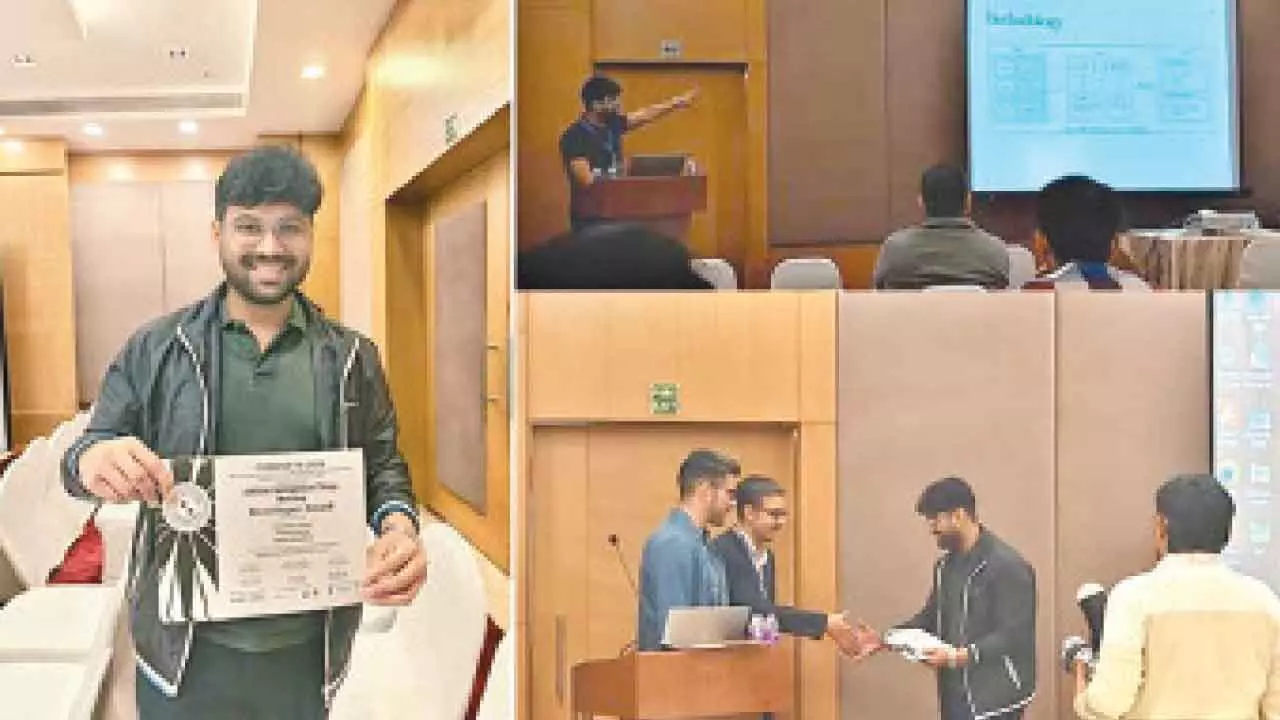
IIIT-H doesn’t just believe in translational research. It walks the talk as evidenced by its latest Best Paper award-winning research that has resulted in the development of an IoT-based UPS detection device.
The idea for a low-cost UPS monitoring system at IIIT-H did not begin in a laboratory or a funding proposal. It began with a familiar frustration – raised by Prakash Nayak, a campus IT staffer who was tired of equipment failures with no clear explanation.
Power outages were happening. Servers were restarting. Despite the installation of UPS units everywhere, no one could say with certainty what the UPS systems were actually doing when the lights went out. That real-world problem became the starting point for a research project that has now resulted in a ₹2,000 IoT-based device capable of tracking UPS behaviour during outages with near-second precision. The research was documented in a paper titled, “Low-cost IoT-based Downtime Detection for UPS and Behaviour Analysis,” by authors Sannidhya Gupta, Prakash Nayak, and Prof. Sachin Chaudhari. It also received the Best Paper award at the 18th International Conference on COMmunication System and NETworkS (COMSNETS-2026) Workshop on AI of Things recently held in Bangalore.
When monitoring costs more than the problem
“Frequent power outages in developing regions cause equipment damage, operational downtime, and data loss,” says Sannidhya Gupta, noting that while UPS systems are meant to provide protection, “affordable options for monitoring their performance remain limited.” Commercial UPS monitoring tools – typically SNMP cards that collect and organize information about managed devices over IP networks – were an option, but an impractical one. According to the paper, “Commercial solutions are expensive, manufacturer-specific, and reliant on network infrastructure”. With prices exceeding ₹20,000 per unit, the campus IT team simply could not justify deploying them at scale. Worse, these tools often failed at the moment they were most needed. “These systems are unable to record data when the UPS itself loses power,” the authors point out, making post-outage diagnosis nearly impossible.
A device that watches, not interferes
Responding directly to the IT team’s request for something affordable and reliable, the team designed a non-intrusive current-monitoring device. Instead of tapping into UPS internals, it clamps onto the input and output lines, observing how current flows before, during, and after outages. “UPS input and output currents are sensed non-intrusively to detect outages, switchovers, and recovery behaviour,” the researchers explain. Additionally, the device is battery-backed, allowing it to keep recording even when both mains power and internet connectivity are lost.
From theory to campus corridors
In order to test out the system, it was deployed across four UPS installations on campus, including one unit already suspected by IT staff to be malfunctioning. Over a month, the devices collected around 3.7 million data points, automatically detecting 61 outage events. The data confirmed what the IT team had suspected but could never prove. “One UPS repeatedly showed no clear charging behaviour after outages,” reports Prakash, indicating a system that could briefly support loads but failed to properly recharge its batteries.
Smart algorithms, Simple assumptions
The backend analytics automatically label each event into phases – normal operation, outage, stabilisation, and battery charging – without manual configuration. “All thresholds are expressed as fractions of a locally estimated baseline,” the authors note, adding that this allows the system to adapt to different installations automatically. The results were precise: no missed outages, no false alarms, and timing errors typically within three seconds.
Real-time monitoring, Ten times cheaper
A web-based dashboard now gives IT staff something they never had before: visibility. Instead of guessing whether a UPS is healthy, administrators can now see it. Plus they have access to historical analysis of UPS behaviour. Built using off-the-shelf components, the device costs about ₹2,000 – roughly one-tenth the price of commercial monitoring cards. “Its affordability, power independence, and portability makes it a practical option for cost-constrained environments,” concludes Sannidhya.
Research grounded in reality
What sets this work apart is not just the technology, but its origin. This was research born out of a real operational pain point, brought directly by the people responsible for keeping systems running. “It is important to note that IT staff Mr. Prakash is part of the research paper we have published.
He is also part of the patent we have recently filed on this. This highlights the value of treating campus operations teams as co-creators of research problems rather than mere end users – a mindset that leads to more relevant and impactful outcomes,” states Prof. Chaudhari. In a landscape where academic research is often criticised for being disconnected from reality, this project offers a counterexample of how researchers take note when a problem statement is identified, and build something that changes how systems are understood and managed.