CSIR–NGRI celebrates 84th Foundation Day

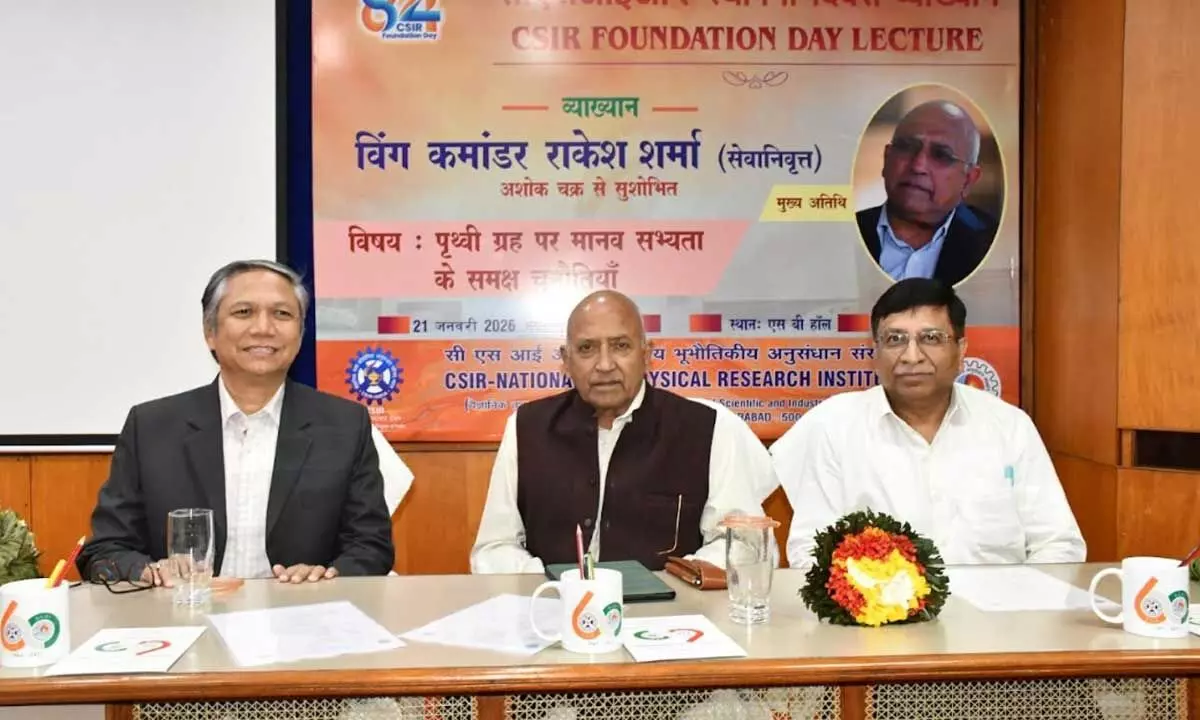
CSIR–National Geophysical Research Institute (CSIR–NGRI) celebrated the 84th Foundation Day of the Council of Scientific and Industrial Research (CSIR) with great enthusiasm and pride. The event was graced by Wing Commander Rakesh Sharma (Retd.), Ashok Chakra Awardee and the first Indian to travel to space, as the Chief Guest, whose presence inspired scientists, students, researchers, and staff alike.
Welcoming the gathering, Dr. Prakash Kumar, Director, CSIR–NGRI, reflected on CSIR’s illustrious legacy as a beacon of scientific excellence in service of the nation. He emphasized the importance of mission-mode research aligned with national priorities and highlighted the need for sustainable solutions, including groundwater recharge in arid regions. Urging scientists to develop new technologies and enhance institutional performance, he recalled the iconic words “Saare Jahan Se Achha Hindustan Hamara,” spoken by the Chief Guest from space, which continue to inspire generations.
Introducing the Chief Guest, Dr. Ajay Manglik, Chief Scientist and Chairman of the CSIR Foundation Day celebrations, highlighted Wing Commander Sharma’s distinguished career as a fighter pilot during the 1971 war, a test pilot, and a pioneer of India’s human spaceflight programme.
Delivering the Foundation Day Lecture titled “Challenges Facing Human Civilisation on Planet Earth,” Wing Commander Rakesh Sharma presented a deeply thought-provoking address structured around the evolution of civilization, the present state of the planet, and humanity’s future. He underscored India’s ancient legacy of living in harmony with nature and emphasized the enduring relevance of Vasudhaiva Kutumbakam—the world as one family—as a guiding philosophy for science, space exploration, and global harmony.
Cautioning against unchecked greed and unsustainable development, he spoke candidly about pollution, climate change, water scarcity, unemployment, and the fragile condition of Earth’s ecosystems. Quoting Mahatma Gandhi, he reminded the audience that the Earth has enough for everyone’s needs but not for everyone’s greed, stressing that addressing these challenges must be humanity’s foremost priority.
Looking to the future, he referred to the visionary leadership of Dr. Vikram Sarabhai and his belief in “Science for all,” which shaped India’s space programme to serve societal needs through applications such as telecommunications, telemedicine, and tele-education. Highlighting India’s successful space missions and the growing momentum toward planetary exploration, he emphasized that space belongs to all humankind and that global cooperation is essential. Space science and technology, he noted, are powerful enablers of sustainable development, informed decision-making, and long-term global well-being.
The lecture was followed by an engaging question-and-answer session with enthusiastic participation from the audience.
The celebrations also featured an awards and felicitation ceremony, during which retired employees were honoured with Samman Patras for their dedicated service, employees completing 25 years of service were felicitated with mementos, and studentship and science exhibition awards were presented, including prizes for the best exhibits showcased during the CSIR Open Day.
The programme concluded on an inspiring note, reaffirming CSIR–NGRI’s steadfast commitment to scientific excellence, societal relevance, and nation-building.