




- Adani Ports shares settle over 6 pc higher after strong Q2 results
- Just a trailer: Congress warns Maha CM Fadnavis after defeating BJP in RSS bastion
- WPL 2027: Choosing four overseas players in playing XI will be really hard, says Klinger
- Anthropic launches new tools to help businesses monitor AI spending and costs
- PM Modi to inaugurate Rs 407.56-crore Banas Dairy projects, lay foundation stone for two Bio-CNG plants tomorrow
- Australian teenager dies in hospital after drive-by shooting
- 'Dangerous for democracy,' Kiren Rijiju hits out at Naseeruddin Shah over 'Dimagi Naxal' boast
- MP govt transfers 12 IPS officers, reshuffles police administration
Skin Barrier Repair Cream and the Case Against Over-Exfoliating
In Short
Learn how skin barrier repair creams support dry and irritated skin, why over-exfoliating can cause barrier damage, and how to build a gentle skincare routine

Share :
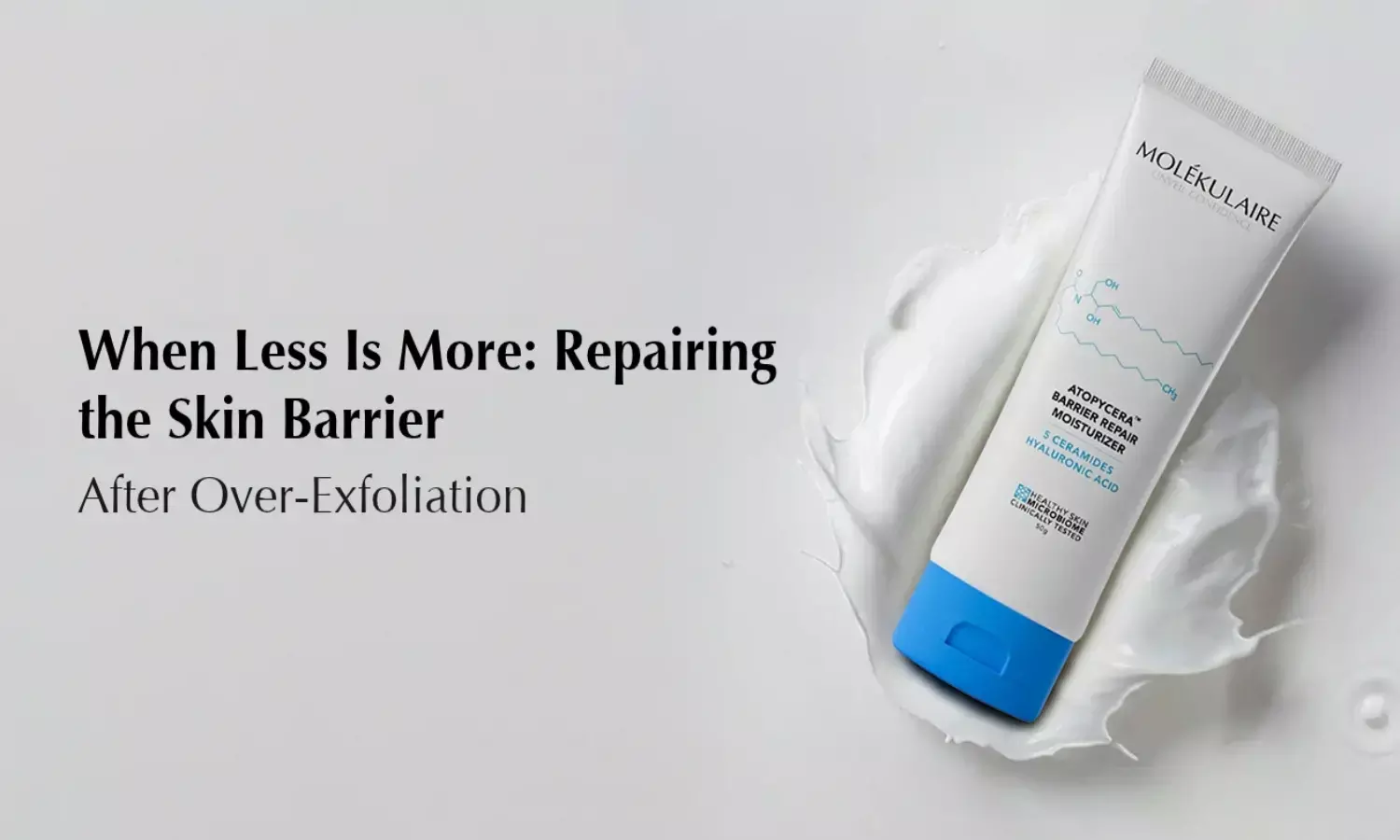
Skin Barrier Repair Cream and the Case Against Over-Exfoliating
Somewhere between the 2nd acid toner and the 3rd serum you’ve got a lot of skincare regimens tipping over. The skin that was looking great on Monday is going to be stinging by Thursday. The moisturiser is going to burn a bit. The face wash that used to work so well for years now leaves your cheeks tight and oddly shiny at the same time. The normal response is to add something in, a ‘soothing’ serum or a more potent treatment. What actually works is the opposite really. Take things away and let a good skin barrier repair moisturiser do its job.
What’s the best way to repair a damaged skin barrier?
Stop the exfoliating acids and retinoids, go back to a mild fragrance free cleanser and moisturise twice a day with a barrier repair moisturiser containing ceramides, glycerin and an occlusive. Sunscreen every morning. Mild cases will often resolve in 2-4 weeks but if the skin just won’t improve then it’s time to see a dermatologist.
That’s the short version. The reasons why you don’t end up here again are the reasons.
How routines got so crowded
A decade ago “skincare” was pretty much just cleanser, moisturiser and SPF. Then it became all about the ingredients. The acids, the retinoids, the peptides and the vitamin C all got their own cults and layering became a bit of a game. A lot of those ingredients do have a genuine track record. The error is to assume that the benefits just keep on stacking. Beyond a certain point they don’t. They simply compete for the same finite tolerance and that tolerance will vary depending on the weather, your age, your level of stress on the skin and whatever else you’ve applied that day.
The wall between your skin and everything else
The outermost layer of skin (the stratum corneum) is thinner than a sheet of paper and is often likened to a brick wall. The ‘bricks’ are the flattened cells. The ‘mortar’ is a mixture of ceramides, cholesterol and fatty acids which work together to keep water in and irritants out.
Water escaping through that layer is known as transepidermal water loss and a healthy barrier will keep that low. If you damage the mortar then the water will escape much more readily and things which previously hadn’t bothered you at all (like fragrance or a very mild acid) will now start to sting. That’s the odd mix of dry, tight and reactive.
Can over-exfoliation harm the skin barrier?
It can. Acids, enzymes and scrubs all work by breaking down the bonds between the surface cells. That’s useful in moderation as it smooths the texture and prevents the pores from becoming clogged. If you go overboard with exfoliation (or indeed if you layer two or three exfoliating products) you’re removing lipids from the skin faster than the skin can replace them. Harsh cleansers add to the problem as the strong surfactants will dissolve the lipids too.
The signs of skin barrier damage are fairly consistent really: stinging from things that used to be perfectly fine, flaking, redness, a sort of glossy stretched appearance and occasionally new breakouts. The breakouts are the one that catch people out. They’ll break out and so exfoliate more which in turn makes the barrier even worse. Bear in mind also that eczema, rosacea and contact allergy all present in a very similar way so these are all signs that you need to simplify, not necessarily a diagnosis.
Dry, dehydrated, sensitive, damaged
These terms are used interchangeably when in fact they are not. Dry skin is skin that produces too little oil. Dehydrated skin is skin that is deficient in water and can occur even in someone with a very oily T-zone. Sensitive skin is skin that reacts easily and will do so all the time. Barrier damage is a transient condition which can sit on top of any of the others. That’s why over-exfoliated skin can look greasy and yet be completely parched and that’s why a more aggressive face wash for oily skin is rarely the solution.
What helps skin recover
Ceramides are by far the most talked about of the three. They’re lower in atopic dermatitis patients and moisturisers containing ceramides along with cholesterol and fatty acids have shown good results in the studies. The caveat is that the formula is far more important than the label. A jar with ceramides on the front and nothing else on the label is not the same as one which is based on a balanced lipid mix.
A good moisturiser for a compromised skin barrier is one that works in layers. You’ve got humectants (glycerin and hyaluronic acid being the classic examples) which draw water in, emollients which smooth the surface and occlusives (petrolatum and dimethicone being the most common) which form a light seal on top. A hydrating serum for dry skin will do the first of those jobs (add the water) but it won’t retain it so it’s not a replacement for a moisturiser, it’s something you use under a moisturiser.
Is moisturiser on its own sufficient? Sometimes. If the problem was down to an over-loaded regime then simply removing the irritants and moisturising steadily and regularly will get it sorted. If the skin isn’t improving or there’s an underlying condition involved then it won’t be.
Niacinamide is worth mentioning as well. It appears to support ceramide production and reduce water loss and is generally well tolerated at the 2–5% concentrations you’ll find in cosmetic products. A niacinamide serum is a product that can be very suitable for many sensitive and oily skins, though some individuals do find higher concentrations to be irritating. You can certainly start off with it.
Keeping the actives, with restraint
There’s absolutely no argument for getting rid of actives altogether. Whether an ingredient is good or bad for you is entirely dependent on the formulation, the concentration, how frequently you use it and how your own skin reacts to it.
Take salicylic acid. As it’s soluble in oil it can work within the pores which is why it’s so commonly touted as having benefits for blackheads and mild acne. The over the counter products will generally be in the range of 0.5 to 2%. Use it every night in conjunction with other exfoliants and it’ll be a classic cause of irritation. If you’re looking at a serum for acne prone skin then two or three nights a week is a reasonable starting point.
Vitamin C is a different ball game. A vitamin C serum for the face is primarily an antioxidant and over time can be of benefit in relation to certain types of uneven skin tone. The form, strength and pH of the product will all have an impact on how effective it is and how it feels. Skin that’s still in the process of healing will often find a milder derivative or indeed just waiting is the better option. Whatever product you go for in terms of brightening, daily broad spectrum sunscreen will do more for pigmentation than any serum as UV exposure is what continues to darken the marks you’re trying to fade. Just avoid the unregulated skin lightening products as these can contain all sorts of nasty stuff.
Cleansing requires the same degree of restraint. That ‘squeaky clean’ feeling is generally just stripped lipids. A cleanser for sensitive skin should be able to lift the sunscreen and oil without leaving the face tight and mild gel or cream formulations (without fragrance) are the safer bet, even if you have oily skin.
A stripped-down routine
Mornings: rinse/cleanse gently, apply a hydrating serum if you’re inclined to do so, then moisturiser then SPF 30 or higher. Evenings: cleanse (double cleanse only if you’ve worn sunscreen or makeup) and moisturise. Don’t introduce the acids and retinoids until the skin is comfortable again, then bring one back at a time, once or twice a week.
Change one thing at a time. If it’s one product that’s causing the sting you’ll want to know which one it is.
Should you stop using the acids if your skin is irritated?
For a while, yes. Applying acids to inflamed skin will tend to prolong the problem. When the stinging and redness have gone, you can gradually reduce the frequency of your single acid.
How long does it take for the skin barrier to heal?
Mild irritation will often settle down within a week or two and full recovery can take several weeks. Skin cell turnover in many adults is around a month (it slows down with age) so you’re allowed a bit of time. If there’s still no change after that then the problem may not be down to your routine.
When to see a dermatologist
Book an appointment if the burning, redness and flaking persists for more than a few weeks even on a simple routine, if the acne is painful, deep or scarring or if you see anything out of the ordinary (e.g. a mole that changes or a sore that doesn’t heal). A dermatologist can distinguish between barrier damage and eczema, rosacea, allergy or infection and can prescribe where cosmetics cannot.
The takeaway
Skin rarely gets better because you’ve done more to it. You’ve got a solid base with a good moisturiser, a mild cleanser and daily SPF. The targeted actives work best when they’re applied on top of that base rather than in place of it. That’s what evidence based skincare tends to look like in reality; fewer steps, but more thoughtfully chosen.
Struggling with irritated, over-exfoliated skin? Explore Molekulaire’s barrier-supportive skincare to find a gentle moisturizer for your recovery routine.
Water, Water Everywhere: Srikakulam Villages Flooded
Rain alert issued to AP amid formation of new weather system in Bay of Bengal
‘Aage Badho, Daro Mat!’ Rahul’s Battle Cry for November 1 Rally
BJP Holds High-Level Huddle to Plan Rallies, Strategise for Polls
Heavy rain warning issued across Andhra Pradesh
Telangana likely to get rain and thunderstorm activity


