'Can have very sweeping consequences': SC stays UGC order

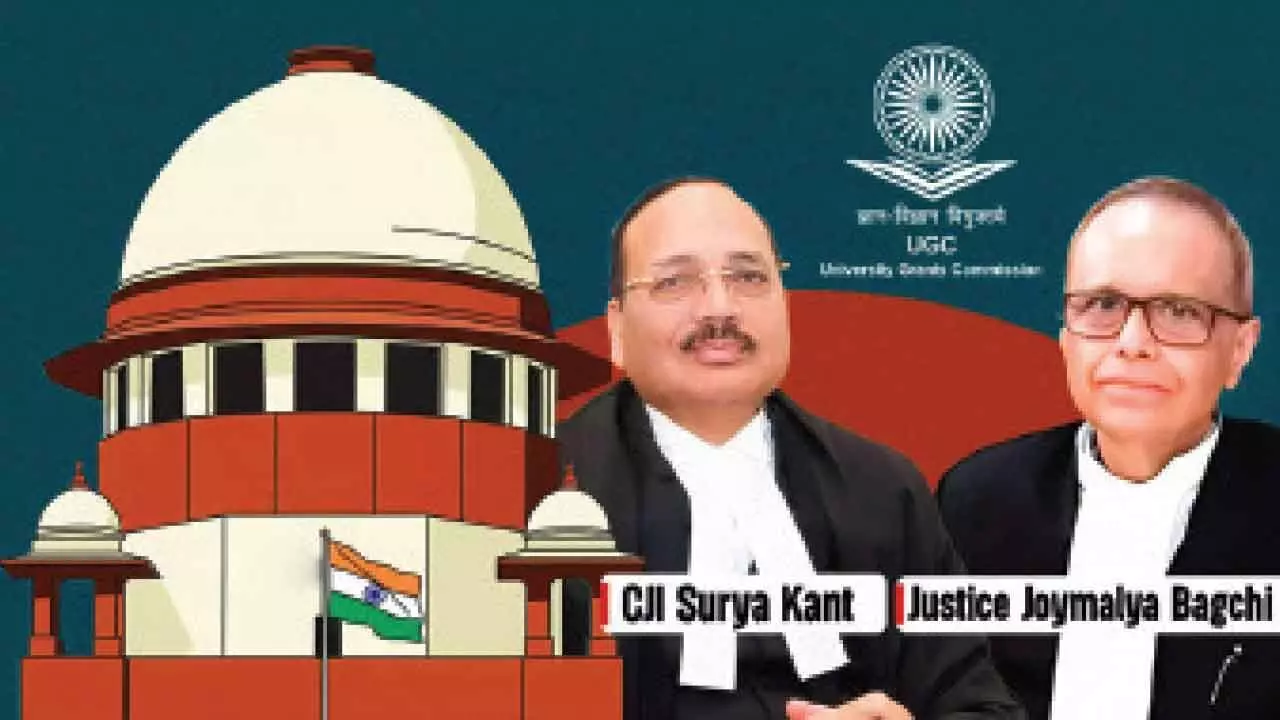
In a significant development, the Supreme Court on Thursday stayed the recent UGC equity regulations on preventing caste-based discrimination on campuses, saying the framework is "prima facie vague", can have "very sweeping consequences" and may end up dividing society with a "dangerous impact", a bench of Chief Justice Surya Kant and Justice Joymalya Bagchi said.
While keeping at abeyance the "non-inclusionary" definition of caste-based discrimination that excluded general categories from institutional protection under rule 3(1)(c), the bench revived the UGC (Promotion of Equity in Higher Educational Institutions) Regulations, 2012.
"In exercise of our powers under Article 142, we direct that the 2012 Regulations shall continue in force till further orders," the bench ordered, noting that the repeal of the earlier framework would otherwise leave students without any remedy. "Issue notice returnable on March 19. The Solicitor General accepts notice. Since issues raised in 2019 plea shall also have bearing while examining constitutionality.. let these petitions be tagged with the same.
Meanwhile, the UGC Regulations 2026 shall remain in abeyance," it said. The 2026 regulations triggered protests at various places, with student groups and organisations demanding its immediate rollback.
The CJI posed a hypothetical scenario involving regional discrimination and said if a student from South India faces humiliation in a northern Indian institution where caste identities are unknown and asked whether Regulation 3(1)(e) would address such situations. Another counsel highlighted a scenario where a general category fresher faces ragging at the hands of a senior belonging to a SC, submitting that the present regulations offer no remedy and may even expose the victim to retaliatory proceedings.
This prompted the bench to question why ragging was not addressed at all under the regulations. "Most harassment happens on junior-senior lines. Why is it assumed that only caste-based discrimination exists," the bench asked, adding, "Whatever we have gained in terms of achieving a casteless society, are we now becoming regressive?" The bench expressed strong disapproval of measures such as separate hostels for different castes.