




- Swami Dayanand Saraswati Death Anniversary 2026: Remembering The Founder Of Arya Samaj And His Reformist Legacy
- Kajal Aggarwal Celebrates Karwa Chauth With Husband Gautam, Shares Adorable Pics
- Tiger Shroff firing case: 12th accused arrested from Sonipat, money trail under scanner
- Manoj Tiwari Takes Dip In Yamuna, Claims River Is Cleaner; AAP Challenges BJP To Drink Water At Kalindi Kunj
- Global security landscape increasingly fragmented, contested: Foreign Secretary Misri at VISV-2026
- Apple Raises iPhone, MacBook Prices as Chipmakers Gain Power
- West Bengal on Alert After Glacial Lake Outburst In Bhutan, Officials Monitor Sankosh River
- ‘Daya Karo, Soniaji!’ Delhi Chamber Makes an Emotional Appeal
Emotional Connect, Political Punch: 'Apna Narendra Bhai' in Gujarat
In Short
One of the major events of the day was the dedication of the Bharat Bovine Breeding and Research Centre (BBBRC) at Bhildi to the nation

Share :
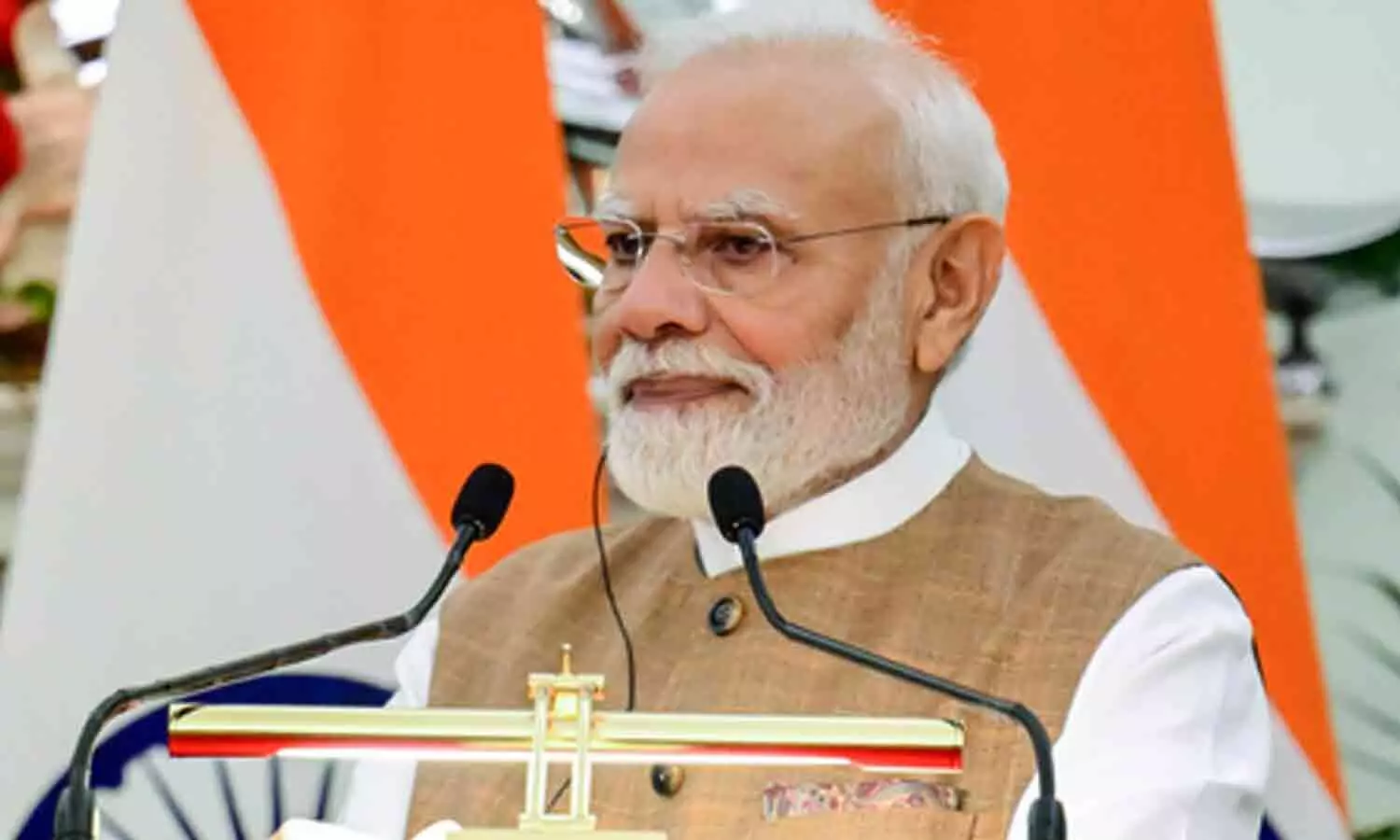
Prime Minister Narendra Modi
Modi, accompanied by Chief Minister Bhupendra Patel and Deputy Chief Minister Harsh Sanghavi, launched development projects worth more than Rs 14,000 crore in Banaskantha and released the 24th instalment of the Pradhan Mantri Kisan Samman Nidhi (PM-KISAN), amounting to around Rs 19,000 crore.
One of the major events of the day was the dedication of the Bharat Bovine Breeding and Research Centre (BBBRC) at Bhildi to the nation.
Addressing the gathering, Modi explained how various government policies had helped increase average milk production. He said the average daily milk output had risen from five litres to eight litres. He also said India had become the world's second-largest exporter of natural honey. Congratulating women Self-Help Groups (SHGs) for bringing about a sweet revolution, he recalled how Gujarat had spearheaded the White Revolution.
Calling upon the people to consider him "Apna Narendra Bhai" rather than the Prime Minister, Modi said it was the people who had guided him throughout his journey. He said he had never even imagined becoming a Pradhan of a village, but the people had supported him through 25 years in public office. "Jan Seva se Rashtra Seva aur Gujarat ke Vikas se Desh ka Vikas," he said.
He added that the people had taught him to pursue ambitious goals and that he would remain indebted to them. In return, he pledged that he would never give up public service until his last breath.
Recalling the days when Banaskantha faced shortages of water and electricity, Modi said his appeal to conserve water had initially met with opposition from people in the region. However, they had eventually accepted the message and transformed the district's profile.
Taking a jibe at the Leader of the Opposition, Modi said potato cultivation had become a source of gold for farmers in the region. "No leader can come here and say, 'You give me potatoes; I will give you gold.' Farmers here have already turned potatoes into gold," he remarked.
He said the Centre of Excellence, spread over 127 acres, would strengthen cattle breeding, genetic improvement and advanced reproductive technologies. It would provide the country's first facility of its kind dedicated to the Kankrej cattle breed.
However, there were some people who could not digest India's progress and felt happy when the country faced difficulties, he said. Referring to the situation in West Asia, Modi alleged that while everyone was trying to deal with the crisis collectively, some people attempted to create panic by spreading fears of shortages of cooking gas, fertilisers and other essential commodities, and disruptions to children's education, merely to defame him.
"I said Modi would stand by the people, and you are seeing the results. There is no shortage of fertilisers, gas or petrol," he said.
Before the inauguration, Modi had highlighted the centre's potential in a post on the social media platform X, saying it would help increase milk production per animal, improve breed quality and enhance farmers' incomes while supporting the conservation of indigenous cattle breeds.
He also gave a call to the youth to actively participate in the Run for Unity on Saturday evening. He said it will be no less than the Republic Day parade witnessed in Delhi on January 26. This is being celebrated as part of the birth anniversary of Sardar Patel.
Bolsonaro backs off Brazil poll challenge after Trump says 'I’m not running Brazil'
Pakistan remains 'deeply hostile' to journalism, media professionals: Report
Political leaders across party lines condole demise of Shivraj Singh Chouhan's mother
NTR district collector Lakshmisha inspect postal voting for municipal elections
Emotional Connect, Political Punch: 'Apna Narendra Bhai' in Gujarat
SIR deadline extended in AP and Telangana
‘Daya Karo, Soniaji!’ Delhi Chamber Makes an Emotional Appeal
Heavy rain alert issued to AP, Telangana amid expected low pressure
'Public banks are not assets to be sold off': Rahul Gandhi amid IDBI bank sale row
Political leaders across party lines condole demise of Shivraj Singh Chouhan's mother


