SC flags fiscal strain of pre-poll freebies

Questions doling out of power subsidies in TN
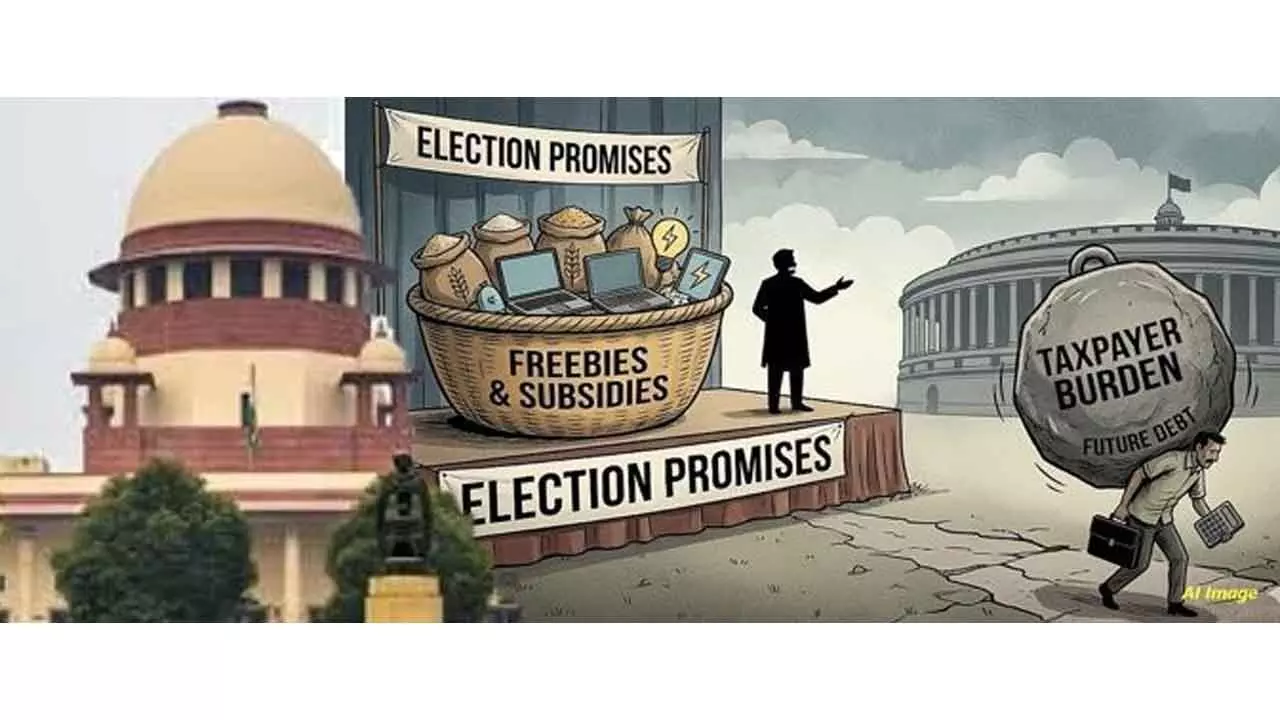
New Delhi: The Supreme Court on Thursday expressed concern over the growing trend of states rolling out subsidies and welfare benefits ahead of elections, observing that the financial burden of such measures ultimately rests on taxpayers.
A Bench led by Chief Justice of India (CJI) Surya Kant, along with Justice Joymalya Bagchi and Justice Vipul M Pancholi, was hearing a petition filed by Tamil Nadu Power Distribution Corporation Limited (TNPDCL) challenging Rule 23 of the Electricity (Amendment) Rules, 2024 in Tamil Nadu Power Distribution Corporation v Union of India & ANR.
The Court issued notice to the Union government and other respondents, seeking their responses.
During the hearing, the Chief Justice questioned how governments propose to finance schemes that are projected as “free” services. Any expenditure, he remarked, has to be sourced from public funds. He cautioned that unchecked distribution of largesse could weaken the country’s economic foundations, particularly when many States are already operating under revenue deficits.
“But this money which the state says it will pay now. Who will pay for it? This is taxpayers’ money,” the CJI asked.
While acknowledging that governments have a constitutional obligation to assist those who genuinely lack access to essential services such as education and basic utilities, the Bench flagged the need for better targeting. Benefits, it observed, should not disproportionately flow to those who are capable of paying. “See on freebies, the economic development of the nation will be hampered with this kind of largesse distribution,” said CJI Kant.
The Chief Justice also referred to electricity subsidy schemes, pointing out that in some instances even affluent landowners receive free power. Public resources, he said, cannot be treated as limitless, and policymakers must ensure fiscal prudence. He underlined that a significant portion of annual State revenue is often absorbed by salaries and subsidy commitments, leaving limited scope for capital expenditure and long-term development.
The timing of such schemes also drew judicial scrutiny. The Bench noted that welfare announcements frequently coincide with impending elections and suggested that political stakeholders and policy thinkers reflect on the sustainability of such practices.
Senior Advocate Gopal Subramaniam, appearing in the matter, argued that allocation of public resources must be equitable and that widening fiscal imbalances raise serious governance concerns.
Justice Bagchi, for his part, emphasised the importance of structured fiscal planning. He observed that if a government intends to extend subsidies, the decision must be transparently incorporated into budgetary allocations. He also expressed reservations about situations where concessions are introduced after electricity tariffs have already been fixed by statutory regulators, cautioning that such post-facto interventions may dilute regulatory autonomy and introduce uncertainty into financial administration.
TNPDCL has assailed Rule 23 of the Electricity (Amendment) Rules, 2024, contending that it travels beyond the scope of the Electricity Act, 2003 and is unconstitutional. The rule mandates that the difference between the approved cost of power supply and the tariff realised from consumers must not exceed three per cent, and requires that any shortfall be liquidated within a stipulated timeframe. It further provides that outstanding gaps be recovered along with an additional charge computed at the base rate of Late Payment Surcharge.
According to TNPDCL, this framework could place severe financial stress on distribution companies. The petition contends that clearing accumulated revenue gaps through surcharge mechanisms may either necessitate steep tariff revisions or compel substantial fiscal support from state governments.
Although the plea does not directly assail subsidy schemes, it arises against the backdrop of State policies granting concessional or free electricity to certain consumer categories, an issue that formed part of the broader fiscal debate during the hearing. The petition has been filed through Advocate T Harish Kumar.