Unnao Rape Case Explained: Why Delhi High Court Put Kuldeep Sengar’s Life Term On Hold

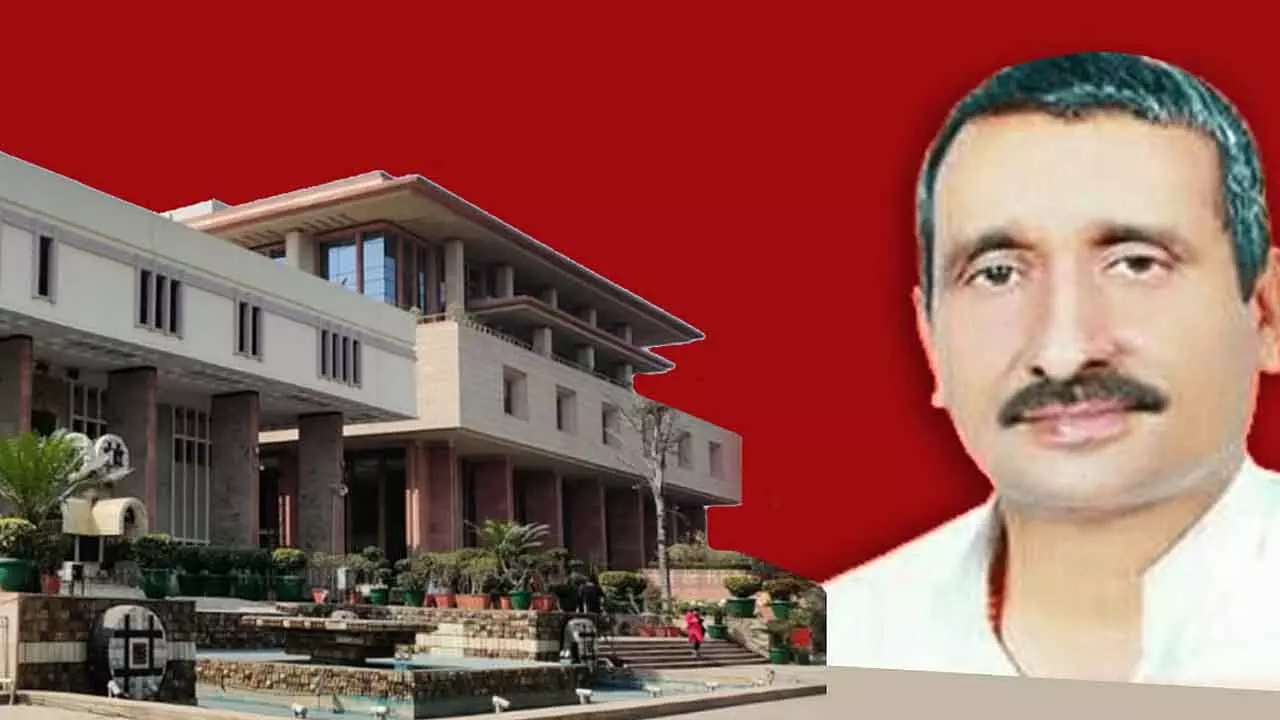
The Delhi High Court has suspended former MLA Kuldeep Sengar’s life sentence in the Unnao rape case, ruling that he does not qualify as a “public servant” under IPC definitions.
The Delhi High Court has temporarily suspended the life imprisonment awarded to former BJP MLA Kuldeep Singh Sengar in connection with the 2017 rape of a minor in Uttar Pradesh’s Unnao district. While the decision offers partial relief, Sengar will continue to remain behind bars unless his sentence in a separate conviction linked to the death of the survivor’s father is also suspended.
Sengar had approached the High Court through two appeals. One challenged the life sentence imposed for the rape conviction, while the second questioned the 10-year sentence handed down for culpable homicide in the custodial death of the survivor’s father. Although the court has stayed the life term, the second appeal is still awaiting a verdict, effectively preventing his release for now.
A key issue before the High Court was whether Sengar could be treated as a “public servant” under the Protection of Children from Sexual Offences (POCSO) Act. The trial court had earlier concluded that he qualified as a public servant by relying on the definition under the Prevention of Corruption Act, which includes legislators. However, the High Court took a different view, stating that the definition under the Indian Penal Code must apply instead.
The court noted that the POCSO Act itself does not define “public servant” but allows courts to rely on definitions provided in laws such as the IPC and CrPC. Under Section 21 of the IPC, public servants include government employees, judges, police officers, and others in government service or pay. Legislators, the court observed, have been consistently held by the Supreme Court as not falling within this category. Based on this interpretation, the High Court made a prima facie finding that Sengar may not attract the enhanced punishment prescribed for aggravated sexual assault committed by a public servant.
The bench also considered sentencing principles applicable during the pendency of an appeal. It observed that even if the offence were examined under the standard provision for penetrative sexual assault under POCSO, the minimum punishment at the time of the offence was seven years’ imprisonment. Since Sengar has already spent over seven years in custody, this factor weighed in his favour while deciding on the suspension of sentence.
Concerns regarding the survivor’s safety have long been central to the Unnao case, particularly after a 2019 road accident that killed two of her relatives and injured her and her lawyer. The Supreme Court had earlier intervened, transferring the case to Delhi, ordering daily hearings, granting compensation, and directing that CRPF security be provided to the survivor and her family.
While earlier courts had taken the threat perception into account while denying relief to Sengar’s relatives, the Delhi High Court, in this instance, held that continued incarceration cannot be justified solely on apprehensions about security lapses. The bench noted that the survivor continues to receive central security cover and stressed that courts cannot deny legal relief on the assumption that law enforcement agencies may fail in their duty.
The suspension of Sengar’s life sentence thus rests on legal interpretation, time already served, and established principles governing appeals, even as the broader case and its impact on the survivor remain under close judicial scrutiny.
Next Story