'Angry' Sun puts India at risk

ISRO warns of strong radio blackout
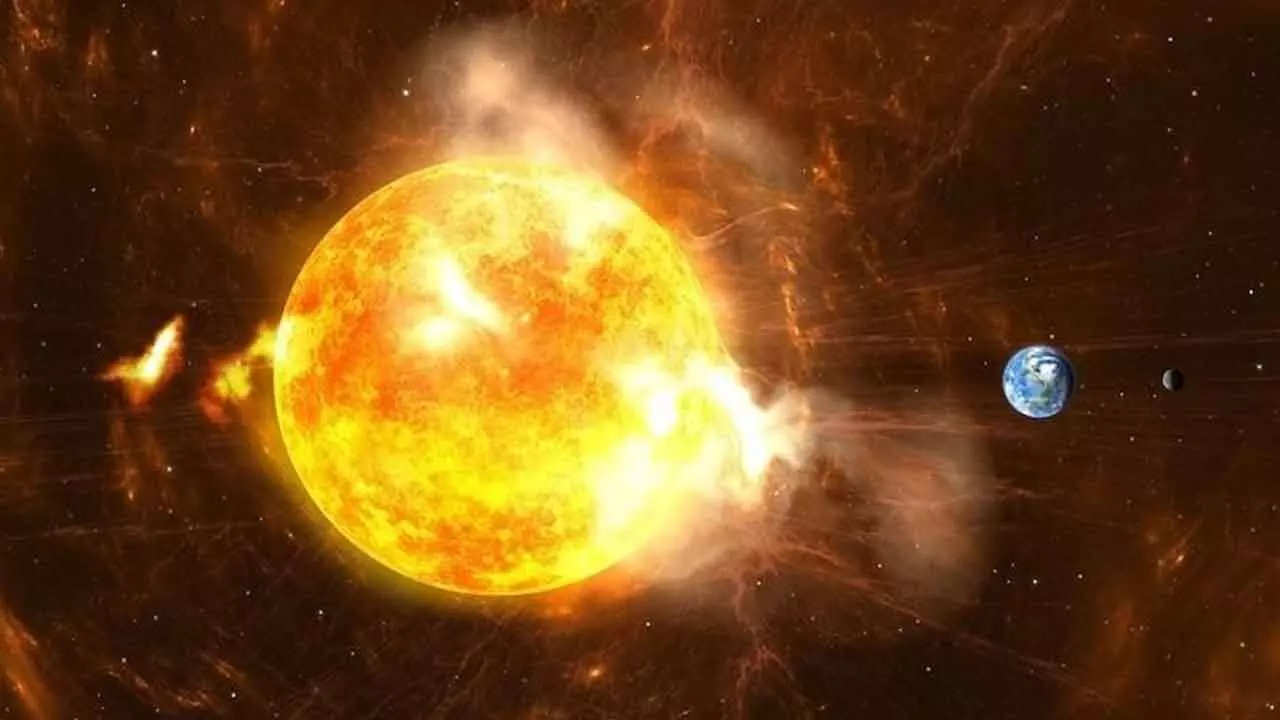
The Sun is angry again, unleashing a series of powerful solar flares that have triggered warnings from space agencies across the world, including India's ISRO, which is closely monitoring the situation for potential strong radio blackout conditions.
Intense solar storms, when directed towards the earth, fry satellites, disrupt television signals, and affect radars and power grids.
ISRO officials confirmed that more than 50 operational Indian satellites are being kept under constant watch as heightened solar activity threatens to disrupt communication, navigation, and satellite payloads.
"There is a strong possibility of radio blackouts. All ISRO satellites are being monitored very closely," Anil Kumar, Director of the Indian Space Research Organisation's Telemetry, Tracking and Command Network (ISTRAC), told NDTV. He added, "Any communication loss will be attended to immediately." He said ground stations have already issued alerts to mission control centres, and contingency plans are in place to respond immediately to any anomaly.
The current solar unrest began with the sudden intensification of a magnetically complex sunspot cluster known as Active Region 14366. Over the past few days, this region erupted repeatedly, producing four extremely strong solar flares, including an X8.1-class flare -- the most powerful of 2026 so far.
NASA confirmed that the flares peaked between February 1 and February 2, with the strongest X8.1 eruption occurring on February 1. Space weather monitoring agencies reported that the event was the brightest solar flare since October 2024 and ranks among the top 20 most powerful flares recorded since 1996, when modern satellite monitoring began.
All eruptions were captured by NASA's Solar Dynamics Observatory, which constantly watches the Sun's surface for explosive events. The Sun undergoes cycles of intense activity every 11 years or so, and this solar storm activity is part of these solar maxima, as it is called.