ISRO successfully executes historic Space Docking

With this, India joins elite Space League with US, Russia and China
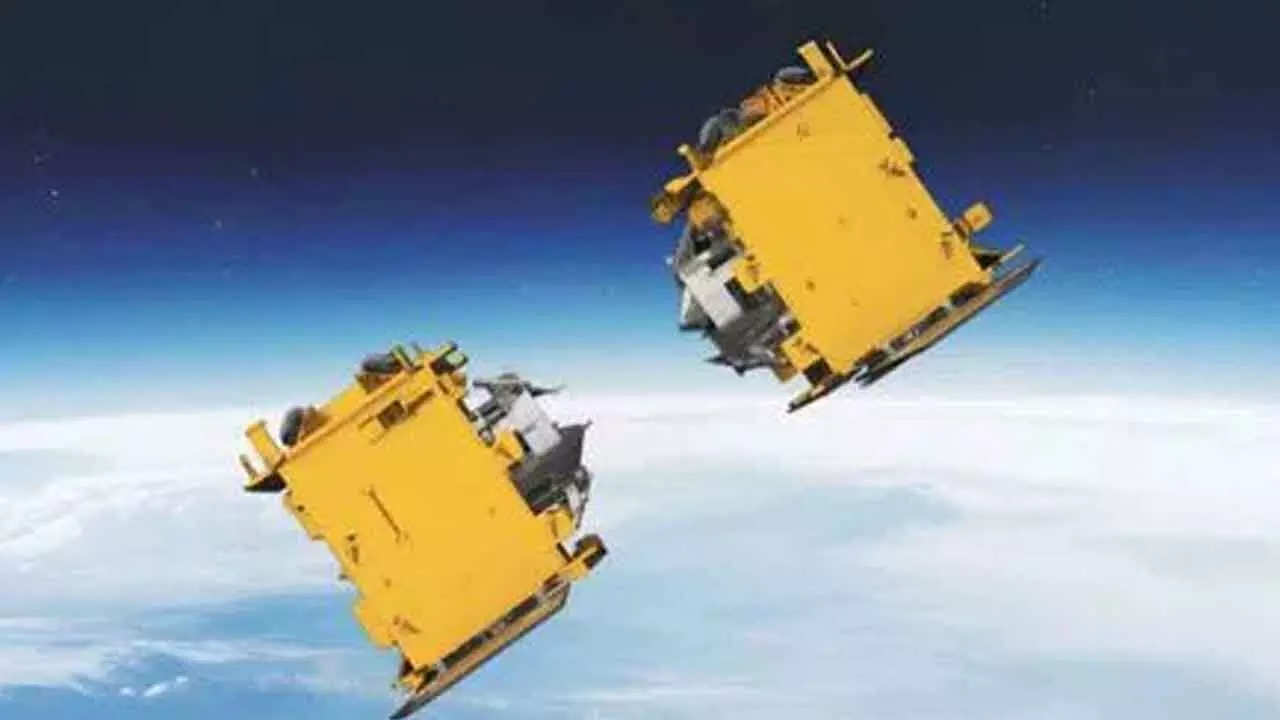
Tirupati: TheIndian Space Research Organisation (ISRO) has achieved a groundbreaking milestone with the successful execution of the SpaDeX (Space Docking Experiment) on Thursday morning.
This achievement positions India as the fourth country globally after the United States, Russia, and China to master spacecraft docking technology.
The experiment involved the seamless docking of two satellites, SDX01 (Chaser) and SDX02 (Target), launched on December 30, 2024, aboard the PSLV C60. The intricate operation was moni-tored and executed by ISRO scientists at the Mission Operations Complex (MOX) under the ISRO Telemetry, Tracking, and Com-mand Network (ISTRAC) in Bengaluru.
In an announcement on platform X, ISRO celebrated the success, stating, “Docking Success! Spacecraft docking successfully completed! A historic moment.
India became the fourth country to achieve successful space docking.
Congratulations to the en-tire team and to India!” The post detailed the docking process, highlighting manoeuvres from a 15-meter hold point to 3 meters, followed by docking initiation, smooth retraction, and final stabili-sation.
ISRO confirmed that after docking, the two satellites were suc-cessfully controlled as a single unit. Upcoming activities include undocking and power-sharing tests to further validate the sys-tem’s reliability.
The SpaDeX mission required meticulous coordination to posi-tion the SDX01 satellite near SDX02. The satellites were guided through various distances—5 km, 1.5 km, 500 m, 225 m, 15 m and finally 3 m—where their docking rings connected, retracted and locked securely. ISRO plans to demonstrate power-sharing between the satellites and will later separate them to pursue their individual payload missions over the next two years.
This experiment highlights critical technologies for future space exploration, including autonomous docking. Initially scheduled for January 7, the mission faced delays due to an abort scenario and an unexpected drift between the satellites. After corrective actions and extensive simulations, the satellites reached the 3-meter hold point on January 12, paving the way for the historic docking.
ISRO employed advanced sensors such as the Laser Range Finder, Rendezvous Sensor and Proximity and Docking Sensor for precise measurements, along with a new satellite navigation processor to determine relative position and velocity. These in-novations ensured the mission’s success.
Docking technology is pivotal for ambitious space missions like modular spacecraft assembly, space stations and lunar sample-return missions. The androgynous docking mechanism used in SpaDeX simplifies the process by equipping both satellites with identical systems. Unlike the globally used International Docking System Standard (IDSS), India’s mechanism operates with just two motors instead of 24, showcasing a unique technological edge.
This capability is crucial for ISRO’s vision of establishing the Bhartiya Antriksh Station by 2035, with the first module’s launch planned for 2028. Docking will also play a key role in the Chan-drayaan-4 mission, aimed at returning lunar samples to Earth. ISRO’s plans include developing a heavy-lift launch vehicle ca-pable of carrying 30 tonnes to low-Earth orbit, supporting its am-bitious goals. The Chandrayaan-4 mission will involve five mod-ules launched in two stages, with docking being integral to its success.