Surabhi Theatre: A 140-yr-old legacy that still lives on stage

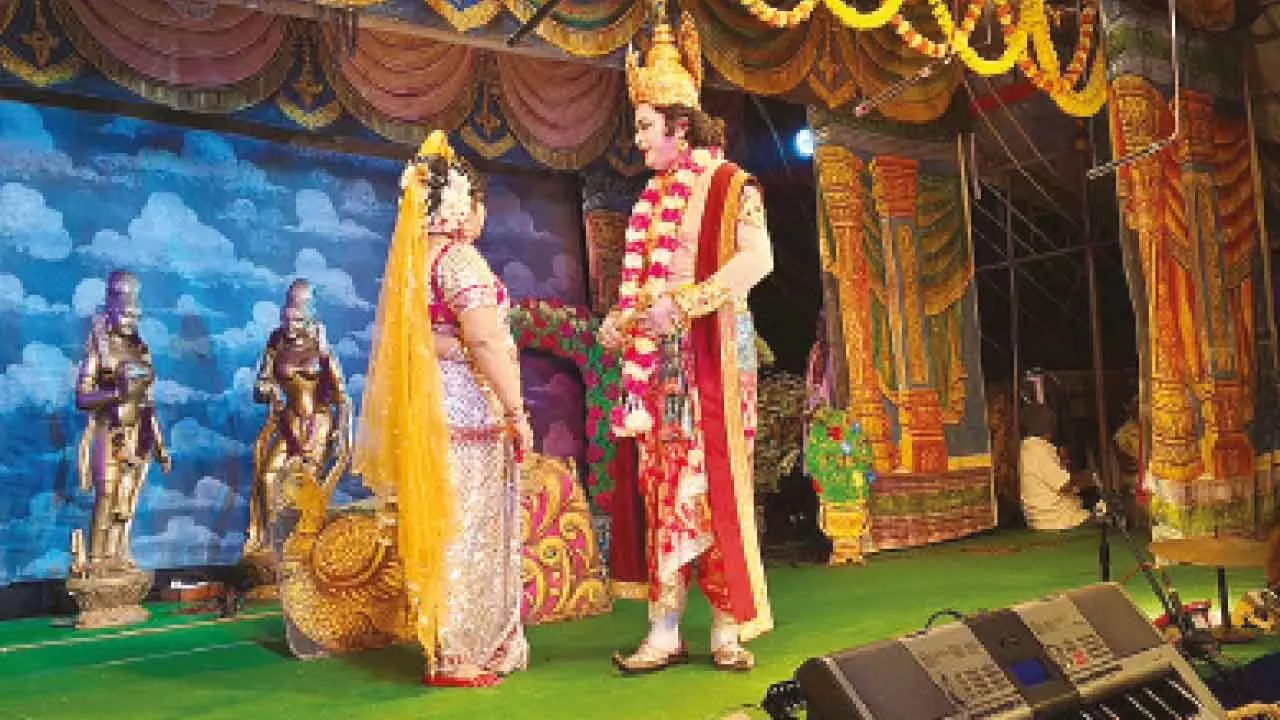
Bhadrachalam: When the curtains rise on a Surabhi play, it is not merely a performance that unfolds but a living tradition passed down through eight generations. For more than 140 years, the Surabhi theatre family has kept alive one of Telugu culture’s most enduring dramatic forms, resisting time, technology and changing tastes.
Founded in 1885 by Vanarasa Govindarao with the play Keechakavadha, Surabhi theatre has since become synonymous with devotional and mythological drama in the Telugu-speaking states. What sets Surabhi apart is not just its longevity, but the fact that theatre here is a way of life. From infants barely a few months old to elders in their seventies, every member of the family grows up on stage, learning roles, rhythms and responsibilities as naturally as breathing.
Unlike modern theatre, Surabhi performances avoid obscenity and controversial dialogue, focusing instead on spiritual, historical and social themes that can be watched by entire families. This commitment to clean, value-based storytelling has helped Surabhi retain its audience even in an era dominated by television, cinema and digital entertainment.
Currently, the tradition is carried forward by the eighth generation under the banner of Sri Vinayaka Natya Mandali, the only surviving Surabhi troupe. Based in Vanasthalipuram, Hyderabad, the group comprises about 40 artistes—all belonging to the same extended family. A unique discipline governs their performances: irrespective of the prominence of their on-stage role, every actor must contribute backstage once their part is over, helping with sets, props and costumes.
Surabhi theatre is particularly known for its imaginative stagecraft. Using handcrafted sets and mechanical ingenuity, the troupe recreates rivers flowing across the stage, animals running through forests, birds chirping in trees and even elephants and bears appearing lifelike before astonished audiences. Long before visual effects became common in cinema, Surabhi mastered the art of visual illusion in live theatre.
Historically, Surabhi families settled in parts of present-day Kadapa district, with villages such as Rayadurgam and Balakondalu becoming closely identified with the art form. Until the 1980s, there were nearly 40 Surabhi theatre groups performing across Andhra Pradesh and Telangana. However, with the rapid growth of electronic media, most troupes faded away, leaving Sri Vinayaka Natya Mandali as the sole torchbearer of this heritage.
Despite the challenges, public interest in Surabhi theatre has not waned completely. According to R. Venugopala Rao, organiser of Sri Vinayaka Natya Mandali, the troupe performs around 150 shows annually across the two Telugu states, largely with support from government cultural and endowment departments.
“There are ups and downs, but our commitment is to ensure that theatre survives,” he says. The continued relevance of Surabhi was evident recently at Bhadrachalam, where the troupe performed as part of the Vaikuntha Ekadashi celebrations organised by the Sri Sita Ramachandraswamy Devasthanam.
Their performances at the Kalyana Mandapam drew devotees and theatre lovers alike, reaffirming the enduring appeal of classical drama when presented with sincerity and skill. For Surabhi artistes, theatre is not a profession chosen but an inheritance embraced. While younger members pursue formal education alongside training in drama, the collective resolve remains strong—to preserve the art that their ancestors nurtured against all odds.
As the lights dim and the applause fades, Surabhi theatre continues its quiet journey through time, reminding audiences that tradition, when rooted in discipline and devotion, can survive even the most dramatic changes
of an age.