Indian classical arts forms of Yoga Vidya: Samavedam

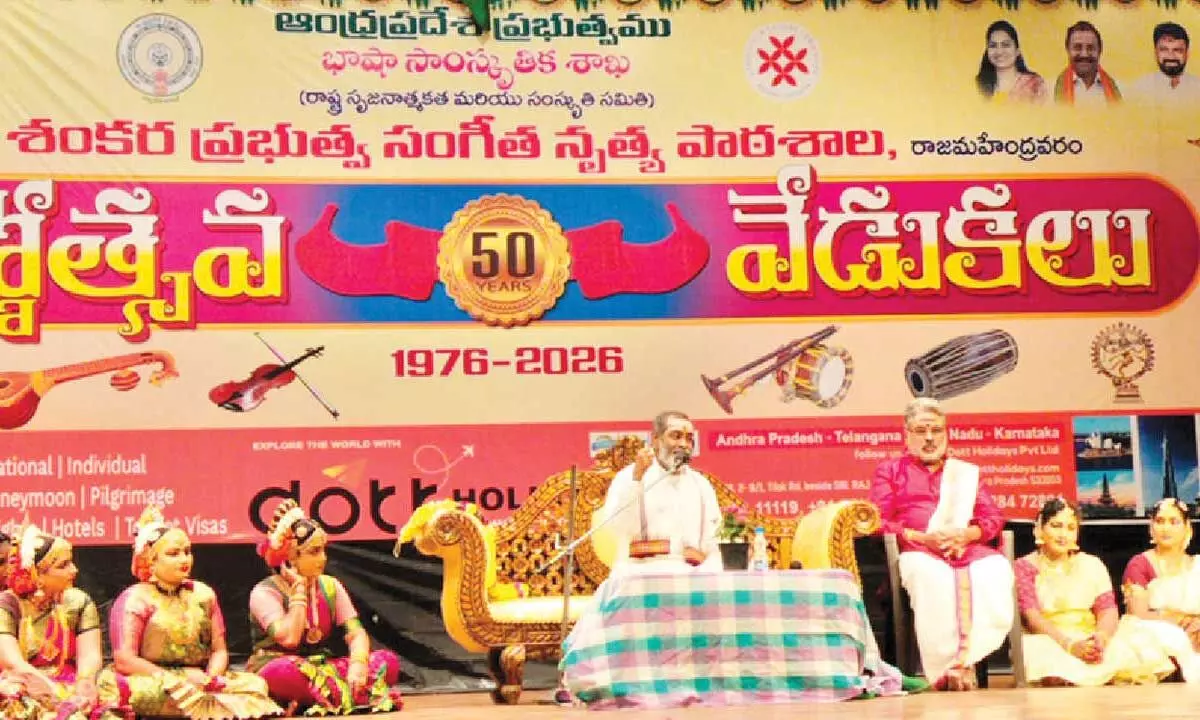
Rajamahendravaram: Renowned spiritual leader and orator ‘Brahmasri’ Samavedam Shanmukha Sarma stated that Indian classical arts are not merely tools for entertainment but serve as forms of Yoga Vidya that facilitate spiritual growth.
Speaking at the 50th anniversary celebrations of the Vijayasankara Government School of Music and Dance at Sri Venkateswara Anam Kalakendram on Sunday, he explained the profound depth of India’s cultural heritage.
He said that when practiced with devotion, music and dance become powerful spiritual disciplines that help an individual attain higher states of consciousness.
Samavedam said the sacred traditions of music and dance, handed down through Rishis, must be pursued not only with enthusiasm but with purity of intent and the spirit of Tapasya. He observed that both practitioners and Rasikas should cultivate refined aesthetic sensibilities, as appreciation is as important as performance in sustaining classical traditions.
Recalling the legacy of Telugu musicians, he said that while many eminent Telugu music scholars emerged from this region, they often received wider recognition and patronage in Tamil Nadu, a historical reality that should not be forgotten. He remarked that music has the power to alleviate physical ailments and even astrological afflictions, citing traditional belief and lived experience.
Samavedam recalled the well-known episode from the life of Saint Tyagaraja, where the saint, confronted by thieves, sang the Huseni raga kriti “Raghuveera Ranaveera… Rara Rajakumara,” surrendering his wealth to Lord Rama, following which Rama and Lakshmana themselves are believed to have protected his home.
He said Tyagaraja’s compositions stand unparalleled for their fusion of exalted music and devotional literature, while Muthuswami Dikshitar and Syama Sastri attained spiritual fulfilment through Nadopasana.
He said that modern science also established the presence of sound energy (Nada Shakti) within the Pranava (Om). Referring to the cosmic symbolism of the Nataraja idol, he said it conveys the philosophical vision that the entire universe is in a state of rhythmic dance.
Emphasising that the arts should not stop at emotional engagement, Samavedam said they must lead the seeker into philosophical enquiry and ultimately towards the Supreme Reality. The synthesis of science, arts and philosophy, he said, lies at the heart of Sanatana Dharma. In contrast, art divorced from divinity and philosophical depth reduces itself to material indulgence and leads to human decline.
Citing the work of eminent danseuse and scholar Padma Subrahmanyam, he said it has been established that dance originated from the Vedas and that the characteristics of all four Vedas are embedded in classical Natya. He elaborated on the inseparable relationship between dance, music and literature, stating that Nada is the very source of music.
Clarifying misconceptions, Samavedam said Hindustani and Carnatic music are merely stylistic streams, and that despite differences in language and region, the core musical philosophy remains one. He recalled that Vidyaranya Swami, the spiritual force behind the Vijayanagara Empire, authored Sangeeta Saramu to propagate musical knowledge, which later evolved into the Carnatic tradition.
Music, he said, should be understood as a discipline that awakens the dormant divinity within human beings. Quoting Swami Vivekananda, Samavedam observed that as science advances, the greatness of India’s Sanatana Dharma is becoming increasingly evident.
However, he cautioned that there are deliberate attempts today to sever Indian arts from their civilisational roots, and called for constant vigilance to preserve their sacred character. The programme was attended by musicians, dancers, scholars, students and art lovers from across the Godavari region.