




- Congress govt committed to advocates’ welfare, protection: Ministers
- Ponnam lays foundation for Rs 3.22-crore Uppal bus terminal
- Govt medical colleges pip private institutions in MBBS 1st yr results
- West Bengal team studies rural development works in Krishna dist
- Jagan’s Letter To Sharmila: YSRCP accuses Chandrababu of exploiting family dispute
- Good response to hmtv’s Innovative Hackathon-2026
- The three qualities that shape our everyday life
- This Diwali, trade fireworks for a sky full of stars in Kenya
Dasha Mahavidya: Ancient wisdom for a generation that needs the greatest vidya of all time
In Short
This is where the Dasha Mahavidya, one of the profound spiritual traditions of Bharat, offers an inspiring perspective for contemporary society.

Share :
Dasha Mahavidya: Ancient wisdom for a generation that needs the greatest vidya of all time
Every generation encounters a defining Dasha—a phase of change that calls for new knowledge, renewed capabilities and a deeper understanding of life. Today's generation is growing in an era of artificial intelligence, digital transformation, global competition and unprecedented access to information. Young people are discovering new opportunities to learn, innovate and create, while also recognising the importance of emotional balance, ethical leadership and meaningful living.
This is where the Dasha Mahavidya, one of the profound spiritual traditions of Bharat, offers an inspiring perspective for contemporary society.
The Sanskrit word Dasha means ten, Maha means great, and Vidya means knowledge or wisdom. In the Shakta tradition, the Dasha Mahavidyas represent ten great manifestations of the Divine Mother, each carrying distinctive philosophical, spiritual and symbolic significance.
Their relevance extends into a contemporary conversation about education, human development and the purpose of knowledge. When approached with respect for their spiritual foundations, the Mahavidyas can inspire young people to reflect on essential questions: What knowledge does life demand from us? Which capabilities help us navigate change? How can learning become a source of individual growth and collective wellbeing?
When Every Dasha Calls for a Vidya
The circumstances of life change continuously. A student enters a phase of academic discovery, an entrepreneur navigates a period of innovation, a professional embraces technological change, and a community works towards sustainable development. Each situation invites the acquisition of appropriate knowledge and capabilities.
In this contemporary interpretation, Dasha represents a phase of life, while Vidya represents the wisdom and skills that help us respond constructively to that phase.
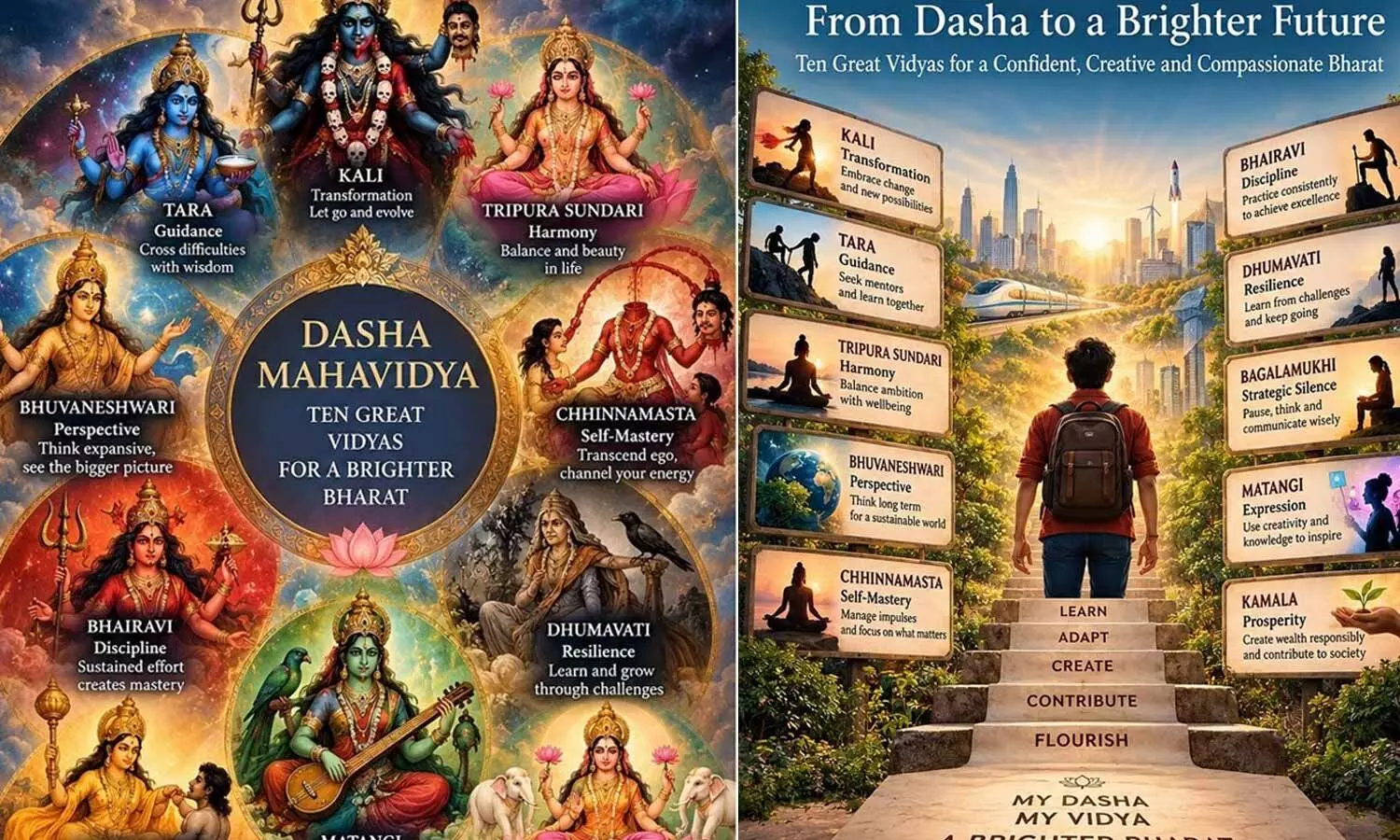
The Dasha Mahavidya offers a rich framework for reflecting on ten dimensions of human development. This approach complements the traditional religious understanding of the goddesses with a practical exploration of their symbolic associations.
Maa Kali inspires the Vidya of transformation. Her association with time and the dissolution of limitations encourages young people to welcome change, release outdated habits and develop adaptability. In a rapidly evolving professional world, the ability to learn new technologies and embrace fresh opportunities becomes an important life skill.
Maa Tara represents guidance and the ability to cross difficult passages. Her symbolism encourages the development of communication, mentorship, attentive listening and sound judgement. Young people can strengthen these qualities by seeking guidance, sharing knowledge and learning collaboratively.
Maa Tripura Sundari inspires harmony, beauty and completeness. Her philosophical significance invites reflection on the relationship between achievement, wellbeing, creativity and meaningful relationships. A balanced approach to personal and professional life can help young people pursue excellence while nurturing their inner development.
Maa Bhuvaneshwari, associated with the universe and the space in which existence unfolds, inspires expansive thinking. Her symbolism connects naturally with systems thinking, ecological awareness and long-term planning. It encourages young minds to understand the relationship between individual decisions, communities and the natural world.
Maa Chhinnamasta offers a profound invitation to reflect on sacrifice, transformation and the transcendence of ego. For contemporary youth, this can inspire self-discipline, thoughtful choices and the ability to direct attention towards meaningful goals. Digital responsibility and conscious use of time become practical expressions of this reflection.
Maa Bhairavi represents spiritual intensity, discipline and determination. Her symbolism reminds learners that mastery develops through sustained effort. Whether pursuing scientific research, entrepreneurship, artistic expression or technological innovation, consistent practice and dedication help convert potential into competence.
Maa Dhumavati invites reflection on adversity, impermanence and the wisdom that emerges through difficult experiences. Her symbolism encourages resilience, patience and the capacity to learn from setbacks. In education and enterprise, the ability to review experience and adapt one's approach becomes a valuable source of growth. Maa Bagalamukhi represents the power of restraint and the stilling of opposing forces. Her symbolism offers an important lesson for the digital age: thoughtful silence can strengthen communication. Pausing before reacting, examining information carefully and choosing words responsibly are essential capabilities for individuals who participate in public conversations.
Maa Matangi is associated with speech, music, knowledge and artistic expression. Her significance resonates with the creative economy, where storytelling, design, communication, original thinking and cultural knowledge create opportunities for livelihoods and innovation. Her symbolism encourages young people to develop their voice and use creativity to contribute to society.
Maa Kamala represents prosperity, auspiciousness and flourishing. Her symbolism invites reflection on wealth creation, enterprise, generosity and responsible resource management. It encourages a vision of prosperity in which individual success contributes to family wellbeing, community development and environmental sustainability.
Together, these ten perspectives provide a rich vocabulary for reflecting on the different capabilities required for a fulfilling life.
Bringing Bharatiya Knowledge Systems into Contemporary Education
Bharat's intellectual heritage offers a vast range of resources for contemporary learning, including philosophical inquiry, mathematical traditions, literature, arts, architecture, ecological knowledge and diverse systems of spiritual practice.
The Dasha Mahavidya can become an engaging entry point for interdisciplinary learning when educators place traditional sources in their proper context and connect their themes with age-appropriate activities.
A lesson inspired by Maa Matangi, for example, can encourage students to explore classical literature, develop storytelling skills, traditional knowledge and examine how language shapes public understanding. A learning activity inspired by Maa Bhuvaneshwari can introduce systems thinking through local water management, biodiversity or community planning. Reflections inspired by Maa Bhairavi can lead to practical exercises in goal-setting, regular practice and the development of expertise.
Such activities can bring together cultural literacy, creativity, critical thinking and practical learning. They also create opportunities for students to appreciate the philosophical diversity of Bharat while engaging with contemporary knowledge.
Scientific temper has an important role in this process. Practices such as habit formation, deliberate practice, emotional regulation, reflection and evidence-based decision-making can be examined through established research in psychology and education. The symbolic associations of the Mahavidyas can inspire these practices, while scientific claims must be evaluated through appropriate evidence. This distinction allows tradition and scientific inquiry to enrich the educational conversation without confusing spiritual meaning with experimentally established findings.
The Greatest Vidya: Learning How to Learn
The contemporary world rewards specialised knowledge, yet lasting success also depends on the ability to acquire new knowledge throughout life. The greatest Vidya for a changing world may therefore be the capacity to learn, unlearn and relearn while remaining guided by sound values.
A young person can translate this principle into everyday action: devote time to focused learning, practise a chosen skill consistently, reflect on decisions, manage digital distractions, seek feedback and use knowledge to solve a real problem. These simple practices connect the pursuit of excellence with personal responsibility.
Entrepreneurs can use the same approach to develop resilience and innovation. Educators can use it to create experiential learning environments. Institutions can use it to encourage ethical leadership and lifelong learning.
The purpose is not to reduce the Mahavidyas to a list of professional competencies. Their spiritual significance deserves recognition in its own right. Rather, their philosophical and symbolic dimensions can open meaningful conversations about the relationship between inner development and outward achievement.
From Ancient Wisdom to a Future-Ready Bharat
A knowledge society requires more than information and technical expertise. It requires people who combine competence with character, innovation with responsibility, and ambition with an understanding of the wider good. The Dasha Mahavidya offers an opportunity to explore these dimensions through a distinctive Bharatiya lens. Its tenfold framework invites reflection on transformation, guidance, harmony, perspective, self-mastery, discipline, resilience, restraint, expression and prosperity.
For the contemporary generation, the message is both timeless and practical: every phase of life offers an opportunity to deepen knowledge and strengthen capability.
When Bharatiya Knowledge Systems engage thoughtfully with contemporary education, scientific inquiry and the needs of young people, they can contribute to a future in which cultural rootedness and global competence grow together.
Every Dasha can become an opportunity for growth when it is met with the right Vidya. And the greatest Vidya is the wisdom that helps individuals flourish while contributing to the wellbeing of society.
(The writer is a Creative Economy Expert)


