A policy perspective on India’s low-carbon electricity transition

Decarbonisation of electricity is at the centre of national energy strategies to mitigate climate change globally. For the first time, nuclear energy was formally recognized as part of the solution to climate change at COP-28, reinforcing its role as low carbon baseload electricity. India, committed to achieve net zero emissions while sustaining high economic growth, has articulated an ambitious roadmap to expand its nuclear power capacity to 100 GWe by 2047. Achieving this target requires not only technological and industrial preparedness but also an enabling legal and regulatory framework that facilitates private and foreign participation while ensuring safety, safguards and security. This article examines the transition imperative for nuclear energy in India, analyses the significance of the Sustainable Harnessing and Advancement of Nuclear Energy for Transforming India (SHANTI) Act, 2025 and revised civil nuclear liability regime for private sector participation.
Transition imperative:
The United Nations Environment Programme’s Emissions Gap Report 2023 estimates that predicted greenhouse gas emissions in 2030, based on polices in place at the time of Paris Agreement in 2015, must be reduced by 28 per cent to limit the increase in global warming to well below two degrees Celsius, and by 42 per cent to limit it to 1.5 degrees Celsius. Decarbonization has therefore become a central policy priority worldwide. In this context, the formal recognition of nuclear energy at COP 28 as a viable climate mitigation option marks a significant shift in international consensus.
India faces dual challenge of meeting its climate commitments while sustaining its economic development as well as working on developing new technologies. While renewable energy sources such as solar and wind have expanded rapidly, their inherent intermittency necessitates complementary sources of reliable, low carbon baseload power. India is focusing on enhancement of nuclear share to achieve its decarbonization goal. Although coal thermal power plant capacity as baseload power at present, its use would tapper only after reaching a certain stage of optimism about deployment of low-carbon technologies, including nuclear, as baseload power. Electricity currently accounts for approximately 21.21 per cent of India’s total final energy consumption (Energy Statistics India, 2023). However, electrification of transport and heating sectors is expected to increase this share substantially.
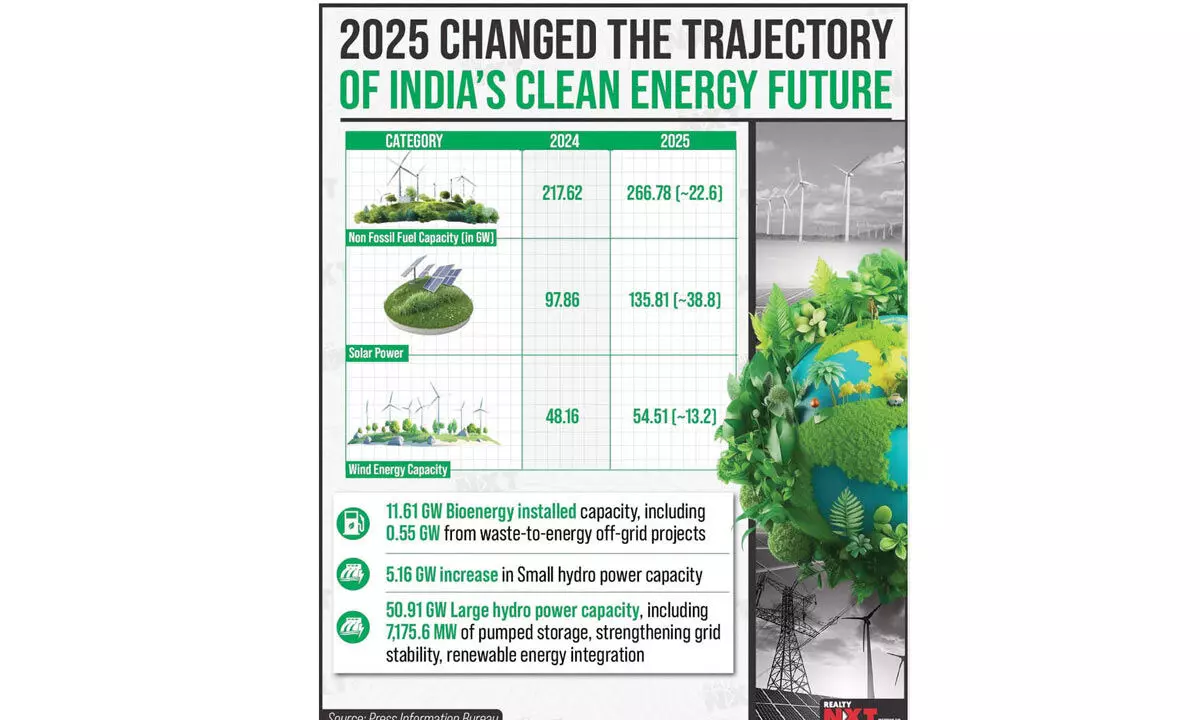
The transition to a low carbon energy mix must therefore be driven by a significant expansion of low emission electricity generation. The Central Electricity Authority’s Report on Optimal Generation Capacity Mix for 2029-30, (April 2023) projects declining emission factors from 0.658 Kg CO2 per KWh in 2020-21 to 0.477 Kg CO2 per KWh by 2029-30. This reflects the growing contribution of renewable and nuclear power. India achieved its target of 50 per cent non-fossil installed electricity capacity ahead of its 2030 nationally determined contribution timeline but a large share of nuclear power is essential to ensure grid stability and decarbonization.
The enabling framework:
Recognising this imperative, India has announced a roadmap to set up 100 GW of installed nuclear capacity by 2047. It envisages a diversified reactor portfolio, including PHWRs, LWRs, SMRs and Fast Breeder Reactors (FBRs) with enhanced participation from private and foreign entities.
India has achieved a high degree of technological maturity in design, construction, commissioning, operations and decommissioning of PHWRs. Reactor capacities have evolved from 220 MWe to 540MWe and further to 700 MWe, all of which are currently in operation, while thirteen 700 MWe PHWRs, four 1000 MWe LWRs and one 500 MWe Prototype Fast Breeder Reactor (PFBR) are under construction or in pre-project stages. These projects are expected to gradually increase the total present nuclear installed capacity from 8880 MWe to 22480 MWe by 2032.
Further expansion will be pursued through fleet mode construction of PHWRs and deployment of the imported reactors technologies.
The SHANTI Act 2025:
The Sustainable Harnessing and Advancement of Nuclear Energy for Transforming India (SHANTI) Act, 2025 is a landmark legislation for opening nuclear sector for private and foreign investment. Provisions from the Atomic Energy Act, 1962, and the Civil Liability for Nuclear Damage Act,2010, are reflected in it, repealing both the Act. It also retains sovereign control over sensitive aspects related to safety, safeguards, and security. It is also strengthening regulatory independence by granting statutory status to Atomic Energy Regulatory Body (AERB).
In respect of civil nuclear liability, the Act provides the right of recourse against suppliers through contractual arrangements between operators and Suppliers. This would attract private and foreign investment.
Private sector participation: Key factors:
1. Manufacturing and supply chain capacity: The pace of nuclear expansion will depend on the availability of infrastructure mainly manufacturing and fabrication facilities of major long delivery equipment/components such as reactor pressure vessel, steam generator and end-shields. This will require sustained policy commitment to justify industry investments.
2. Human resources and safety culture: A robust nuclear safety culture and the availability of skilled manpower—both within industry and among operators—are prerequisites for successful private participation.
3. Project gestation and financial returns: Nuclear power projects have longer gestation periods compared to other power generation technologies, therefore, demands investor patience and access to long term financing.
4. Market and policy signals: Another influencing factor is carbon border tax regime that stimulates demand for clean electricity which is currently addressed by renewal power can be supplemented by base load nuclear power.
Cost competitiveness and profitability:
The Levelised Cost of Electricity (LCOE) for nuclear, an assessment carried out for entire operational life of a plant is competitive. This is attributed to low variable cost of nuclear generation and longer plant life, despite high initial capital costs. Actual tariff of NPPs is quite comparable to thermal power stations of the same vintage and location. Hence, profitability should not pose a significant barrier for private sector participation if plants are operated at reasonable capacity factor.
Conclusion:
Nuclear energy has emerged as a critical component of global and national strategies to address climate change, India’s roadmap to set up 100 GWe of Nuclear installed capacity by 2047 reflects this strategic importance. The enactment of the SHANTI Act 2025 provides a robust and enabling legal framework by opening the nuclear sector to private and foreign participation, strengthening regulatory independence, and clarifying civil nuclear liability regime through contractual flexibility.
With appropriate checks and balances to ensure safety, safeguards and security, the current policy environment presents a timely opportunity for Industries to participate meaningfully in India’s nuclear expansion.
Such participation will be instrumental in achieving the country’s long term decarbonisation goal while supporting sustainable economic growth.
(The writer is a member of the Steering Committee on ICEMF and a former Raja Ramanna Fellow DAE)
India has achieved a high degree of technological maturity. Reactor capacities have evolved from 220 MWe to 540MWe and further to 700 MWe, all of which are currently in operation, while thirteen 700 MWe PHWRs, four 1000 MWe LWRs and one 500 MWe Prototype Fast Breeder Reactor (PFBR) are under construction or in pre-project stages