Inclusive governance gets an urban mandate in Telangana

The outcome of the recent municipal elections in Telangana has done more than merely redrawing the political map of urban local bodies. It has reopened a substantive debate on representation, caste arithmetic and the evolving grammar of social justice in a rapidly urbanising State.
While local elections are often treated as peripheral contests, the scale and pattern of results across the State’s 113 municipalities and corporations suggest a deeper political recalibration.
The Congress, which returned to power in the State promising “praja palana” (people-centric governance), has secured control in 90 municipalities. What distinguishes this verdict, however, is not merely the number of urban bodies won, but the social composition of those who now head them.
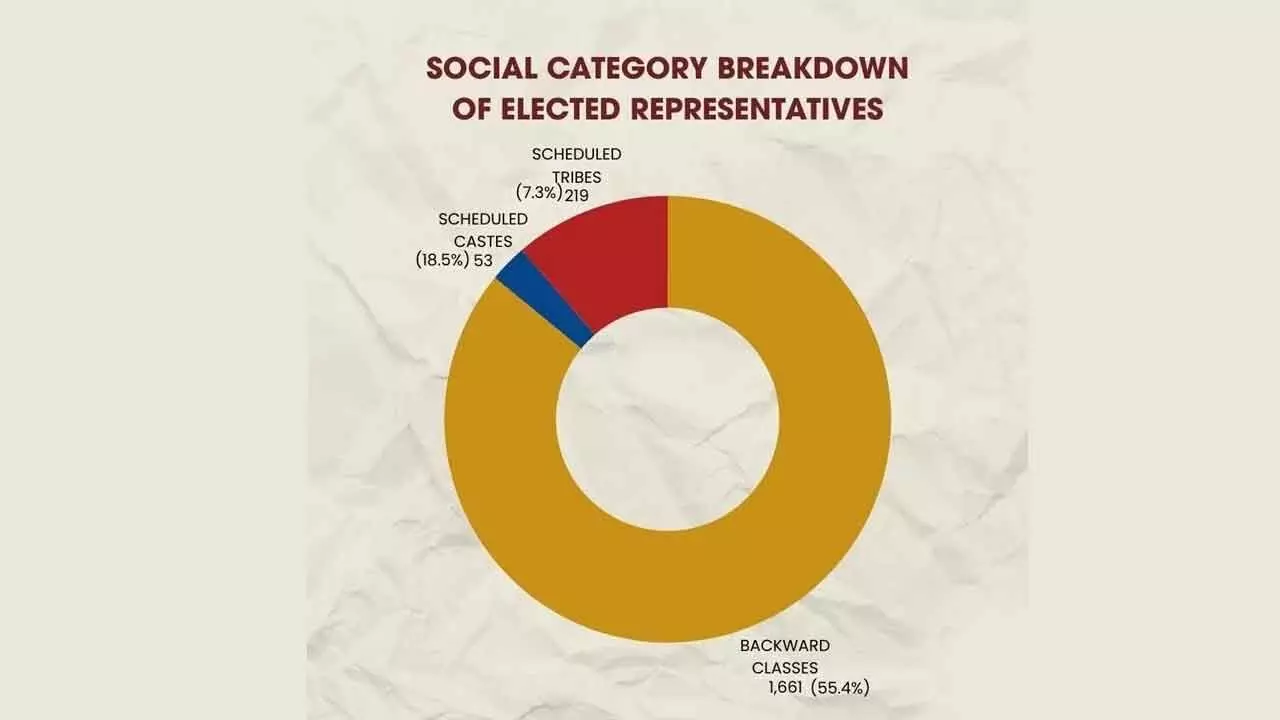
Approximately, 66 of the 113 municipal chairpersons are from Backward Class (BC) communities , which roughly translates to 61 per cent of the total. In municipalities secured by the Congress, 51 chairperson posts have gone to BC leaders. Representation extends beyond titular leadership: BCs account for more than 60 per cent of key positions including chairpersons, vice-chairpersons, mayors and deputy mayors. At the ward level too, more than 55 per cent of elected councillors are from BC communities.
At the corporation level, the numbers are equally striking. Four of the seven mayoral positions are now held by BC representatives, marking a notable shift in the social profile of urban power centres. In a State where BC communities constitute a significant share of the population, and are deeply embedded in urban informal economies from small traders and artisans to service providers and lower-middle-class employees, this redistribution of political authority carries symbolic as well as practical weight.
The Congress leadership has projected this outcome as validation of its commitment to institutionalising social justice. In the run-up to the Assembly elections, the party had promised caste enumeration and 42 per cent reservations for BCs in local bodies. While legal and procedural complexities surround the full operationalization of such quotas, the party appears to have moved proactively in ticket distribution. Reports indicate that over 53 per cent of party nominations in municipal elections were given to BC candidates exceeding the stated reservation benchmark.
Critics may argue that candidate selection is ultimately a political calculation rather than a moral gesture. Yet electoral endorsement by voters suggests that the strategy has resonated. Urban constituencies, often perceived as less driven by caste considerations than rural ones, have demonstrated that social identity and representational claims remain potent in towns and cities as well.
Broader implications merit closer scrutiny:
Urban local bodies are not ornamental institutions. They oversee critical functions: water supply, waste management, road infrastructure, public health, urban planning and local taxation. The composition of leadership in these bodies shapes budget priorities and administrative focus. Enhanced BC representation may therefore influence policy choices, particularly in areas like slum upgrading, small enterprise facilitation; market infrastructure and welfare delivery for lower-income households. At the same time, social justice in governance cannot be reduced to numerical dominance.
Telangana’s municipal structure also accommodates representation for Scheduled Castes, Scheduled Tribes, minorities and other communities under constitutional mandates. The current distribution appears to reflect a layered inclusion rather than a zero-sum redistribution. Whether this balance endures will depend on the government’s administrative prudence.
Politically, the municipal verdict strengthens the Congress’s urban foothold at a time when local elections are increasingly interpreted as mid-term referendums. Consolidation among BC voters, a decisive social bloc in Telangana, could influence future Assembly and Parliamentary contests. Yet, as history repeatedly demonstrates, social coalitions are sustained less by symbolism and more by performance.
The Telangana model:
The durability of what some describe as the “Telangana model” of BC empowerment will hinge on governance outcomes. Transparency in municipal administration, efficient delivery of services and credible implementation of development schemes will determine whether expanded representation translates into substantive empowerment.
If the proposed 42 per cent reservation framework for BCs attains statutory backing and withstands judicial scrutiny, Telangana may find itself at the forefront of a renewed national conversation on caste enumeration and proportional representation. For now, the municipal results underscore a clear trend: urban politics in Telangana is being reshaped not just by party competition, but by an assertive reconfiguration of social representation. In that sense, the elections mark less an end than a beginning, the start of a test of whether inclusion in office can meaningfully transform governance on the ground.