13-year-old Hyderabad student develops multi-system AI architecture

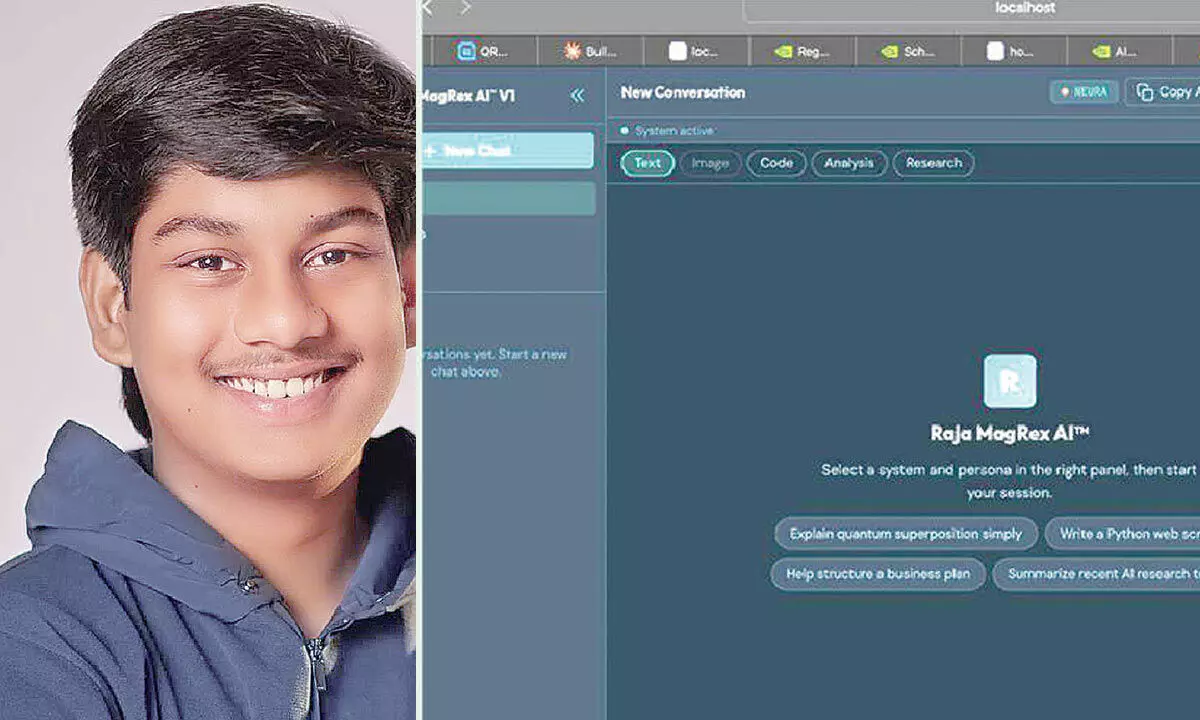
In an unusual example of young innovation, a 13-year-old student from Hyderabad has designed an artificial intelligence ecosystem that is attracting attention in technology and research circles. Raja Dharma Tej Maddala, a Grade 7 student, has developed an original AI framework called Raja MagRex AI™, which has been recognised as an innovation initiative by the Government of India’s Department for Promotion of Industry and Internal Trade (DPIIT). At an age when most students are just beginning to explore coding and basic digital tools, Raja is attempting to rethink how artificial intelligence systems can be structured and coordinated.
Raja, who studies in the IB Middle Years Programme at Oakridge International School, Gachibowli, describes himself as a technology enthusiast with a deep interest in artificial intelligence, science and complex systems. His curiosity about how mathematics, computing and scientific ideas connect with each other gradually led him to explore artificial intelligence more seriously.
This interest eventually resulted in the creation of Raja MagRex AI™, an AI ecosystem designed around a structured architecture rather than a single model. According to Raja, the system is built on 22 cognitive systems, 87 modules and more than 100 functional features. The aim is to allow the system to examine problems from multiple analytical perspectives before producing a final response.
The project introduces a concept he calls “Artificial Civilisation Intelligence.” The idea is inspired by how human societies solve complex problems. In the real world, experts from different fields such as science, engineering, economics and policy often collaborate to reach better decisions. Raja’s framework attempts to replicate this model within an AI environment, where multiple reasoning systems analyse an issue simultaneously and contribute to a unified conclusion.
At the centre of the architecture is a coordination system called NEURA, which manages how the different cognitive modules interact with each other. When a problem or prompt is introduced, NEURA analyses it and determines which reasoning systems should be activated. These systems may focus on areas such as logical reasoning, contextual understanding, analytical evaluation or creative exploration. Their outputs are then combined through a structured synthesis process to produce a final response.
Unlike many current AI tools that rely on a single large model to generate answers directly from prompts, Raja’s framework emphasises structured reasoning and collaborative analysis. The architecture allows different reasoning pathways to examine the same problem before arriving at a conclusion, which he believes could make AI systems more transparent and easier to interpret.
Building the system while continuing regular school responsibilities was one of the biggest challenges, Raja said. Balancing classes, assignments and examinations while working on research and system design required careful time management and discipline.
Much of the work involved not just coding but also conceptual thinking about how different systems should interact and how reasoning should flow across the architecture.
Despite the challenges, Raja continued refining the concept and developing the structure of the AI ecosystem. He is currently working on Version 1 of Raja MagRex AI™, focusing on integrating the core systems and modules and preparing the framework for real-world testing.
The next stage will involve deploying the system to observe how different cognitive modules collaborate in practical scenarios. This phase will help improve the orchestration logic and refine the coordination between different reasoning systems.
In the long term, Raja hopes to expand the architecture by adding more advanced modules and exploring applications in research, decision analysis and complex problem-solving. He believes that structured AI systems could help individuals and organisations examine complicated challenges from multiple perspectives before making decisions.
As artificial intelligence becomes more deeply integrated into everyday life, Raja says the goal should be to develop systems that support human thinking rather than replace it.
His vision is for AI to function as a collaborative tool that works alongside human reasoning, helping people analyse information more clearly and make better-informed decisions.
Examples of how it helps solve problems
For example, if a city wants to reduce air pollution, the system can study pollution sources, traffic patterns, weather conditions and policy options before suggesting balanced solutions such as improving public transport or regulating emissions.
In education, if a student faces a difficult scientific question, the AI can break the problem into smaller steps, examine different theories and explain possible solutions. By combining these viewpoints, the system helps users understand the problem better and arrive at more thoughtful and practical solutions.