Students blend tradition, science, and ecology in Ganesha Chaturthi celebrations

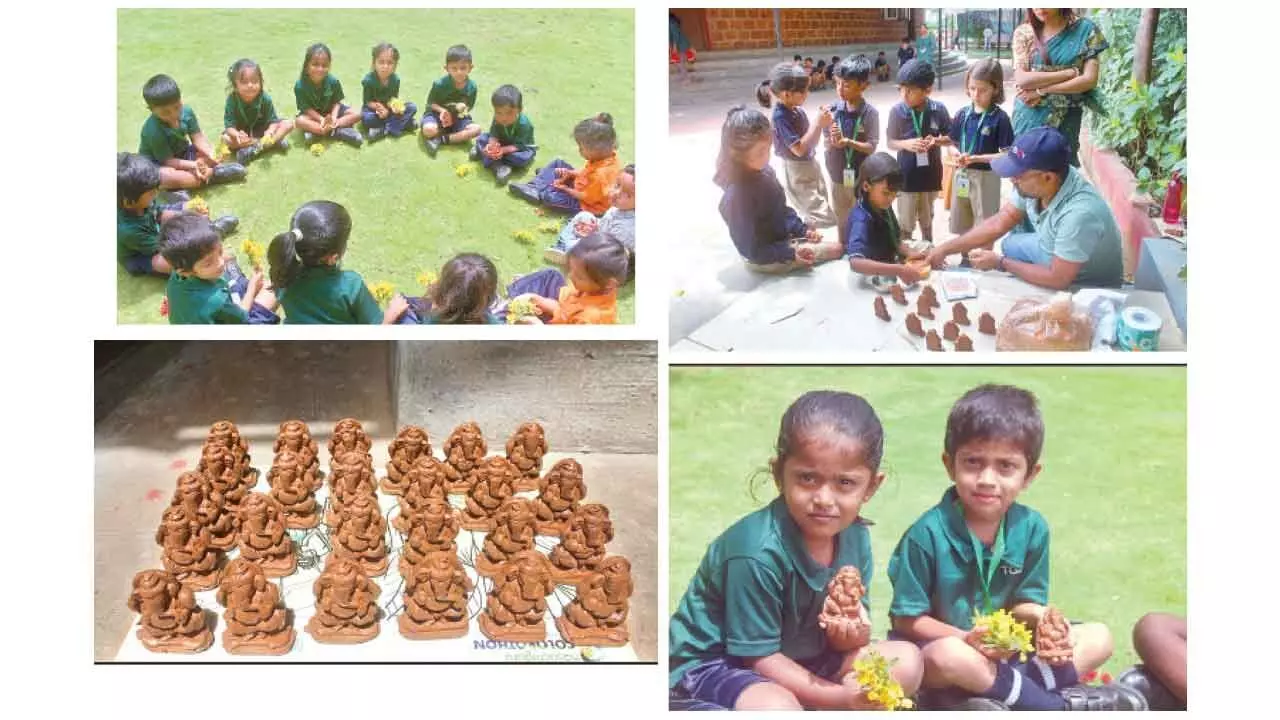
Students at The Green School Bangalore (TGSB) have introduced an innovative way to celebrate Ganesha Chaturthi—by crafting seed-embedded clay idols that grow into flowering plants after immersion. The initiative combines traditional religious practice with scientific research and environmental responsibility, creating a model of sustainability-driven celebration.
Ganesha Chaturthi has long been celebrated with clay and plaster idols, many of which are immersed in lakes and rivers. However, the use of Plaster of Paris (PoP) and chemical paints has caused ecological damage, from rising toxicity levels in water to long-term harm to aquatic biodiversity.
The annual idol-making activity evolved this year into a student-led research initiative. Under faculty guidance, students from kindergarten to Grade 10 studied clay compositions, tested solubility, and examined environmental impact. Senior students conducted sieving and processing of locally sourced lakebed clay, while younger learners experimented with embedding seeds into clay mixtures.
The outcome was a set of 100% biodegradable idols designed not for immersion in water bodies but for planting in soil. Once watered, the idols dissolve naturally, allowing the embedded seeds—such as sunflower and dahlia—to sprout.
The initiative spanned across all grade levels:
• Kindergarten to Grade 2: Students molded small clay idols with teacher support, embedding seeds by hand.
• Grades 3–5: Lessons focused on plant life cycles, linking the embedded seeds to environmental learning.
• Grades 6–8: Middle schoolers conducted clay experiments and tested different natural colorants derived from turmeric and beetroot.
• Grades 9–10: Senior students investigated the ecological impact of idol immersions, comparing biodegradable idols with conventional PoP idols.
Teachers from both science and arts departments collaborated to balance technical research with creative expression, turning the project into a multidisciplinary learning experience.
Beyond sculpting idols, students also engaged in peer-driven storytelling. A Grade 5 student took on the role of “Ganesha’s Voice,” narrating facts about sustainable festival practices and explaining the link between traditional rituals and environmental responsibility. This interactive method was used during workshops to help students connect spirituality with ecological awareness.
By contrast, biodegradable clay idols dissolve within days. When paired with natural dyes and seed embedding, they create a restorative cycle that offsets pollution by contributing to air purification and biodiversity. The planting of seed-embedded idols allows families to mark the festival while nurturing a living symbol of devotion in their homes. Instead of immersion in local water bodies, students and parents will plant the idols in pots or gardens, where they will decompose naturally and give way to new plant life.
For students, the exercise was not only about preserving tradition but also about reinterpreting it through a lens of science and sustainability. Faculty members described the project as a “living legacy,” one that connects cultural rituals with environmental stewardship in tangible ways. The initiative reflects a growing trend in Indian schools to integrate sustainability with cultural education. While festivals remain deeply rooted in tradition, student-driven projects like this illustrate how rituals can evolve without losing their spiritual essence.