Madras High Court Halts Tamil Nadu's Move to Appoint Vice-Chancellors

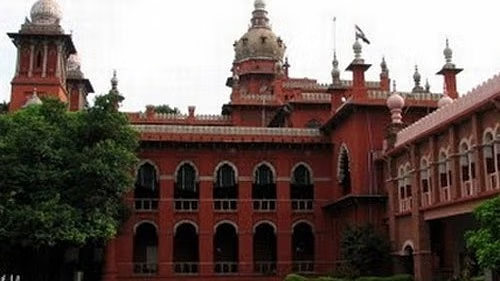
Madras HC halts Tamil Nadu govt's law shifting VC appointment power from Governor to state, amid ongoing legal and political tensions.
A recent legislation by the Tamil Nadu government that aimed to give the state government the power to name vice chancellors (VCs) in state-run universities instead of the governor was temporarily halted by the Madras High Court.
The decision was made by a Division Bench of Justices G.R. Swaminathan and V. Lakshminarayanan, who granted the stay despite strong resistance from the state administration opposing the expedited hearing of the case.
The provision empowering the state government to select venture capitalists (VCs), a function customarily assigned to the governor in his capacity as Chancellor of public universities, is momentarily halted by this legal intervention. In order to give the state more authority over university administration, the amendment was proposed. However, the court's decision highlights persistent conflicts over educational autonomy and governance in Tamil Nadu's university system between the state government and the judiciary.
Regarding the appointment of VCs, the Tamil Nadu government and Governor R.N. Ravi are engaged in a larger legal and political battle that includes the court's ruling. The Supreme Court had earlier this year ordered the parties to settle their disagreements regarding VC appointments. The Tamil Nadu government then announced 10 measures pertaining to universities as laws, giving the state the authority to name and dismiss VCs and designate members for important university bodies. These events have made the ongoing governance debate between the governor and the state administration more intense.
The attempt by the Tamil Nadu government to change university statutes and the ensuing legal disputes demonstrate the intricate relationship that exists between constitutional principles, state power, and educational institutions' autonomy. In order to ascertain the ultimate result and its consequences for the administration of higher education in Tamil Nadu, more court proceedings are expected as the case develops.