People’s Pulse Tracker Poll hints at BJP hat-trick

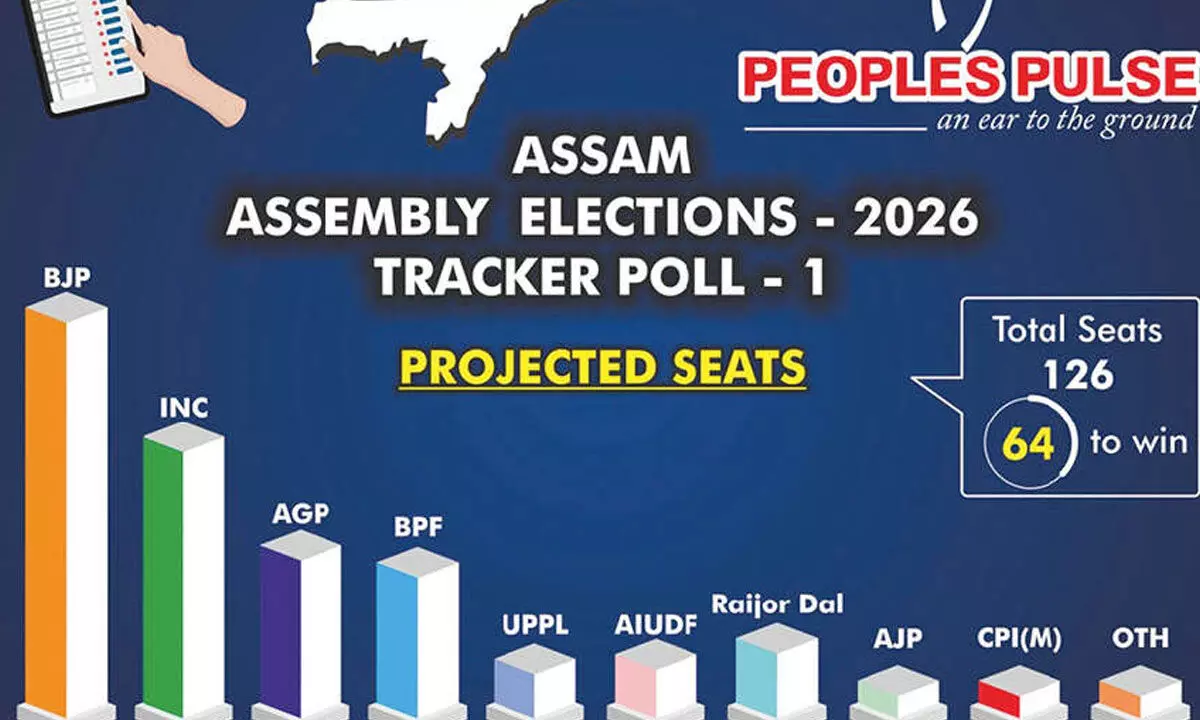
New Delhi: The Bharatiya Janata Party is set to retain power in Assam for a third consecutive term, according to the first Tracker Poll conducted by the People’s Pulse Research Organisation ahead of the 2026 Assembly elections. The survey, carried out between November 15 and December 31, 2025, projects the BJP as the single largest party with 69 to 74 seats in the 126-member Assembly, comfortably crossing the majority mark of 64 on its own. With its National Democratic Alliance partners, the NDA’s overall tally is expected to approach the 90-seat mark, pointing to a decisive mandate amid a fragmented opposition.
Commenting on the findings, political analyst and survey director Dr. Rajan Pandey said the Tracker Poll reflects voter sentiment at a crucial juncture. He noted that the BJP’s projected performance is not merely an outcome of incumbency but the result of sustained political consolidation across communities. According to him, the opposition’s disarray has further cleared the path for the ruling alliance.
The projections reaffirm the BJP’s continued dominance in Assam, built on organisational strength, alliance management, and welfare-driven outreach. The Congress is projected to win between 25 and 29 seats, remaining the principal opposition but falling well short of challenging the ruling party.
Among NDA allies, the Asom Gana Parishad is expected to secure 8 to 11 seats, while the Bodoland People’s Front is projected to win 8 to 10 seats, reinforcing the coalition’s numerical strength. Smaller parties are likely to remain marginal, with the All India United Democratic Front and the United People’s Party Liberal projected at 0 to 2 seats each, Raijor Dal at 1 to 2 seats, and Assam Jatiya Parishad, CPI(M), and others limited to one seat or none.
In vote share terms, the BJP is expected to secure around 39 percent, narrowly ahead of the Congress at 37 percent. Dr. Pandey observed that in a relatively small and politically compact state like Assam, even a two-percentage-point gap can produce a disproportionate difference in seat outcomes. Other parties trail significantly, with AGP projected at 7 percent, BPF at 5.5 percent, AIUDF at 2.5 percent, UPPL at 1.2 percent, Raijor Dal at 0.9 percent, CPI(M) at 0.8 percent, AJP at 0.7 percent, and others together accounting for about 5 percent.
The Congress’s marginal improvement in vote share is attributed largely to the erosion of AIUDF’s support base, particularly among Muslim voters, though delimitation and weaker alliance arithmetic are expected to prevent proportional seat gains.
The chief ministerial preference poll presents a closely fought contest. Himanta Biswa Sarma leads with 30 percent support, followed by Sarbananda Sonowal at 28 percent and Gaurav Gogoi at 27 percent. Other leaders remain far behind, while 7 percent of respondents are undecided or prefer other options.
Dr. Pandey pointed out that although Gogoi enjoys strong personal popularity, especially among certain sections, it has not translated into comparable support for the Congress as a party. He added that Sarma’s narrow lead is strengthened by significant backing from women voters, including among tribal communities, even where male voters show a preference for Sonowal.
On broader public sentiment, the NDA continues to hold a decisive advantage in Assam. When respondents were asked which party is better suited to drive the state’s development, 48 per cent favoured the BJP, compared to 38 per cent for the Congress. A clear majority of 55 per cent believe the BJP is most likely to form the next government, and an equal proportion feel the party deserves another term. According to Dr Pandey, the BJP’s consistent lead across key parameters—development, welfare delivery, leadership preference, party choice and demographic reach—reflects voter endorsement of stability and continuity in governance.
The survey points to the BJP’s steadily expanding social base across communities. Caste Assamese voters largely support the BJP, with smaller sections divided between the Congress and regional parties. Ahom voters are increasingly aligning with the BJP, barring a few pockets in Upper Assam. Other OBC groups display a similar inclination, while Hindu Bengali voters continue to back the BJP strongly, particularly after the implementation of the Citizenship Amendment Act. Muslims, who constitute around 30 per cent of the population, are now overwhelmingly consolidating behind the Congress, accelerating the decline of the AIUDF. Among tribal communities, support for the NDA remains strong, with Bodos backing the BJP–BPF combination and groups such as Misings, Karbis, Dimasas, Deoris, Rabhas and Sonowal Kacharis leaning towards the BJP.
Tea tribe voters, despite some dissatisfaction over unfulfilled promises related to ST status and land pattas, largely remain aligned with the BJP.