Supreme Court gives conditional nod to green crackers

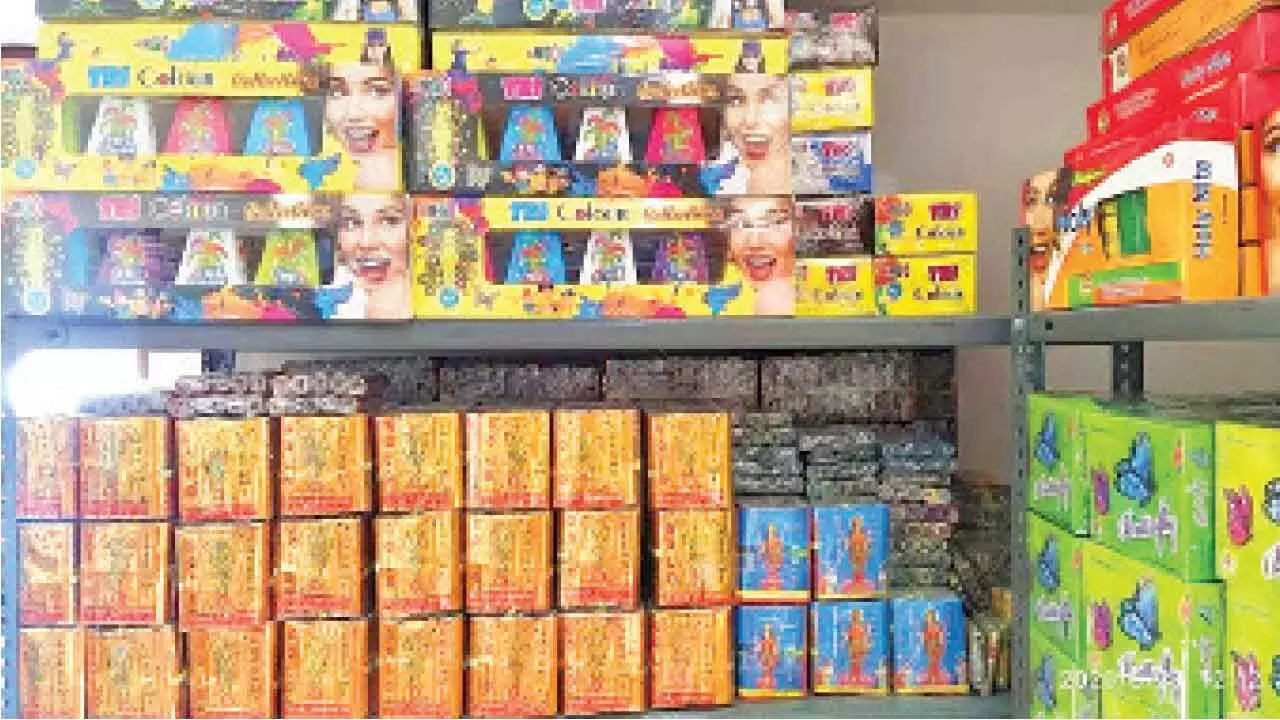
A bench headed by Chief Justice B R Gavai also asked the Centre to take a fresh look at the absolute ban on the manufacture of firecrackers in the Delhi-National Capital Region
The Supreme Court on Friday allowed certified manufacturers to produce green crackers on the condition that their sale is not carried in Delhi-NCR without approval.
A bench headed by Chief Justice B R Gavai also asked the Centre to take a fresh look at the absolute ban on the manufacture of firecrackers in Delhi-National Capital Region (NCR).
The bench, also comprising Justices K Vinod Chandran and N V Anjaria, directed the Ministry of Environment, Forests and Climate Change (MoEFCC) to consult all stakeholders, including the Delhi Government, manufacturers, and sellers, before arriving at a final decision.
“In the meantime, we permit the manufacturers who are having the certification of green crackers as certified by NEERI (National Environmental Engineering Research Institute) as well as PESO (Petroleum and Explosives Safety Organisation) to manufacture. However, this will be subject to an undertaking by the manufacturers to this court that until further orders passed by this court, they would not sell any of their crackers in the prohibited areas," it ordered.
The conditional order permitting certified manufacturers to produce green crackers till the plea is heard again on October 8 on filing of the MoEFCC report on the issue assumes significance as earlier on April 3, a bench headed by former top court judge Justice A S Oka, refused to relax the ban on the manufacture, storage and sale on firecrackers in Delhi-NCR.
Justice Oka had noted that air pollution levels remained alarming for a considerable time and a large section of the population worked on streets and was the worst affected by pollution. On Friday, the CJI-led bench batted for a balanced approach keeping in mind the right to livelihood of workers employed in such manufacturing units and the fact that such a complete ban is hardly implemented fully.
The orders were passed while hearing the 1985 PIL of MC Mehta relating to environmental concerns in Delhi-NCR.
The bench said while curbing pollution was essential, an absolute ban was not “practical or ideal”.
The court illustrated it with the prohibition on mining in Bihar, which inadvertently gave rise to powerful illegal mining mafias.