Supreme Court Questions Rahul Gandhi's Patriotism Over China Territory Claims, Stays Defamation Case

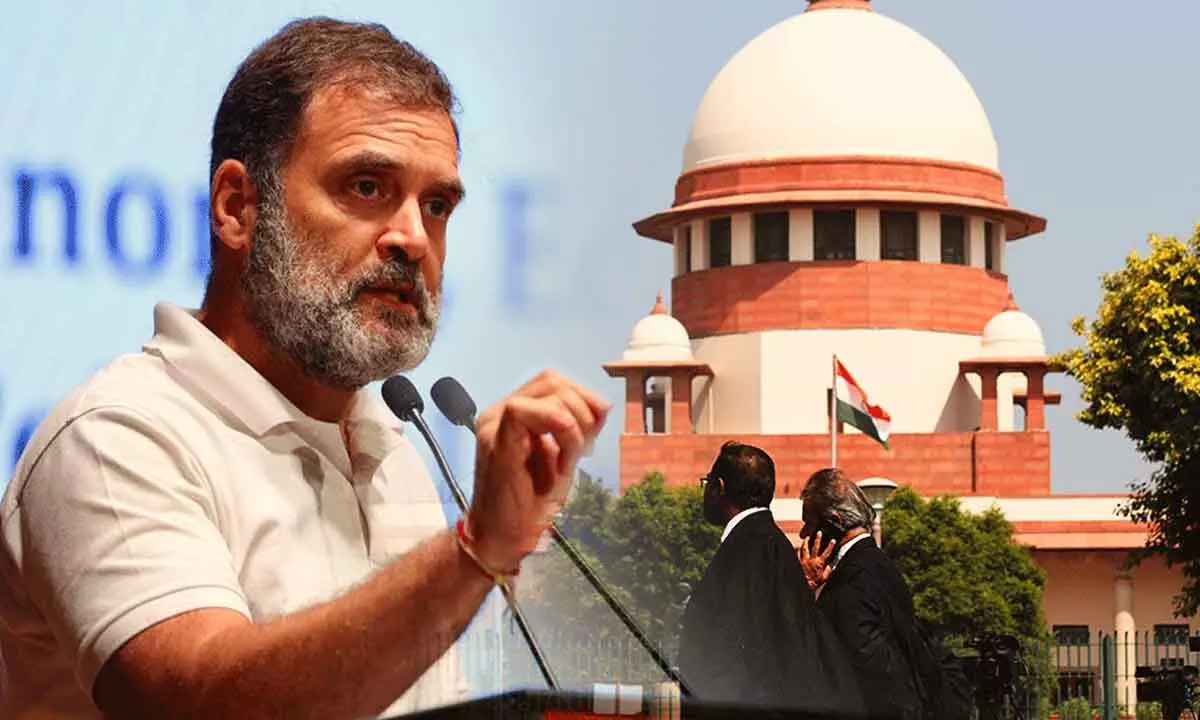
Supreme Court criticizes Congress leader Rahul Gandhi for claiming China annexed 2,000 km of Indian territory, questioning his patriotism while pausing defamation proceedings against him.
The Supreme Court delivered sharp criticism to Congress leader Rahul Gandhi on Monday regarding his assertions that China had seized over 2,000 square kilometers of Indian territory. The justices questioned whether a genuine patriot would make such statements, though they simultaneously halted defamation legal proceedings against the Leader of Opposition.
The controversy stems from Gandhi's statements during his 2022 Bharat Jodo Yatra, where he alleged that Chinese forces had occupied significant portions of Indian land and were physically attacking Indian military personnel in Arunachal Pradesh. The Supreme Court bench, comprising Justices Dipankar Datta and Augustine George Masih, expressed skepticism about the source of Gandhi's information regarding the territorial claims.
The justices questioned Gandhi's approach as the Leader of Opposition, suggesting that such concerns should be raised within Parliament rather than through public statements. They emphasized that his position carries significant responsibility and questioned why he would make such assertions publicly instead of utilizing proper parliamentary channels.
Gandhi had approached the Supreme Court after the Allahabad High Court rejected his petition in May, which challenged both the summoning order and the criminal complaint filed against him. The High Court had previously ruled that freedom of speech does not provide protection for statements that defame the military forces.
The original complaint was filed by Udai Shanker Srivastava, who accused Gandhi of making disparaging comments about the Indian Army during his political campaign. The complainant alleged that Gandhi's remarks were made in the context of ongoing border tensions with China and were detrimental to the armed forces' reputation.
During a 2022 press conference in Rajasthan, Gandhi had criticized the ruling party for allegedly ignoring China's territorial advances and military aggression. He claimed that while media attention focused on internal political matters, insufficient attention was given to what he described as China's capture of Indian territory and violence against Indian soldiers.
Gandhi reiterated similar claims in January 2023 while in Jammu and Kashmir, stating that former military officials had corroborated his assertions about territorial loss. He mentioned meeting with retired army personnel and a delegation from Ladakh who allegedly confirmed that Chinese forces had taken control of significant Indian territory.
The Congress leader also claimed that former military personnel informed him that numerous patrolling points previously under Indian control had been permanently occupied by Chinese forces. These statements formed the basis of the defamation case filed in Uttar Pradesh, which led to a trial court issuing summons against Gandhi.
After receiving the summons, Gandhi approached the Allahabad High Court seeking to have both the proceedings and the summons dismissed. However, the High Court rejected his petition, leading to his appeal to the Supreme Court.
The case highlights the delicate balance between political criticism and statements that may be perceived as harmful to national interests or military morale. While the Supreme Court has stayed the defamation proceedings, the justices' comments reflect concerns about the appropriateness of Gandhi's public statements regarding sensitive border issues.
The matter underscores ongoing political tensions regarding India's border management and the role of opposition leaders in addressing national security concerns. The Supreme Court's intervention suggests that while legal proceedings have been paused, questions remain about the proper channels for raising such sensitive issues in India's democratic framework.