Python Backtesting Pain Points: Data, Execution Assumptions, and Evaluation

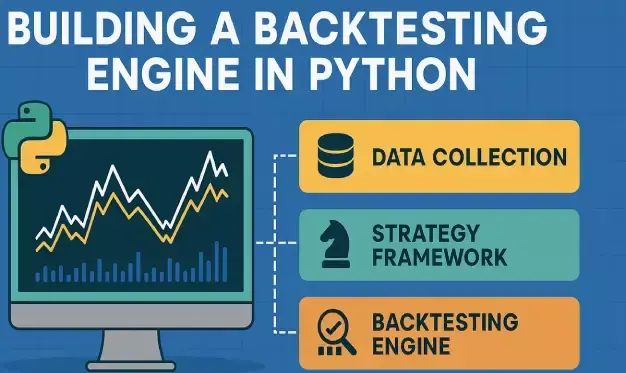
Explore common Python backtesting pain points, including data quality issues, execution assumptions, and evaluation challenges that can impact the accuracy and reliability of trading strategy results.
For many beginners to quantitative markets, the primary triumphing backtest feels almost magical. With only some lines of Python code and a few historical facts, the fairness curve starts off, evolving, rising easily, and self assurance builds quickly. But once the approach goes live, fact regularly tells an exclusive tale. What appeared best in simulation starts to underperform. This hole normally comes from not noted flaws in algorithmic trading backtesting. To construct structures that certainly keep up, investors should carefully address records nice, execution assumptions, and overall performance assessment.
Why Backtesting Is Essential, and Dangerous
At its center, backtesting simulates how a trading strategy could have behaved using historical marketplace information. It permits traders to test thoughts speedily, refine parameters, and estimate risk before committing capital.
Python has come to be the dominant environment for this work. With libraries like Pandas and NumPy, investors can control time-collection data correctly, prototype techniques fast, and visualize consequences with minimum overhead. This accessibility is precisely why such a lot of learners gravitate in the direction of Python-primarily based studies workflows.
However, ease of use creates a false experience of security. Clean-searching equity curves can hide critical structural flaws. The reason for backtesting isn't to show a strategy works, it is to stress-check whether or not the concept might keep up beneath sensible conditions.
That difference is in which many traders cross incorrect.
The Data Dilemma: Garbage In, Garbage Out
Every backtest rests on one foundation: data. If the data is flawed, incomplete, or improperly handled, the resulting performance metrics become unreliable. Financial time-series data is rarely clean straight out of the box.
Data Quality and Sanity Checks
One of the most common issues is missing values, typically represented as NaNs. If these gaps are ignored, calculations such as returns or indicators can break silently. Traders often use forward-filling or row deletion, but both methods must be applied carefully to avoid introducing bias.
Beyond missing data, several sanity checks are essential:
- Duplicate timestamps
- Price spikes that defy market logic
- High prices recorded below low prices
- Sudden volume anomalies
Professional backtesting begins with rigorous data validation. Skipping this step is one of the fastest ways to produce misleading results.
Survivorship Bias: The Hidden Inflator
Survivorship bias is more subtle but equally dangerous. It occurs when traders test strategies only on stocks that exist today, unintentionally excluding companies that were delisted or went bankrupt during the test period.
This creates an artificially strong dataset. The strategy appears more robust simply because the failures have been removed from history.
The proper solution is to use point-in-time datasets that include delisted securities. While harder to obtain, they are essential for realistic research.
Look-Ahead Bias: The Silent Performance Killer
Look-ahead bias is often called the cardinal sin of backtesting. It happens when the model uses information that would not have been available at the moment a trade decision was made.
A classic mistake is triggering a buy signal using the same day’s closing price while assuming execution at the opening price. Python makes data shifting easy but that convenience can accidentally introduce future leakage.
Even a small amount of look-ahead bias can dramatically inflate results. Careful timestamp alignment is non-negotiable in professional backtests.
Execution Assumptions: Where Theory Meets Friction
Even with pristine data, a backtest can still be unrealistic if it assumes perfect execution. Markets are not frictionless, and ignoring trading costs is one of the most common beginner errors.
Transaction Costs and Commissions
Every trade carries expenses: brokerage fees, exchange charges, and taxes. Individually they may seem small, but over hundreds or thousands of trades, they compound quickly.
High-frequency strategies are especially vulnerable. A system that looks profitable before costs can become unviable after realistic fees are applied.
Any serious algorithmic trading backtesting framework must deduct transaction costs from each simulated trade.
Slippage: The Price You Don’t Control
Slippage represents the gap between expected price and actual execution price. It occurs because markets move, liquidity shifts, and orders compete in the queue.
Ignoring slippage creates overly optimistic backtests. Even a modest adjustment, a few basis points per trade can materially change performance metrics.
In python for trading workflows, traders often model slippage by adjusting fill prices or applying spread penalties. While imperfect, this step brings simulations closer to reality.
The Liquidity Constraint
Another common oversight is assuming unlimited liquidity. In reality, large orders cannot always be filled at historical prices.
If a strategy attempts to trade a significant percentage of daily volume in an illiquid stock, the backtest becomes a fantasy. The order would either move the market or remain partially unfilled.
Best practice is to cap simulated order size at a conservative fraction of average daily volume to manage market impact. This simple constraint dramatically improves realism.
Evaluating Performance: Beyond the Equity Curve
Once data and execution assumptions are realistic, the next challenge is interpretation. A rising equity curve alone does not confirm a robust strategy.
The Overfitting Trap
Overfitting occurs when traders excessively tune parameters to historical data. The model begins to memorize noise rather than capture genuine market structure.
This often happens when traders test hundreds of parameter combinations and select the best-performing one. The result looks impressive in-sample but fails out-of-sample.
The primary defense is strict separation between training data and unseen test data. Walk-forward analysis and cross-validation are also widely used in professional workflows.
Risk-Adjusted Metrics Matter
Professional quants rarely judge systems on raw returns alone. Key metrics include:
Sharpe Ratio: Measures return relative to volatility. Higher values generally indicate better risk-adjusted performance, though acceptable ranges vary by strategy type and asset class
Maximum Drawdown (MDD): Captures the worst peak-to-trough loss. This reflects real psychological and capital risk.
CAGR: Shows true compounded growth. Together, these metrics provide a far more complete picture of strategy quality than returns alone.
Vectorized vs. Event-Driven Backtesting
Most traders begin with vectorized backtesting in Pandas because it is fast and convenient. It processes entire datasets at once and works well for simple strategies.
However, vectorized models struggle with:
- Limit orders
- Partial fills
- Intraday execution logic
- Real-time risk controls
As strategies become more sophisticated, traders often migrate to event-driven engines that process data bar by bar. While slower, this approach more closely mirrors live trading conditions.
Practitioners in advanced algorithmic trading programs often encounter this transition.
Bridging the Gap Between Backtest and Reality
Almost every trader experiences the “performance gap” the moment when live results fall short of backtest expectations. This gap usually traces back to one or more of the pain points discussed:
- Imperfect data
- Unrealistic execution assumptions
- Hidden biases
- Overfitting
- Changing market regimes
The goal of algorithmic trading backtesting is not to predict the future with certainty. It is to increase the probability that a strategy possesses a genuine, durable edge.
Understanding this mindset shift separates hobbyists from serious quantitative practitioners.
Case Study: From Manual Trading to Structured Backtesting
Kalpesh Ramoliya built his academic foundation in Mathematics and Applied Statistics before beginning his career as a Data Analyst at TCS. Although his role involved statistical modeling and programming, he wanted work that truly aligned with his passion for numbers and markets. After experiencing losses in manual trading, he became curious about automation and decided to explore algorithmic trading seriously. He enrolled in EPAT, where he strengthened his financial market knowledge and gradually became comfortable with Python. Kalpesh works as a Quantitative Developer for a European hedge fund, managing multi-million-dollar portfolios using statistical and data-driven strategies.
Conclusion: Learning the Right Way Matters
Mastering backtesting requires far more than writing code and plotting returns. It demands disciplined data handling, realistic execution modeling, and rigorous performance evaluation. Traders who overlook these foundations often face disappointing live results.
For those looking to build these capabilities systematically, structured learning can make a significant difference.
Quantra courses follow a modular, flexible format built around a strong “learn by coding” philosophy. Some courses are free for beginners starting in algo or quant trading, though not all Quantra courses are free. The per-course pricing model keeps learning affordable, and the availability of a free starter course makes it easier to begin building practical skills in python for trading and algorithmic trading backtesting.
Live classes, expert faculty & placement support. QuantInsti’s Executive Programme in Algorithmic Trading (EPAT) offers a deeper career-focused pathway. The program highlights alumni career transitions, established hiring networks, and documented testimonials. For traders serious about transitioning into professional quantitative roles, a structured algorithmic trading course like EPAT can provide structured mentorship and practical exposure to support the transition from backtests to live trading systems.