What Is the Breakdown of Costs for SEO Services Provided by a Digital Marketing Agency Focused on E-Commerce Web Development?

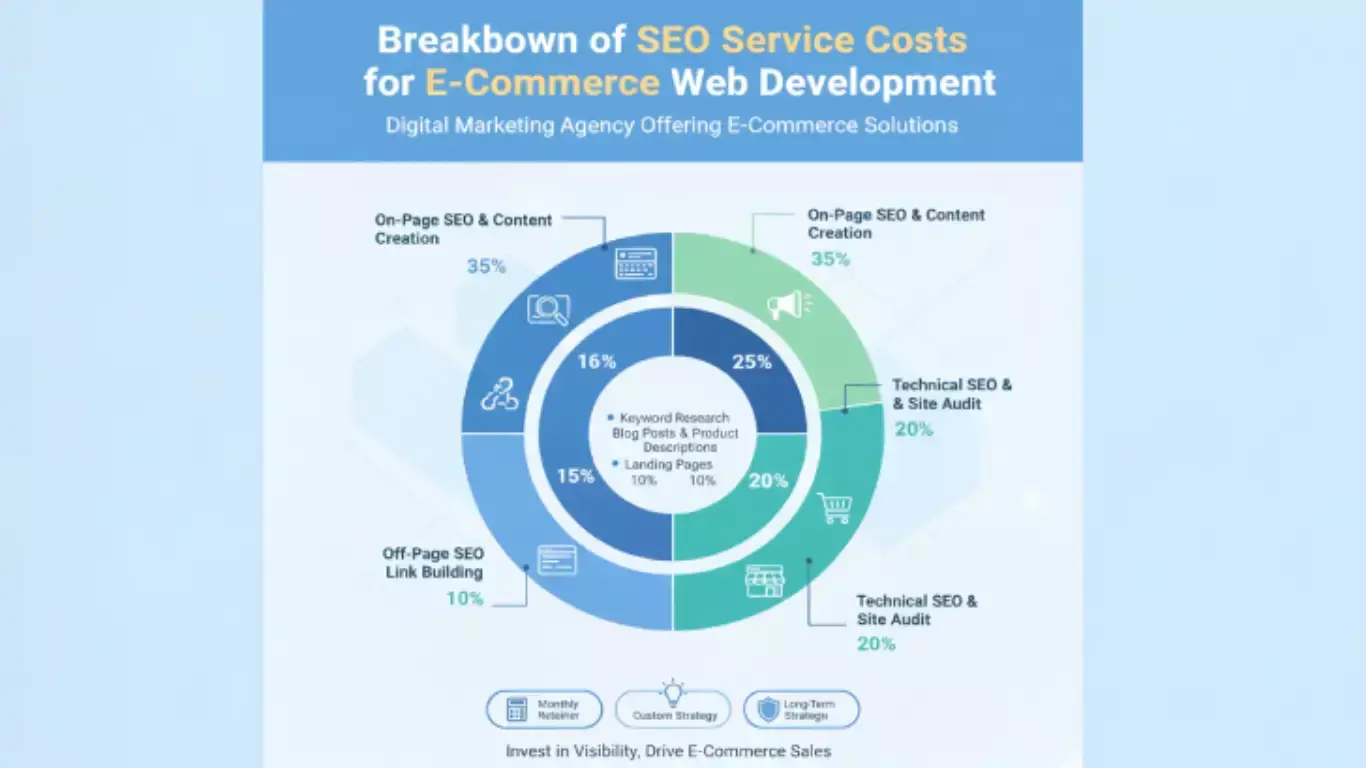
Explore how digital marketing agencies price SEO services for e-commerce web development, with a clear breakdown of costs, deliverables, and ROI.
E-commerce businesses operate in one of the most competitive online environments. Ranking product pages, category pages, and branded content requires a well-planned SEO strategy that goes far beyond basic optimization. When working with a digital marketing agency that specializes in e-commerce web development, understanding how SEO costs are structured becomes essential for accurate budgeting and long-term planning.
SEO pricing for e-commerce is rarely a single flat fee. Instead, it is a combination of strategic planning, technical implementation, content optimization, and ongoing performance management. This article explains the full breakdown of SEO costs in an e-commerce context, helping business owners understand where their budget goes and how each component contributes to growth.
Understanding SEO as a Core Part of E-Commerce Infrastructure
Unlike informational websites, e-commerce platforms depend on SEO to drive product discovery, category visibility, and transactional traffic. SEO influences site architecture, URL structures, filtering systems, and product data presentation. As a result, SEO costs are closely tied to both web development and long-term maintenance.
A digital marketing agency focused on e-commerce typically integrates SEO into every stage of the build and optimization process. This integration affects pricing, as SEO work is distributed across multiple phases rather than treated as a single service.
Initial SEO Discovery and Strategic Planning Costs
The first cost component involves research and planning. For e-commerce sites, this phase is more complex due to large inventories and diverse user intent.
This stage usually includes:
- Keyword research for products, categories, and informational content
- Search intent mapping across the buyer journey
- Competitive landscape analysis
- Site architecture planning aligned with SEO goals
Because these insights shape how categories, filters, and product pages are built, this phase directly impacts web development decisions. Strategic planning costs often represent 10 to 20 percent of the total SEO budget, depending on site size and complexity.
Technical SEO and Platform Optimization Costs
Technical SEO is one of the largest cost components for e-commerce websites. It ensures that search engines can efficiently crawl, index, and rank thousands of pages without performance issues.
Key technical tasks include:
- Optimizing crawl paths for large product catalogs
- Managing duplicate content caused by filters and sorting options
- Implementing canonical tags and pagination logic
- Improving site speed and core web vitals
- Ensuring mobile usability across product and checkout pages
These tasks require close collaboration between SEO specialists and developers, making them a significant part of web development budgets. For many e-commerce projects, technical SEO accounts for 25 to 35 percent of the overall SEO investment.
Site Architecture and Internal Linking Costs
E-commerce SEO relies heavily on logical site architecture and internal linking. Poor structure can prevent search engines from discovering important products or categories.
Costs in this area include:
- Designing SEO-friendly category hierarchies
- Structuring navigation menus for both users and search engines
- Implementing internal linking strategies that distribute authority effectively
- Ensuring deep product pages remain accessible
These changes often require development time, testing, and iteration, particularly for large stores. While not always listed separately, architecture optimization is a major contributor to SEO costs.
On-Page SEO for Category and Product Pages
On-page optimization is another core cost area. Unlike service websites, e-commerce pages must balance SEO requirements with conversion optimization.
On-page SEO costs typically cover:
- Optimizing title tags and meta descriptions at scale
- Structuring headings for category and product pages
- Improving product descriptions for search intent and uniqueness
- Optimizing images with descriptive alt text
- Enhancing schema markup for products, pricing, and reviews
Because e-commerce sites can have hundreds or thousands of pages, on-page SEO pricing often scales with inventory size. This can represent 15 to 25 percent of the SEO budget, depending on scope.
Content Optimization and Expansion Costs
Content plays a growing role in e-commerce SEO, especially for competitive niches. Beyond product pages, agencies often optimize or create supporting content to capture informational and commercial searches.
Content-related SEO costs may include:
- Category page content expansion
- Blog or buying guide optimization
- SEO-driven landing pages for promotions
- Content updates based on seasonal demand
This work often requires collaboration between SEO strategists and content specialists. For e-commerce businesses investing heavily in content, this can account for 10 to 20 percent of total SEO costs.
SEO-Driven UX and Conversion Considerations
While not always labeled as SEO, user experience improvements directly influence search performance. Search engines increasingly reward sites that provide fast, intuitive, and engaging experiences.
Costs in this area may include:
- Improving page load times
- Simplifying navigation and checkout flows
- Enhancing mobile shopping experiences
- Adjusting layouts to improve engagement metrics
These improvements sit at the intersection of SEO, design, and development. As part of a broader digital marketing strategy, they contribute to both rankings and revenue, justifying their inclusion in SEO budgets.
Analytics, Tracking, and Performance Monitoring Costs
Measuring SEO success in e-commerce requires advanced tracking. Basic analytics setups are often insufficient for understanding how organic traffic contributes to sales.
SEO analytics costs may include:
- Enhanced e-commerce tracking configuration
- Conversion and revenue attribution setup
- Monitoring keyword and category performance
- Regular reporting and insights analysis
These tasks ensure that SEO efforts align with business goals and help agencies refine strategies over time. Analytics and monitoring often represent 5 to 10 percent of the SEO budget but are critical for long-term optimization.
Ongoing SEO Maintenance and Optimization Costs
SEO for e-commerce is not a one-time investment. Search trends, inventory changes, and algorithm updates require continuous attention.
Ongoing SEO costs typically cover:
- Monitoring technical health
- Updating product and category pages
- Addressing crawl and indexation issues
- Adapting strategies to new search behaviors
Monthly SEO retainers are common for e-commerce brands, as consistent optimization is necessary to maintain and improve rankings. These ongoing costs are often a separate budget line from initial setup.
How SEO Costs Scale With E-Commerce Growth
As an e-commerce business grows, SEO costs often increase proportionally. Expanding product lines, entering new markets, or adding international versions of a site introduces new optimization requirements.
This scalability affects how much does SEO cost? over time. While initial investments build a strong foundation, ongoing growth requires additional resources to support new pages, languages, and search features.
Balancing SEO Costs With Overall Digital Marketing Spend
SEO should not be viewed in isolation. A digital marketing agency often aligns SEO with paid media, email marketing, and conversion optimization to maximize overall ROI.
When budgeting, businesses should consider how SEO supports broader digital marketing goals. Strong organic visibility can reduce reliance on paid advertising, offsetting SEO costs over the long term.
Conclusion
The breakdown of SEO costs for e-commerce websites reflects the complexity of selling products online at scale. From strategic planning and technical optimization to content development and ongoing performance monitoring, each component plays a vital role in driving sustainable growth.
Understanding how SEO integrates with web development and overall digital marketing efforts helps businesses budget more effectively and avoid unexpected expenses. Rather than asking only how much does SEO cost?, e-commerce brands should focus on how each investment contributes to visibility, conversions, and long-term profitability.
When managed by an experienced agency, SEO becomes a strategic asset that supports every stage of the e-commerce journey, delivering value well beyond initial costs.