Be cautious amid currency swings, mixed global signals

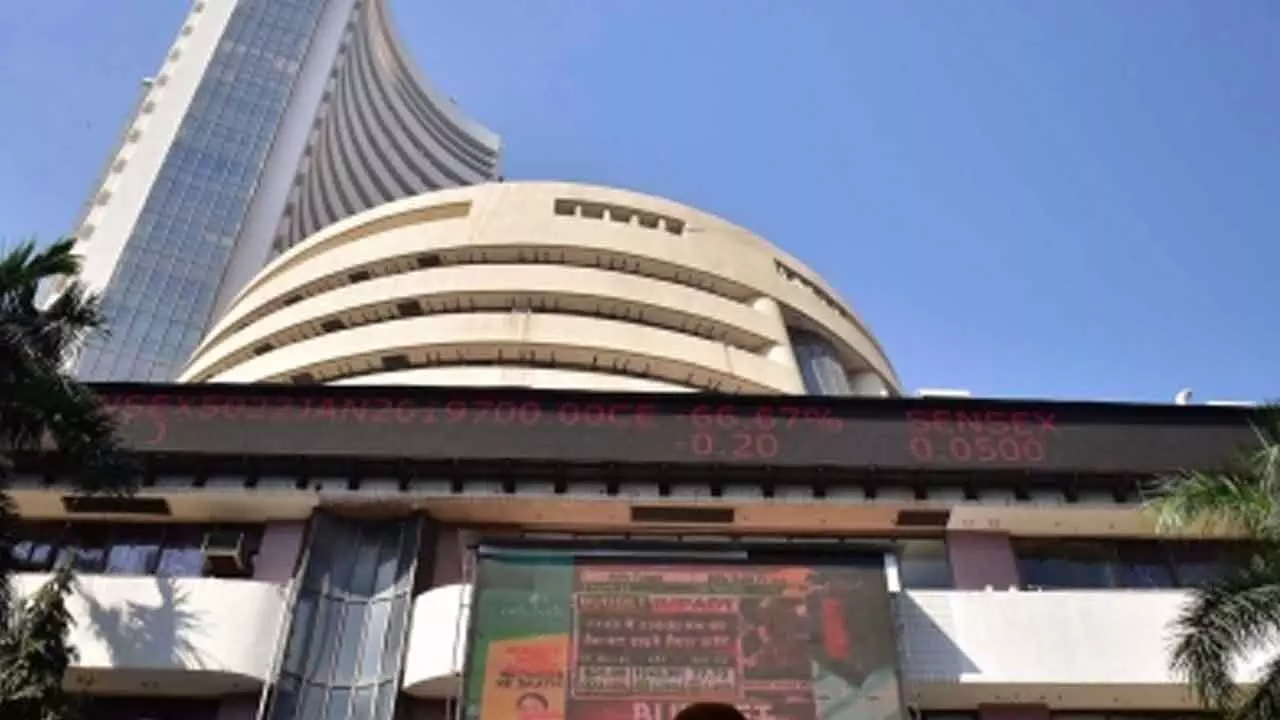
Spookedby ongoing uncertainty surrounding the US–India trade deal and threats of fresh round of tariffs by Mexico, further rupee depreciation against the dollar, persistent FII outflows and weak sentiment in broader market; the benchmark indices ended lower during the week ended.
The Sensex shed 444.71 points or 0.51 per cent at 85,267.66, while Nifty fell 139.5 points or 0.53 per cent at 26,046.95. In the broader market, the BSE Mid-cap Index shed 0.3 per cent and the BSE Small-cap index fell 0.4 per cent. On the sectoral front, the Nifty Defence index shed 3 per cent; however, the Nifty Media, Nifty PSU Bank, Nifty IT, and Nifty FMCG were down between 1-1.7 per cent. On the other hand, the Nifty Metal index rose 2 per cent, and the Nifty Consumer Durables added 0.4 per cent.
The FIIs sold equities worth Rs 9,201.89 crore. However, the DIIs’ continued their support by buying equities worth Rs 20,184.70 crore. It is pertinent to observe that FIIs have been net sellers on 141 of 234 trading days this calendar year and is second only to 2008, when sell days peaked at 154 amid the global financial crisis. Till date net FII out flows are at Rs 1,52,273 crore. Spread across 234 trading days of six hours each, this translates to about Rs110 crore exiting the market every trading hour. By any measure, 2025 ranks among the toughest years for Indian equities in nearly two decades in terms of foreign participation.
Yet, the market impact has been far milder than in past episodes of sustained FPI exodus. The Indian rupee has extended its fall against the US dollar as it touched a fresh record low of 90.56 during the week and ended 43 paise lower at 90.42. With global yields climbing, Indian bonds are facing stress from the unwinding of the USD and JPY carry trades. The tailwind from monetary easing by RBI is being supported by continuing reform momentum - labour codes, end of QCOs and EoDB.
Decisive signals from the RBI have restarted the credit channel, the most important driver of monetary transmission, in addition to lower rates helping loan demand. Observers feel that as policy targets economic slack, growth can remain above trend for longer without generating inflation. The GST changes implemented in Sep’25 were not only a fiscal boost to growth, but also a simplification (fewer slabs), and make the government’s stance more contemporary. The incessant structural pressure of Chinese exports (to India’s export markets) and higher global capital costs are challenges, but not enough to derail growth.
India to remain the fastest growing economy with 7.5 per cent growth in FY27E. Developments related to India–US trade discussions will also remain in focus. The spate of new listings is reshaping the market: in the past five years, 126 new entrants to the BSE500 have added 21 per cent to incremental market capitalization. The IPO market is well-positioned to gain further momentum in the second half of the calendar year with a robust pipeline.
The pipeline of issues continues to be healthy as 74 companies, holding SEBI approval waiting to hit the market, while another 104 are awaiting SEBI approval. Some marquee names who have filed DRHP include Imagine Marketing (boaT), Manipal Payment and Identity Solutions and Shadowfax Technologies. Market performance is usually driven by swings in P/E multiples, while the likelihood of improving earnings should keep the market well supported.
Follow market trends and history. Don’t speculate that this particular time will be any different. For example, a major key to investing in a specific stock is its performance over five years.
FUTURES & OPTIONS / SECTOR WATCH
Amidst heightened volatility, continued foreign fund outflows and a sharp fall in the rupee; derivative segment witnessed fresh shorts and during the early part of week ended the Nifty slipped below its rollover range of 26,050–26,100. However, after the Fed’s rate cut announcement, the Nifty rebounded later in the week but both the Nifty and the Bank Nifty still closed the week with a loss of around half a per cent. In the options segment, the highest Call open interest for Nifty was observed at the 26,500 and 26,200 strike levels whereas notable Put open interest was concentrated at the 26,000 and 25,800 strikes. For Bank Nifty, significant Call open interest was seen at the 60,000 and 59,500 strikes with substantial Put open interest at the 59,500 and 59,000 strikes. Implied volatility (IV) for Nifty’s Call options settled at 9.11 per cent while Put options concluded at 10.23 per cent. The India VIX, a key indicator of market volatility declined by -2.01 per cent to 10.11, reflecting continued complacency and low hedging demand. India The Put-Call Ratio Open Interest (PCR OI) stood at 1.07 for the week. Given the current technical picture, the coming week may see a cautious-to-flat start. Key resistance lies at 26,200 and 26,300, followed by a stronger barrier near 26,550. On the downside, immediate support is at 25,750, followed by the 25,600 zone. Market players should stay selective and maintain a balanced approach amid ongoing currency volatility and mixed global cues. Besides, traders should avoid chasing stocks facing negative news flow in anticipation of a rebound and wait for clear signs of stability before taking fresh exposure.
Stocks looking good are AU Bank, Godrej Consumer, HDFC Life, Phoenix Ltd, Voltas and VBL. Stocks looking weak are BDL, Dabur, JSW Energy, Trent, Zydus Life and PI Inds.
(The author is a senior maket analyst and former vice-chairman, Andhra Pradesh State Planning Board)