




- CM Revanth alleges secret understanding between BRS and BJP
- Congress seeks CPI support for Graduate MLC polls
- HYDRAA completes restoration of Sunnam Cheruvu in Madhapur
- Tummidihetti Project gets fresh push, Fadnavis agrees for talks
- Centre prohibits reuse of single-use medical devices
- HCA multi-crore scam: CID charge sheet names Ex-Chief Jagan Mohan Rao
- Harish Rao slams CM Revanth over water crisis
- KTR commends Raghunandan for developing Mallaram govt school
Hyd builds homes, but where is the water?
In Short
CREDAI seeks ring-fencing of impact fees, STP power subsidies and a major infra push as water security emerges as a key challenge for the city’s fast-growing residential corridors

Share :
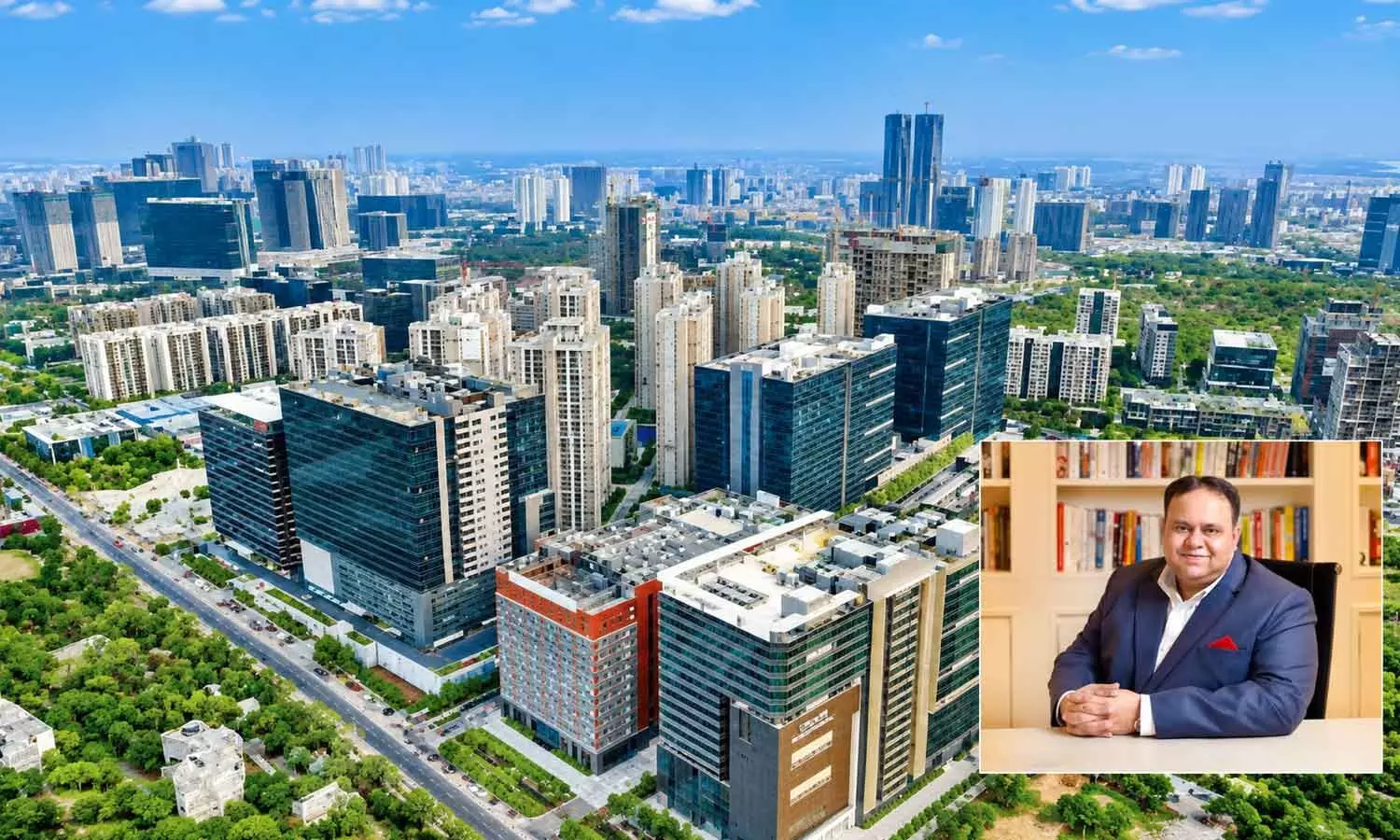
Hyderabad’s skyline is rising rapidly, but can its water supply keep pace with the city’s booming growth? Photo: Adula Krishna [Inset Pic: B Jagannath Rao, president-elect, CREDAI]
Hyderabad: Hyderabad’s real estate boom could hit a roadblock if water infrastructure fails to keep pace with the rapid expansion of apartments, gated communities and townships. With borewells and private tankers filling gaps in municipal supply across several growth corridors, the question is whether the city can reliably provide water to its growing population.
B Jagannath Rao, president-elect of the Confederation of Real Estate Developers’ Associations of India (CREDAI), says Hyderabad cannot sustain its expansion by depending indefinitely on groundwater extraction and tanker supplies.
“Relying indefinitely on deep borewells and private tankers is not a sustainable primary operational model. Borewells should serve strictly as secondary or emergency backups,” he says.
Rao calls for greater public investment in water pipelines and sewerage networks, better utilisation of infrastructure impact fees and financial incentives to ensure residential sewage treatment plants (STPs) remain operational after projects are handed over to homeowners.
Water security is increasingly becoming a primary consideration for homebuyers, particularly in the western corridors and peripheral municipalities, where demand is rising rapidly. While developers are incorporating recycling systems and rainwater harvesting, infrastructure availability and its long-term operation remain critical.
Impact fees must fund infrastructure
CREDAI wants the government to ring-fence infrastructure charges collected from developers, including City Level Infrastructure Impact Fees, Road Impact Fees and Special Impact Fees, and direct them towards roads, water pipelines, sewerage networks and power infrastructure.
“CREDAI strongly urges the government to ring-fence and strictly channel these collections directly into localised and macro infrastructure projects,” Jagannath Rao says. He says high-density peripheral corridors need large-scale public investment to extend municipal water supply, drainage trunk routes and power capacity. Project approvals must also be better aligned with the rollout of Hyderabad Metropolitan Water Supply and Sewerage Board (HMWSSB) bulk supply mains and drainage networks. While government master plans envisage an expansion of water supply capacity, CREDAI believes infrastructure must keep pace with development rather than follow it.
Recycling can cut freshwater demand by 40%
Wastewater recycling offers a practical way to reduce pressure on municipal supplies and groundwater. “By recycling greywater and blackwater for non-potable uses like toilet flushing, cooling towers and landscaping, communities cut total freshwater demand by 30% to 40%, drastically reducing tanker dependence and relieving pressure on local aquifers,” Rao says.
He says nearly 100% of newly launched, high-density residential projects developed by organised CREDAI members incorporate dual-piping systems and on-site STPs designed to recycle wastewater for non-potable uses.
Traditional, unmonitored consumption in large gated communities ranges from 135 to 150 litres per capita per day (LPCD). Low-flow aerated fixtures, dual-flush systems and recycled water for non-drinking applications can bring freshwater consumption down to 85-90 LPCD, he says.
“When these operational expenses become financially painful, communities are tempted to under-operate or bypass their treatment plants, rendering valuable, high-grade infrastructure underutilised during critical dry months,” Rao says.
He proposes subsidised electricity tariffs or green rebates for residential associations that continuously operate STPs, along with property tax concessions and discounted bulk municipal water rates for communities meeting certified sustainability standards.
CREDAI also wants HMWSSB to introduce buy-back arrangements for surplus treated wastewater supplied by residential communities for construction, industrial and municipal uses.
“By introducing these financial and operational rebates, the government can ensure that the infrastructure designed and built by developers remains fully operational, financially viable for residents, and actively functional during water scarcity periods,” Rao says.
Treated water needs reliable supply
The proposed mandatory use of treated wastewater for construction and landscaping from November 1 will require dependable supply arrangements, transparent pricing and effective delivery systems. Rao says developers are registering private STPs with HMWSSB and adapting construction-site processes to accept recycled water. However, he stresses the need for dedicated “Green Water Tanker” fleets, digital platforms matching supply with demand, clear quality standards and predictable delivery schedules.
CREDAI also wants an integrated recycled-water grid, with pipelines transporting surplus treated water from decentralised STPs to industrial hubs, public parks and construction sites. This would create a reliable market for recycled water and reduce dependence on freshwater.
Lake protection and water audits
Rapid concretisation and shrinking open spaces have increased concerns over groundwater recharge and stormwater management. Developers must respect statutory buffer zones around lakes and natural drainage channels and provide rainwater harvesting pits, percolation shafts and green spaces within projects. The association supports voluntary independent water audits for large residential developments, covering per-capita consumption, STP discharge quality, recycling efficiency and groundwater recharge. CREDAI proposes a common Water Sustainability Framework for members, with standards for STP operation, dual plumbing, rainwater recharge and consumption benchmarks.
On linking building permissions and occupancy certificates to water infrastructure, Rao supports verification of installed facilities but wants time-bound inspections.
“Inspections should follow a clear, time-bound checklist to ensure compliance without stalling final handovers to homebuyers,” he says.
Andhra Pradesh: ZPTC, MPTC polls may be postponed to November 5
El Nino impact: Revanth sounds alarm over prolonged drought in state
Revanth to host dinner meet in Delhi ahead of Global Summit
Jio IPO scripts global record with 1.39 cr applications
IMD warns of thunderstorms, gusty winds in Telangana
Needless row over Jaishankar-Rubio meeting in Mumbai


