A critical illumination of eternal wisdom

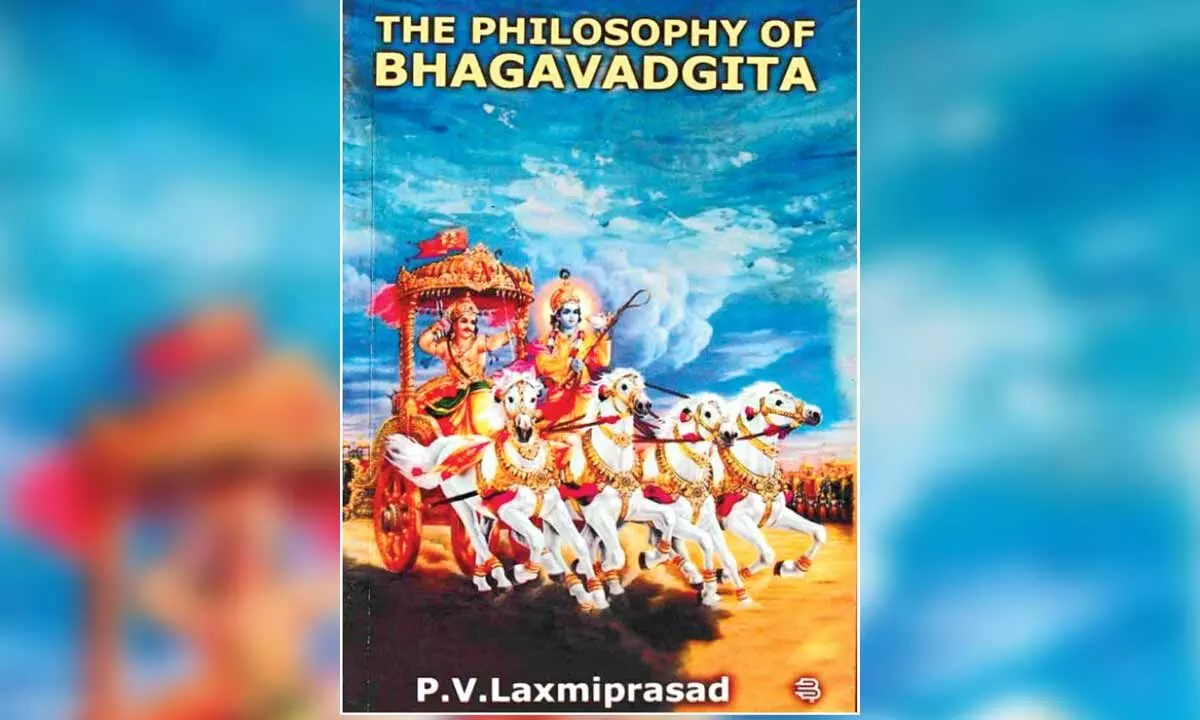
‘The Philosophy of Bhagavadgita’ by P V Laxmiprasad is a thoughtful exploration of the timeless dialogue between Krishna and Arjuna in ‘Bhagavadgita’. Blending scholarship with devotion, the book makes complex philosophy accessible to modern readers. It illuminates the Gita’s enduring relevance as a guide to self-knowledge, action, and inner balance
The ‘Bhagavadgita’, the timeless dialogue between Lord Krishna and Arjuna, has inspired philosophers, saints, and seekers for centuries. In his book ‘The Philosophy of Bhagavadgita’, P.V. Laxmiprasad undertakes the formidable task of reintegrating its essence for contemporary readers. With his background as an erudite scholar and literary critic, Laxmiprasad weaves a study that is both accessible and profound, reflecting his lifelong devotion to this sacred text.
The book opens with a reflective preface, where the author confesses his personal journey with ‘Bhagavadgita’—first encountered through recitations and later internalised through study and meditation. This confessional tone adds warmth, reminding the reader that philosophy, however abstract, springs from lived experience. Laxmiprasad is modest about his authority, yet what he offers is the passion of a lifelong learner—an approach that makes the book appealing to both scholars and general readers.
The early chapters trace the roots of Indian philosophy, situating ‘Bhagavadgita’ within the wider context of Vedantic, Upanishadic, and classical traditions. Philosophy, as he observes, is “the mother of all sciences,” aiming to clarify life and its deepest values. This contextual groundwork helps the reader appreciate why ‘Bhagavadgita’ has endured—not as a mere scripture of ritual, but as a universal guide to self-knowledge, action, and liberation. The core section on the philosophy of ‘Bhagavadgita’ is the book’s immense strength.
Laxmiprasad highlights the text’s unique placement in the Mahabharata—a dialogue delivered on the battlefield, where Arjuna confronts despair and moral paralysis. By interpreting this moment as symbolic of every human being’s inner battles, the author underscores ‘Bhagavadgita’’s universal relevance. He draws on Krishna’s teachings of Nishkama Karma (selfless action), the impermanence of the body, the eternality of the soul, and the need for balance among the three Gunas—Sattva, Rajas, and Tamas. A particularly engaging aspect is his exploration of ‘Bhagavadgita’’s global influence. He notes that figures like Albert Einstein and Swami Vivekananda, as well as modern thinkers, drew inspiration from its verses. By bridging spirituality with science and faith with philosophy, the book illustrates ‘Bhagavadgita’’s continued vitality in a fragmented modern world.
Stylistically, Laxmiprasad blends textual analysis with selected Slokas, often quoting both Sanskrit and English renderings. This lends authenticity while keeping the philosophical arguments grounded. At the same time, he avoids overwhelming jargon, making the work approachable for readers unfamiliar with Indian philosophy.
The conclusion of the book is both relevant and practical. For Laxmiprasad, ‘Bhagavadgita’ is not simply a religious text but a guide to the science of self-realisation. He insists that its message—recognition of the eternal soul, cooperation between the individual and the universal, and the path of disciplined action—remains both revelatory and revolutionary. By affirming that “wherever there is Krishna and Arjuna, there is victory and peace,” the book resonates with timeless optimism.
Ultimately, ‘The Philosophy of Bhagavadgita’ is not just a commentary but a heartfelt offering. Laxmiprasad succeeds in making a classical text relevant to the modern seeker, reminding us that the dialogue of Kurukshetra is as much about our inner conflicts as it is about an ancient war. The book remains a lucid, insightful, and devotional exposition of one of humanity’s greatest philosophical treasures.