A distinctive vocalist & a dynamic mridangam artiste – Sivaanand Malladi

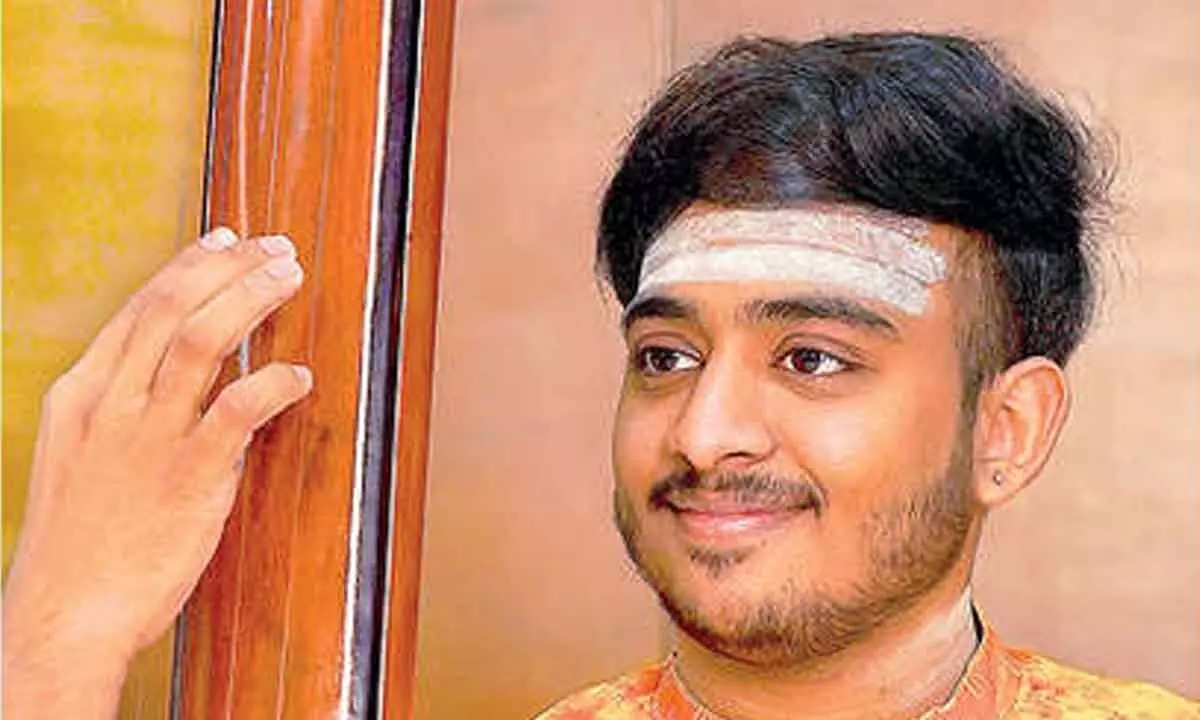
Sivaanand Malladi’s brilliance as both a Carnatic vocalist and mridangam artiste is truly remarkable. A youth icon, he embodies a wholesome blend of extraordinary talent, relentless hard work, and natural dynamism that enables him to connect instantly with audiences. “The secret to progress is to fall in love with the process,” he says—and his musical journey reflects that love in every step.
Over the past five years, Sivaanand has performed widely across India, earning prestigious recognitions including Yuva Ratna, Yuva Puraskar, Upcoming Young Artist Talent Award, Champa Narayan Award, Nada Pallava, Best Junior Male Vocalist, and the Kalasagaram Tambura Prize. In 2025, he was honoured with both Best Senior Vocalist and Best Senior Mridangist by Shanmukhananda Sangeetha Sabha. He has also won 15 national first prizes and 5 national second prizes from the Association of Indian Universities (AIU).
His acclaimed performances include the Nita Mukesh Ambani Cultural Centre, Mumbai; SIFAS, Singapore; Ramotsav, Ayodhya; Spirit of Youth Festival, Madras; and the Maha Kumbh Mela, Prayagraj (2025).
What were your initial influences of being born into such an illustrious family with a rich legacy?
My musical journey began with my mother, Smt. Nagalakshmi, whose patience and guidance laid my foundation. She is my first guru, inspiration, and role model. Later, I began my formal training under my father, Dr. Malladi Ravikumar, who, despite his demanding career as a performing artist, has taught me with immense patience and love. His lessons go far beyond technique—he instills discipline, devotion, and a deep understanding of music and life itself. Every moment with him is like a masterclass.
I also draw immense strength from my grandfather, Vidwan Malladi Suribabu, and my peddananna, Malladi Sriram Prasad, who, as part of the renowned Malladi Brothers duo, carry forward our family’s legacy with distinction. Being born into such an environment naturally nurtured in me a deep love and respect for Carnatic music.
Equally special to me is my younger sister, Sindhu Rageswari. She is my closest musical companion—we share the stage in a unique way: when I sing, she plays the violin, and when she sings, I accompany her on the mridangam. This bond brings me immense joy and enriches my journey. For me, my parents are my Parvathi Parameshwara. Whatever I am today is because of their dedication, guidance, and unconditional support.
As a vocalist and mridangist, talk about your manodharma aspect and musical journey.
Manodharma (creative improvisation) and laya (rhythm) form the heart of my musical expression. I firmly believe that vocal music and mridangam complement each other—learning vocal makes me more sensitive as a percussionist, while playing mridangam sharpens my rhythmic awareness as a singer.
My journey with the mridangam began at the age of three, inspired by my revered mama, Vidwan Burra Sriram. Later, I had the privilege of learning under the late Shri M. L. N. Raju, who patiently laid a strong foundation for me. I also learned alongside my elder brother, Malladi Aravind, which made the process even more special. Currently, I am blessed to train under Vidwan Shri Tumkur B. Ravi Shankar, whose artistry, dedication, and humility deeply inspire me.
This dual path of vocal and mridangam has helped me experience music both melodically and rhythmically, giving me a more holistic connection with the art.
Talk about your practice hours—how do you divide between vocal and mridangam?
A: Singing with the tambura is my favourite part of practice. The tambura gives me a divine, immersive experience—I often feel like I could hold it forever. My vocal practice happens under my father’s constant guidance; whenever I sing, he not only corrects me but also accompanies me on the mridangam, which gives me a complete sense of concert dynamics. Similarly, when I practice mridangam, he sings for me, allowing me to experience the beauty of being both accompanist and main performer.
Practicing with my sister Sindhu is another blessing—we constantly exchange ideas, learn together, and inspire each other to grow. This environment of shared learning makes practice both disciplined and joyful.