Folk aesthetics in Modernism: Jamini Roy’s unique vision

Jamini Roy’s pioneering art redefined Indian modernism by embracing folk aesthetics, moving away from Western academic styles. His unique vision, deeply inspired by the Santhal tribe and Kalighat paintings, celebrated indigenous traditions with bold forms, earthy colors, and evocative themes
Jamini Roy is known for his pioneering contribution during the art movement which has reconnected with the country’s roots. His style of paintings have focused on folk traditions which are different from the dominated western academic style during the colonial period. Among the major influences that have shaped his work, the Santhal tribe holds a unique place. The rich traditions, vibrant lifestyle, simplicity of the community has been reflected in his work.
Representation of Santhals
The Santhals are one of the largest janjatiya communities in Bharat, primarily inhabited in the regions of Bengal, Odisha, Bihar, and Jharkhand. The community is well known for their proximity with nature, festivals and unique lifestyle. Santhals have a vibrant cultural heritage which includes music, dance and oral traditions.
Jamini Roy’s work represents his fascination towards their simplicity and lifestyle expressions. During the freedom struggle his work encountered colonial cultural domination by beautiful depiction of local identities and art forms.
Roy portrayed Santhal men and women engaged in activities like harvesting, dancing, and playing musical instruments. These paintings exude a sense of joy and rhythm, capturing the spirit that is central to Santhal life. One of his iconic works features a group of Santhal women dancing in a circle, their movements fluid and harmonious, symbolizing the unity and vitality of their culture He often depicted them against the backdrop of lush greenery, fields, or rural landscapes, emphasizing their coexistence with the natural world. Images of mothers with children, couples working together, and siblings sharing a tender moment reflect the close-knit relationships that define Santhal society.
Jamini Roy abandoned the realism and perspective of European art in favor of bold, simplified forms and flat compositions. His Santhal figures are characterized by strong, sweeping lines, geometric shapes, and minimal detailing. This stylistic choice reflects the influence of Kalighat pat paintings and the tribal art forms of Bengal, which emphasize clarity and directness. The color palette in his arkworks is earthy and vibrant, dominated by ochres, reds, greens, and blues. These colors not only reflect the natural surroundings of the local but also evoke the raw, unpretentious quality of their lives. Roy often used natural pigments, staying true to the materials used in traditional folk art. The reflection is from the intricate designs on their clothing to the rhythmic arrangement of their postures, his paintings are rich in ornamental details that enhance their visual appeal.
Varied themes
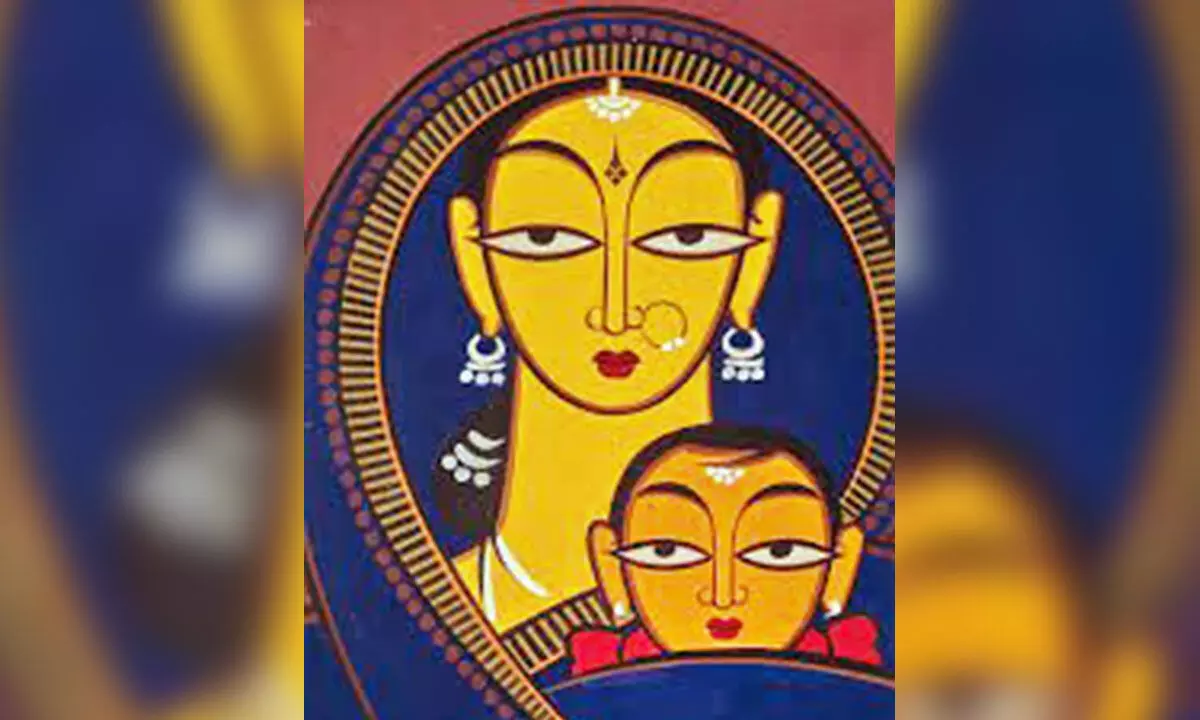
Another unique feature of his iconic works are Mother and Child paintings, embodying the universal theme of maternal love and care. The mother is often depicted with large, almond-shaped eyes and serene expressions, holding her child tenderly in her arms. The figures are adorned with minimal yet intricate patterns, reflecting rural aesthetics.
Roy’s Mother and Child series conveys a sense of intimacy, spirituality, deep connection with nature and love for Mother Earth. The theme draws parallels to depictions of motherhood in Indian culture, celebrating the nurturing essence of womanhood in a way that resonates deeply with cultural values.
One more interesting feature of his work include animals, among them were horses, cats with prawns/lobster, elephants, peacocks and cows. The most adorned paintings are inspired by Kalighat paintings with bold compositions.
Roy’s work on animal themes has a greater attraction to young children. The geometric pattern of representation of these animals is interesting and appealing. Through his representation of animals, Jamini Roy connected traditional storytelling with modernist aesthetics.
Exclusive Museum
Jamini Roy’s home in Ballygunge Place, Kolkata, has been converted into a museum to honor his legacy and showcase his work by Delhi Art Gallery. The museum, in a built-up area of 7,284.17sqft across three floors, is equipped with state-of-the-art galleries to house the permanent collection as well as rotating exhibitions. It will also have a resource centre and a library, art workshops and event spaces, as well as a museum shop and café to complete the visitor experience.This space preserves the essence of his life and art, providing visitors with an intimate glimpse into his creative journey. The museum displays his personal belongings, letters, sketches, and several original paintings, reflecting his deep connection to Indian folk traditions and cultural heritage.
Jamini Roy’s Collection
in NGMA
The National Gallery of Modern Art (NGMA) houses a significant collection of Jamini Roy’s works, making it one of the most comprehensive repositories of his art. There are around 200 of his works, which include his iconic depictions of rural life, Santhal themes, animal themes and mother-and-child compositions. NGMA’s collection highlights Roy’s transition from academic realism to his distinct folk-inspired style, celebrating his contributions to Indian modern art.