Vadhan’s Blockbuster

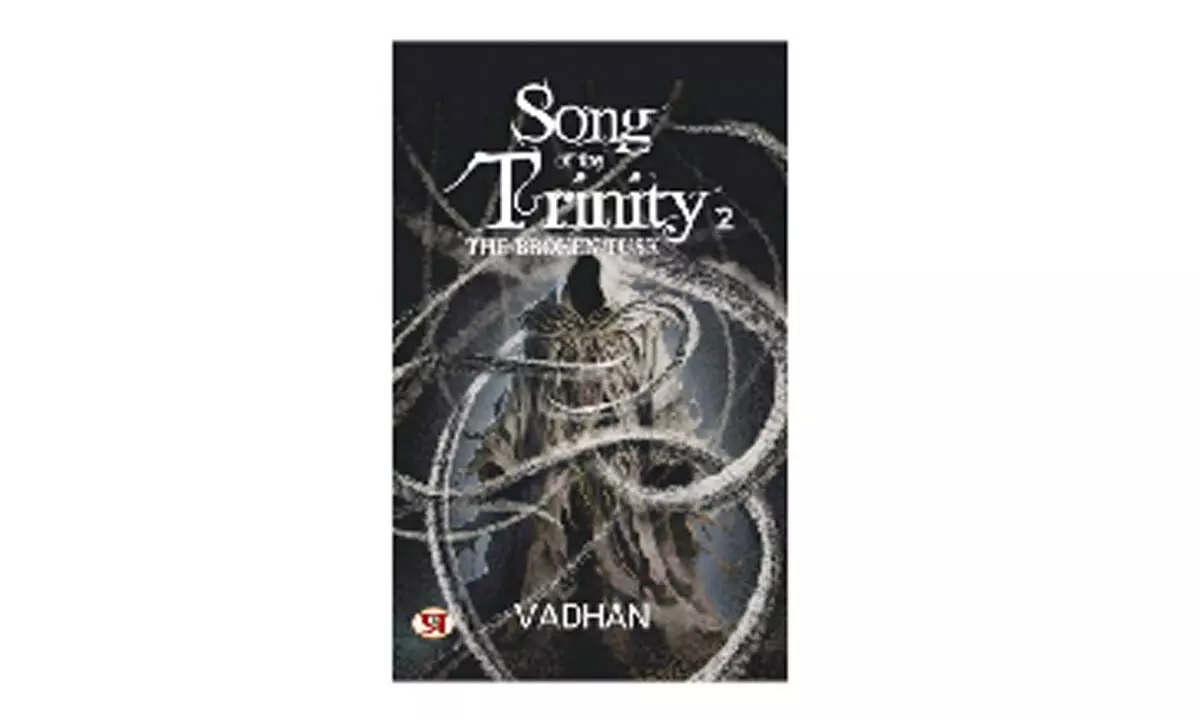
Vadhan brings a refreshingly unique perspective to Indian literature in his ‘Saga of the Song of the Trinity’. He expands the idea of ‘Vasudevam Kutumbakkam’ from a worldly concept to a cosmic truth, envisioning the entire universe as one family. With imaginative storytelling grounded in tradition, Vadhan redefines epic fantasy for the modern reader
Vadhan looks at Indian literature through a very different lens. That’s the irrefutable conclusion I drew after reading ‘The Saga of the Song of the Trinity’. He expands the definition of Vasudevam Kutumbakkam beyond this planet. In his eyes, it is not just “the whole world is one family,” but “the whole universe is one family.” He proves the point by drawing from literature without ever straying from its substantive truths (give or take a few poetic liberties).
The story itself is as old as time: Right vs. Wrong. But then, Vadhan introduces an approach that shines a light on the grey area in between—“that which is not right and that which is not wrong.” A phrase often used in the book, it’s intriguing because it allows for many nuanced interpretations of morality. There is philosophy there—deep insights, even. Again, the lens is unique.
‘The Song of the Trinity – The Broken Tusk’ picks up where Book 1 ended, with a prologue that sets the tone. Vadhan presents the story of Mushika like never before, without altering the core truth of the legend. The sheer power of his words and narration is breathtaking—frightening even—and creates visual brilliance. I saw a movie play out right there in the prologue.
Most of the characters were introduced in the first book, subtitled ‘The Rise of Kali’. Not to be mistaken for the mother goddess Kali—though the English spelling is the same, in this book it’s pronounced Kali as in Kaliyug, because the big bad villain of the saga is the mongrel-faced, blue-eyed ruler of Kaliyug. He can kill a god just by looking at them and seeks to “replace choice with need” across the universe. How Vadhan explores that concept is another testament to his brilliance.
Imprisoned within the ‘Song of the Trinity’—a prison designed by the Trinity (Lord Brahma, Vishnu, and Shiva) at the end of the last Kaliyug—Kali (named Kroni, also known as the Maharishi) is now on the verge of breaking free. It is up to the heroes of the story to stop that from happening.
Will they succeed?
Aswathaman, one of the seven immortals, cursed with never-healing wounds, is the main hero. That said, many fans of the saga believe Ajathashatru is the true hero, since the saga began with his story in ‘Shatru’ (a prequel published in 2014). The Rap Sage—with his pidgin language and magical rap songs—is a standout character. Using “Inglish” instead of English for the Rap Sage’s speech is a stroke of comic genius.
There are many others: Lalitha, the doomed Nagin princess; Kris, the orphaned extraterrestrial; the Garuda warrior Mrihir; Bhavani, Queen of the Asuras; and a finely crafted King Indra of the Devas. The villains are plenty, chief among them Trigund the Anomaly—both victim and villain.
A scientific approach to Indian mythology, unforgettable characters, phenomenal storytelling, and a vast, multi-layered world—these are the hallmarks of a cult classic. ‘The Song of the Trinity’ saga hits every benchmark. It’s a must-have in every book lover’s library.