A brilliant Kuchipudi rangapravesham

Guru Smt. Swati Mahalakshmi is a distinguished artist who has had the rare privilege of being trained under the foremost exponents and legends in their respective fields of Kuchipudi, Bharatanatyam, and Odissi. Her guru in Kuchipudi was the renowned Padma Bhushan Dr. Vempati Chinna Satyam. She learned Bharatanatyam from Rukmini Devi, Ramaiah Pillai, Swaminathan Pillai, and Gauri Ammal, and Odissi from Padma Shri Mayadhar Raut and Padma Vibhushan Kelucharan Mohapatra.
After an illustrious performative career, her deep dedication to the classical arts and the galaxy of legendary gurus continues to inspire her numerous students in India and abroad. She also teaches vocal music and sitar, showcasing her versatility.
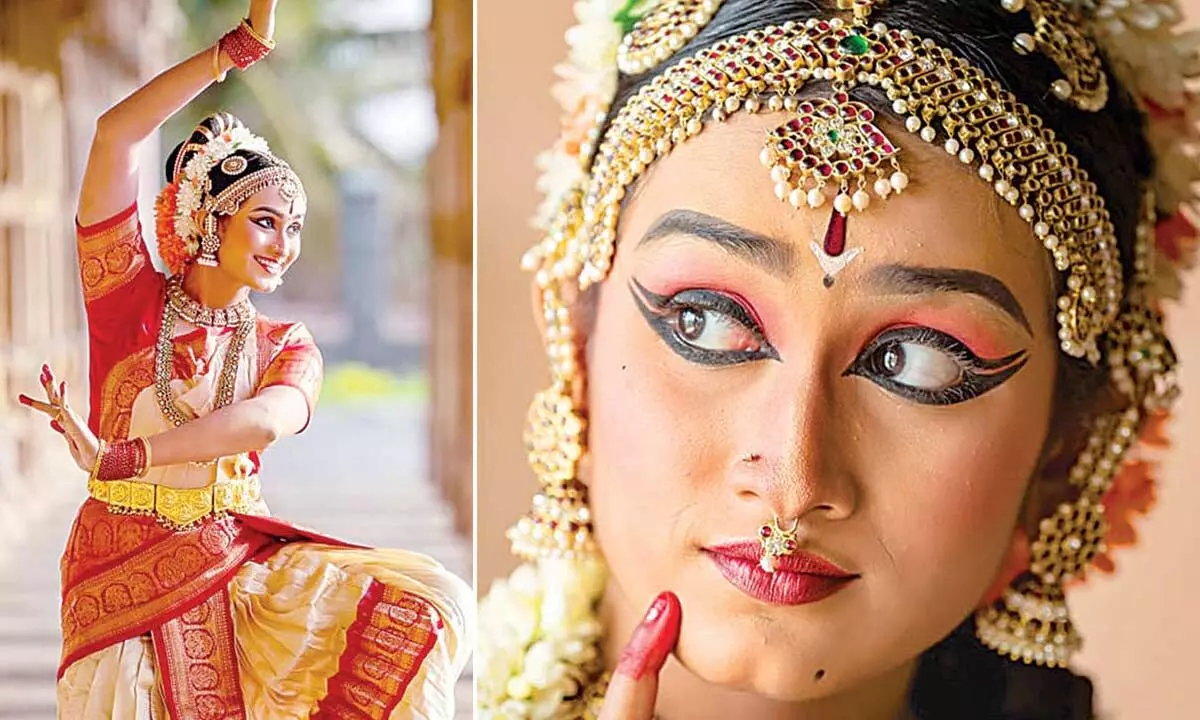
Purni Hasitha Tumati began her dance journey at the age of five. What started as a weekend activity blossomed into a daily passion. Hasitha is continuing her learning online from the United States and has honed her skills through virtual classes under her guru’s guidance. She is also an excellent flute player. A recent graduate with accolades, she is preparing to attend the University of South Florida.
Her Rangapravesham was presented on Saturday at the Telugu University Auditorium by Praachya Bhaarati Center for Performing Arts, headed by her guru Smt. Swati Mahalakshmi.
Vocalist Janani Hamsini regally enunciated the traditional invocatory song addressed to the Goddess — “Amba Paraaku”, ably supported by the orchestra — Charudutt on the mridangam and Hariprasad on the flute. Hemanth Lakshman shone on the nattuvangam.
The Ganesha Stuti, “Thaandava Nritya Kare” in Mohana raga, was the first item, competently performed. Ganesha is praised as the magnificent dancer who is beseeched to remove all obstacles and bless the recital to proceed auspiciously. Hasitha appeared in a bright violet and orange aaharya (costume).
She went on to perform “Brahmanjali Taandava” in Ragamalika. This composition of Siddhendra Yogi is a stirring and unforgettable item. Lord Nataraja, the Guru, and the Audience are eulogised. As Lord Shiva, in his divine dancing form of Nataraja, embodies Angika Abhinaya, the different sound waves signify Vachika Abhinaya. The moon, stars, and cosmos are his Aaharya. Saatvika is his essential nature. The trinity of Brahma, Vishnu, and Maheshwara as gurus impart knowledge to their devotees. Finally, the spectators are saluted as representatives of the Divine.
The Jatiswaram in Atana was a rhythmic cascade of nritta movements, fluently delineated. The Keertanam, “Koluvaittivaa Rangashaayi” of Devulapally, is a prominent piece, giving scope for energetic patterns of elegant movements depicting the recumbent Lord Vishnu lying on Sesha, the many-headed Serpent. The celebrated sight of the Lord giving darshan in this manner is a glorious delight, which even a thousand eyes are not sufficient to absorb. The eager thirst of the bhaktas to visualise him is quenched by the detailed portrayal provided.
Ever-smiling, decked with tulasi, adorned with gems and musk fragrance, he is a lustrous effulgent vision. The three worlds are attracted and awestruck. The refrain — “the exquisite one residing in the Temple of Srirangam” — was vividly danced by Hasitha. The artiste was radiant in white and red-gold as she went on to the next item, an excerpt from a longer ballet — the crucial Pravesha Daruvu of Bhamakalapam.
The scene introduces Satyabhama’s character, setting the tone for the entire dance drama. Hasitha’s abhinaya was exceedingly expressive as she brought out the nature of Satyabhama. Her proud mien and sharp features were true to the life and soul of the heroine. Every tiny detail, including the posture presented in every shade of emotion, was exact. Haughtiness and consciousness of superiority from her royal descent exuded from every pore, so to speak! It was a triumph indeed, as the capricious Satyabhama was veritably brought to life before the audience’s eyes.
The Ashtapadi, “Sanchara Dhara”, was a lilting melody of Radha’s remembrance of Krishna. In a quiet bower, Radha details the beauty of the Lord to her friend — his infatuating flute, peacock feathers, enchanting earrings. His honeyed lips are eager for the gopi’s kisses, and sandalwood marks his forehead. Wearing a yellow robe, he is surrounded by a retinue. All these coruscating descriptions were well brought out in natya.
The Tarangam in Arabhi, “Maragatha Manimaya”, included complicated jathis performed by the dancer with elan as she balanced on the rim of a brass plate. The lyrics praise Krishna as Jagannatha, the protector of the Universe. With a lotus-like smile in Rasleela and a bewitching flute, he transfixes the devotee, in whose heart he is ever present. Bala Gopala, Mukunda, the son of Nanda, has all virtues. His glory is infinite, and his origin and end are beyond comprehension. Like a hovering bee, he enjoys the sweet nectar of love from the lotus-like face of Radha.
The Mangalam concluded an elegant recital to much applause. Sparkling compering by Sahana in Telugu and Naveena in Hindi added further lustre. Chief Guest Dr. C. Suvarna, Principal Chief Conservator of Forests, graced the occasion