LA fires akin to ‘Khandava Dahana’

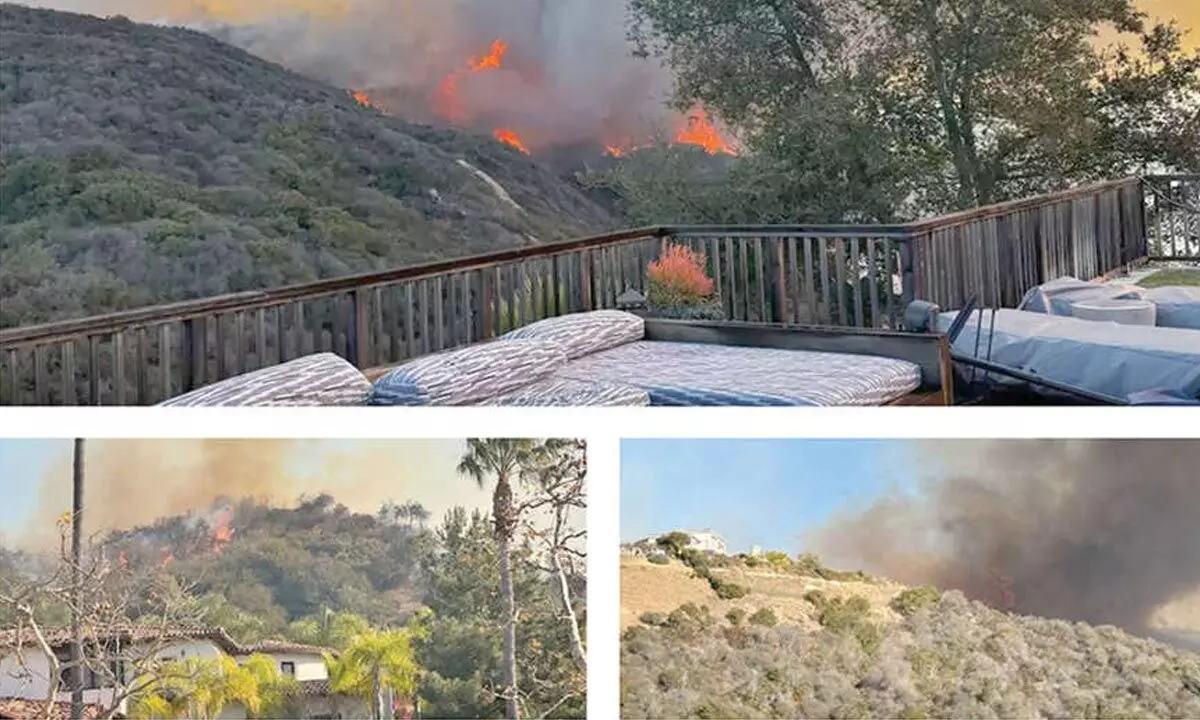
For now, the answer to what caused Los Angeles wildfires is elusive
According to the Mahabharata, the vast forest ‘Khandava’, inhabited by many creatures as well as Maya, the ‘Architect of the Demons’, was set on fire deliberately through ‘Fire God Agni’, who was ‘Hungry for the Forest’ due to a curse, by Arjuna and Krishna, with the divine purpose and mission of clearing forest land. It was part of a cosmic plan that led to the destruction of the forest but simultaneously cleared the land for creation of ‘Maya City’
The Los Angeles wildfires raging from January 7, 2025, or named as ‘Hughes Fire’ later, which resulted in 28 fatalities, destruction of structures, and displacement of about 2 lakh people directly or indirectly, may be symbolically, with significant differences, compared to the mythological story of ‘Khandava Dahana.’ The massive catastrophic fire affecting large portions of Khandava forest represented the ‘End of one Era and Beginning of Another’ as part of the destruction and creation cycle as mentioned in the great epic Mahabharata. The process involved divine powers. But, the modern wildfires tend to be more destructive without the accompanying divine or purposeful creation. Both events highlight the ‘Power of Fire’ as a force.
In the Los Angeles wildfires, several famous Hollywood celebrities lost their priceless homes in the Pacific Palisades Area, which is their favored location. The Palisades and Eaton fires burned more than 23,700 acres and 14,100 acres respectively. Los Angeles Home, where ‘The Doors Guitarist’ Robby Krieger penned the Band’s Hit Song, intoxicating rock single ‘Light My Fire’, was destroyed. Significant landmarks including the J Paul Getty Museum and University of California were damaged.
Wildfires are driven by a combination of natural and human-induced factors. Global warming causing rising temperatures; prolonged droughts turning it into highly flammable fuel; heatwaves and reduced rainfall; strong hot and dry Winds that spread wildfires; windborne sparks causing new fires in unburned areas; overgrown forests increasing fire intensity; flammable plant species: wildland-urban interface; untold human and natural causes; lightning as an ignition source; constructions in high-risk fire zones; terrain causing spread of fires faster; narrow canyons and valleys etc. are among them.
Satellites, drones, and fire tracking technologies allow for better monitoring and predicting of wildfire risks. However, meteorologists may not be able to predict the precise timing of the outbreak of wildfires, and the path of a fire, which is an annual occurrence in California, especially during the dry summer and fall months. This is partly due to the complexity of weather and terrain factors. This time, the scale and intensity of the fires were exacerbated beyond prediction. Strong, unpredictable winds caused fires to spread much faster than anticipated.
The crisis management during the Los Angeles wildfire required a comprehensive approach, involving state and federal government agencies, which jumped into action with immediate firefighting efforts. Thousands of firefighters comprising specialized teams were deployed to bring the situation under control. A state of emergency was declared. National Guard was deployed and evacuation shelters were established. Hundreds of federal personnel and aircraft were pressed into service to support firefighting efforts, which, however, were significantly hampered by water shortages due to century-old pipelines. Fire hydrants ran dry, forcing firefighters to rely heavily on aerial water drops. Relief centers provided very temporary support.
Mandatory evacuation orders were issued promptly to protect residents. Wireless emergency alert system, social media, and local broadcasts to issue real-time updates were pressed into action. Preventive power shutoffs to reduce risk of electrical equipment sparking new fires was done. Major disaster declaration was made enabling Federal Emergency Management Agency (FEMA) assistance. National Interagency Fire Center (NIFC) coordinated firefighting efforts across the state. Environmental Protection Agency (EPA) monitored the hazardous air quality that was causing respiratory and cardiovascular problems. Severe air pollution, smoke and ash blanketed large areas of Los Angeles.
Social and non-governmental organisations (NGOs) played a crucial role in wildfire response, relief, and recovery. Their involvement ranged from immediate relief efforts (shelters, food, and water) to mental health support, animal rescue, advocacy, and rebuilding efforts. Limited resources, communication gaps, and uneven recovery highlighted the need for better coordination between NGOs, government agencies, and local communities. American Red Cross and other local (California) volunteers provided critical disaster relief services during the wildfires.
According to the Mahabharata, the vast forest ‘Khandava’, inhabited by many creatures as well as Maya, the ‘Architect of the Demons’, was set on fire deliberately through ‘Fire God Agni’, who was ‘Hungry for the Forest’ due to a curse, by Arjuna and Krishna, with the divine purpose and mission of clearing forest land. It was part of a cosmic plan that led to the destruction of the forest but simultaneously cleared the land for creation of ‘Maya City.’ This symbolised transformation of the environment, where destruction eventually paved way for construction.
Modern wildfires, like those in California, do not have the divine or purposeful elements of Khandava Dahana, though there are symbolic parallels. Much like the destruction of Khandava, modern wildfires can devastate forests, wildlife, and human settlements. In both cases, lives are lost, and the landscape is dramatically altered. Just as the burning of Khandava led to the creation of new city, post-fire recovery of modern wildfires can lead to new development and an eventual return of wildlife, and sometimes may result in ecological transformation, and, eventually, in coming up of a new city. However, the land can also face long-term challenges like soil erosion or loss of biodiversity.
In the ultimate analysis, in the Mahabharata’s Khandava Dahana, the fire was part of a larger moral and ethical battle, with the heroes (Krishna and Arjuna) being part of a divine plan. Modern wildfires invariably lead to human suffering, loss of property, and environmental damage. They are typically seen in the context of disaster management rather than cosmic or divine action. Praying to Hindu Gods for total normalcy or recovery from wildfires, which is deeply spiritual and cultural, and which many people in Hindu traditions find meaningful, could be an answer for early salvage.
In Hinduism, there are specific prayers and rituals that may be offered to seek divine intervention for protection, recovery, and restoration of normalcy. These include prayers to Lord Agni, Maha Mrityunjay Mantras, and prayers to protectors like Goddess Durga and Lord Shiva. While spiritual prayers and rituals offer important emotional and cultural support, bringing about long-term restoration may also require pragmatic disaster management. A combination of spiritual resilience and scientific action ensures not only the rehabilitation of affected communities but also the prevention of future wildfires. Ultimately, addressing the wildfire crisis requires multi-faceted and multipronged approach, balancing spiritual support, governmental action, community efforts, and environmental sustainability to rebuild and prepare for a future where such wildfires are less devastating.
Authorities investigating the cause of the fire revealed that the Palisades wildfire had inadvertent ‘Human Origins’ as a ‘Likely Cause’ which was started by someone. According to New York Times, Palisades fire ignited near a ‘Hiking Trail’ and an area that had burned six days earlier. A ‘Red Flame Retardant’ was dropped from overhead to battle the blaze and smoke billowing from all sides of the scar. The area known as ‘Skull Rock on the Temescal Ridge Trail’ is popular with hikers as a hangout by local teens. Officials are investigating whether that fire could have had any connection. For now, the answer to what caused Los Angeles wildfires is elusive.
At least two lawsuits have been filed against Southern California Edison Power Company, on the speculation that faulty power lines may have sparked the Eaton Fire. Meanwhile, 31,000 fled as new blaze threatened Los Angeles County, and thus the fire-weary southern California is in crisis again in the face of another fast-moving wildfire and the threat of mudslides. A new wildfire, the ‘Hughes Fire’ named so, erupted on January 22 morning in the rugged mountains north of Los Angeles, rapidly spreading through dry vegetation and sending thick plumes of smoke into the sky, as per a Reuters report. Firefighters have halted the spread of this ‘Hughes Fire’ which rapidly burned over 10,000 acres and led to 31,000 evacuations. Containment has increased to 24%. Relief Package worth $2.5 billion is being used to handle the crisis.
(Sources: US media reports and Mahabharata)