Telangana poised for a triangular contest in 2028

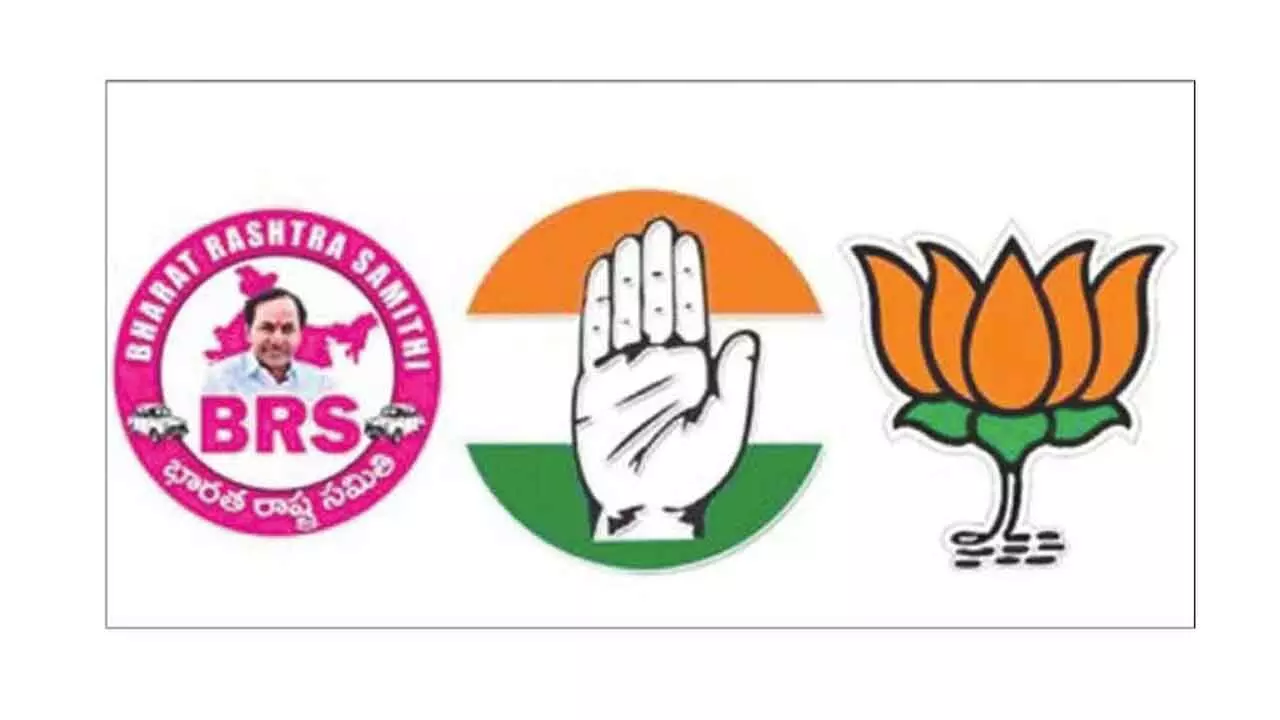
AsTelangana approaches the 2028 Assembly elections, the state’s political arena is brimming with intrigue and strategic maneuvering. The contest is shaping up as a three-cornered fight among the ruling Congress, the resurgent Bharatiya Janata Party (BJP), and the Bharat Rashtra Samithi (BRS). While the Congress holds power under Chief Minister A. Revanth Reddy, speculations about shifting alliances—particularly a potential tie-up between the BJP and BRS—have fueled debates. Such a partnership could alter the electoral dynamics, although official denials and internal frictions suggest a more complex reality.
This analysis explores the evolving landscape, drawing on recent developments to assess the strengths, challenges, and implications for each player.
At the heart of current discussions is the possibility of a pre-poll pact between the BJP and BRS, often described by observers as a “calculated gamble” that could consolidate opposition forces against the Congress. Proponents argue that the alliance would leverage complementary assets. The BJP, with its control over the central government, could funnel resources into major infrastructure projects in Telangana, such as expansion of Hyderabad Metro, Musi Riverfront development, and upgraded road networks. This could provide a compelling development narrative, potentially eroding the Congress’s financial edge in campaigning. Additionally, financial facilitation through national banks and schemes could address state-specific needs, like agricultural support amid ongoing urea shortages affecting over 70 lakh farmers.
Meanwhile, the BRS brings a robust grassroots network and influential leaders like founder K Chandrashekar Rao (KCR), K T Rama Rao (KTR), and T Harish Rao. This organizational strength could enable targeted attacks on the Congress’s alleged governance lapses, such as delays in welfare schemes and internal factionalism.
Rumours of power-sharing arrangements have circulated, with KTR positioned as a potential Chief Ministerial candidate and Harish Rao eyed for a Union Cabinet role, blending regional clout with national influence.
However, these speculations have been met with firm denials. Harish Rao has repeatedly asserted that the BRS aims to contest independently, targeting a majority with ambitions of securing up to 100 seats in the 119-member Assembly. Similarly, BJP leaders, including its state president N Ramachander Rao, have dismissed any alliance talks. Union Minister Bandi Sanjay Kumar echoed this, labeling the BRS as “outdated” and ruling out collaborations.
Internal strains within the BRS further complicate the alliance narrative. In June, their MLC K Kavitha publicly accused certain party sections of pushing for a merger with the BJP, highlighting rifts within the KCR family and raising questions about succession and stability. Union Minister G. Kishan Reddy dismissed merger talks, underscoring no such discussions were entertained.
High-profile defections are reshaping the field. In August, former MLA Guvvala Balaraju joined the BJP, part of a broader trend of political migrations that could influence voter perceptions ahead of 2028. This follows earlier shifts, such as the BJP’s absorption of disgruntled leaders from other parties, bolstering its cadre in key regions like northern Telangana, where it secured seven Assembly seats in 2023. The BJP’s vote share has surged from seven per cent in 2018 to 14 per cent in 2023 and 35 per cent in the 2024 Lok Sabha polls, indicating growing appeal among backward classes (BCs) and urban voters.
The BJP is now focusing on local body elections, expected soon, as a prelude to 2028. Party leaders like Sunil Bansal have emphasized high-voltage campaigns targeting BCs, while criticising both Congress and BRS on corruption and anti-people policies. This grassroots push aims to counter the BJP’s historical weakness in rural areas, where regional parties dominate.
Under Revanth Reddy, the Congress is fortifying its position by emphasizing internal unity and inclusivity. Since its 2023 victory—securing 64 seats against BRS’s 39—the party has targeted the state’s BC population through enhanced reservations in local bodies (up to 42 per cent) and welfare initiatives. Revanth’s youth-oriented, energetic image, backed by the party’s high command, positions him as a bulwark against any opposition coalition. The government has also nurtured a political-business ecosystem, implementing guarantees like free power for farmers and addressing land issues via an improved version of the Dharani portal.
Yet, challenges loom. KTR has accused Congress and BJP of a “secret pact” harming Telangana’s interests, citing lost projects and quid pro quo deals. Anti-incumbency could build by 2028 if issues like urea shortages and governance gaps persist. The Congress’s performance in southern Telangana, where it won 30 seats in 2023, will be crucial, while urban and northern regions remain vulnerable to BJP inroads.
Telangana’s politics cannot be isolated from national trends. The BJP’s Hindutva agenda has found traction in the state, evident in its 2024 Lok Sabha gains, where it matched Congress’s eight seats while BRS drew a blank. The BRS, positioning itself as independent, has tied its support in national matters—like the Vice-Presidential election—to state-specific demands, such as urea supply. This pragmatic stance underscores its regional focus but exposes vulnerabilities amid family dynamics and defections.
Economic and social issues will likely dominate the 2028 campaign. Agricultural distress, urban development, and reservations for marginalized groups could sway voters. Opinion polls and analyses suggest a hung Assembly, with some predicting a BJP-Jana Sena Party tie-up or even a post-poll BRS-BJP government. However, the BRS resilience—rooted in its role in Telangana’s formation—remains a factor, despite its 2023 setback attributed to anti-incumbency and welfare discrepancies.
For now, Telangana appears set for a triangular showdown, with no clear frontrunner. While the underlying logic of a BJP-BRS coalition persists—driven by mutual benefits and anti-Congress sentiment—internal divisions and public denials make it unlikely in the immediate term.
As 2028 nears, electoral math, defections, and issue-based campaigns could force realignments. The outcome will hinge on how each party addresses local aspirations amid national pressures, ultimately determining whether Telangana witnesses unified opposition or fragmented mandates.
(The writer is a researcher at Peoples Pulse Research Organization)