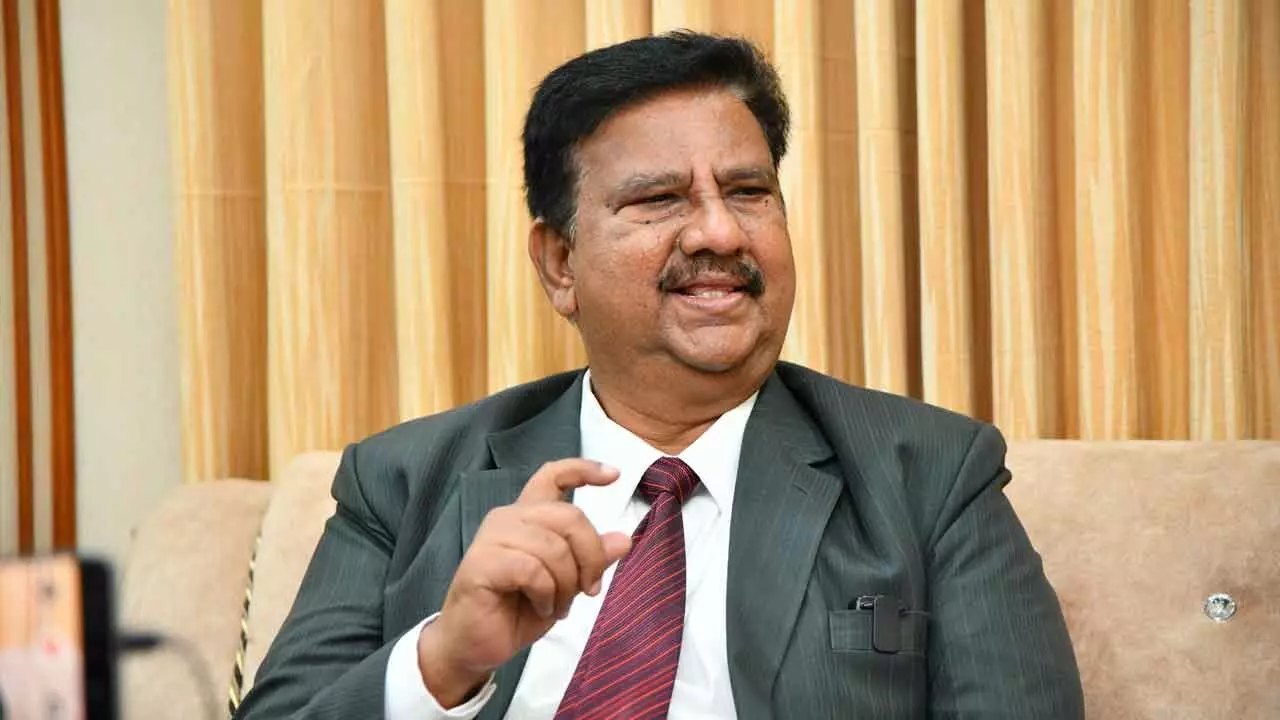
TG Human Rights Commission disposing cases on fast track: Justice Shameem Akhtar

A mindboggling 2,800 cases were cleared in less than two months
There are always two sides to a dispute, with allegations and counter-allegations. We cannot accept anything at face value. Our job is to detect the mischief and deliver justice. I am for alternative dispute resolutions: Justice Akhtar
In a remarkable development that augurs well as regards delivery of justice, the Telangana Human Rights Commission (TGHRC) hit a new peak by disposing of more than 2,800 cases in less than two months, which translates to an average of clearing over 1,000 cases a month.
A credit for putting in place a workable and achievable speedy disposal system goes to Justice Dr. Shameem Akhtar, who achieved this distinction since taking over as the Commission’s Chairman on April 17. Not surprisingly, he inherited a backlog of around 11,500 pending cases.
These included a wide range of human rights issues such as civil disputes, matrimonial conflicts, domestic violence, and criminal cases, among others, all falling under Section 21D of the Protection of Human Rights Act, 1993.
In a chat with the writer, Justice Akhtar emphasized the Commission’s commitment to treating every complaint with equal seriousness. There would be no discrimination or prioritization, whatsoever.
“Every case is important. Irrespective of whether it is a dispute over one rupee or a crore, we will view and address them with the same lens of justice, which is what matters at the end of the day. Judges must build a reputation that prevents external interference in order to ensure that the judicial process remains just and fair,” is his governing yardstick, which sounds pragmatic and helps build public trust.
Incidentally his roots are equally illustrious. His father the late Jaan Mohammed served as the superintendent of the Andhra Pradesh High Court, while mother Raheemunnisa is a literature enthusiast.
In a way, coming from a family of advocates, the legal spark in him was ignited while he was quite young.
“For nearly 100 years, there have been more than a handful of lawyers from my maternal side,” he points out with a sense of professional pride.
Incidentally, Justice Akhtar had an affinity for social and political activism from an early age but chose law as his profession given that he was naturally drawn to it.
“I would wake up early and read law magazines and make notes,” he recalls of his growing up years, a passion that has propelled his career to the zenith.
His career-graph shows a steady rise right from the time he enrolled himself in the Nalgonda Bar in 1986. He served with distinction as a district judge to eventually rise to the stature of judge of the Telangana High Court. He served as the registrar of AP High Court for nearly five years.
Notably, Justice Akhtar led a one-man commission that was constituted by the Telangana state government on Scheduled Caste sub-classification.
With a legal career spanning over 16 years as an advocate and six years on the bench, Justice Akhtar is no stranger to rigorous workload.
An indication of the dexterity with which he handles cases is evidenced by the fact that he has delivered judgments in over 18,000 cases and an equal number of interim applications.
Justice Akhtar points out that while the Commission is prioritising older cases, new cases are being taken up simultaneously to maintain the momentum.
“Nearly 70 to 80 new complaints are registered with us every week. However, we are disposing of thrice that number to ensure that we reduce the backlog efficiently,” he points out, while stressing on striking a balance between pending and new cases.
The Commission’s recent push is not merely a matter of numbers. According to the Chairman, the real challenge lies in carefully examining each case to unravel the truth.
“Like a coin, there are always two sides to a dispute, comprising allegations and counter-allegations. We cannot accept anything at face value. Our job is to detect the mischief and deliver justice,” he maintains.
Justice Akhtar also stressed the importance of alternative dispute resolution.
“My advice to most people is to settle disputes amicably outside the court, whenever possible. It saves time, money, energy, and shields individuals from complex legal entanglements,” he notes.
(The writer is a software engineer and journalist, best known for his book ‘The Kohinoors: Distinguished Personalities of Hyderabad’)