Art as action: Kashika Reddy on storytelling, sustainability, and equality

Arti Adke
At a time when cities grapple with questions of inclusion, safety, and sustainability, a new generation of changemakers is turning to unconventional tools to spark dialogue. Kashika Reddy, a student artist and founder of Samagra Collective, is one such voice. Through public art made from waste, community collaborations, and her illustrated children’s book Sparsa (The Touch), she has been addressing themes of gender equity, consent, and environmental responsibility in everyday spaces. In this feature interview, Kashika speaks about her journey, the ideas that drive her work, and how art and storytelling can become powerful instruments of social change.
Excerpts from an interview
Can you tell us about your early influences and how art became a tool for social change for you?
I grew up seeing art as a form of language rather than decoration. From a very young age, sketching helped me observe the world closely. My art teacher, Nilofer Suleman, played a major role by sharing stories of artists who shaped thought and society. Around the same time, I became aware of gender inequities through everyday experiences and conversations. Slowly, I realised that art and storytelling could communicate ideas across barriers of age, literacy, and background. That realisation shaped the foundation of my work.
What led to the creation of Samagra Collective, and why use waste as a medium?
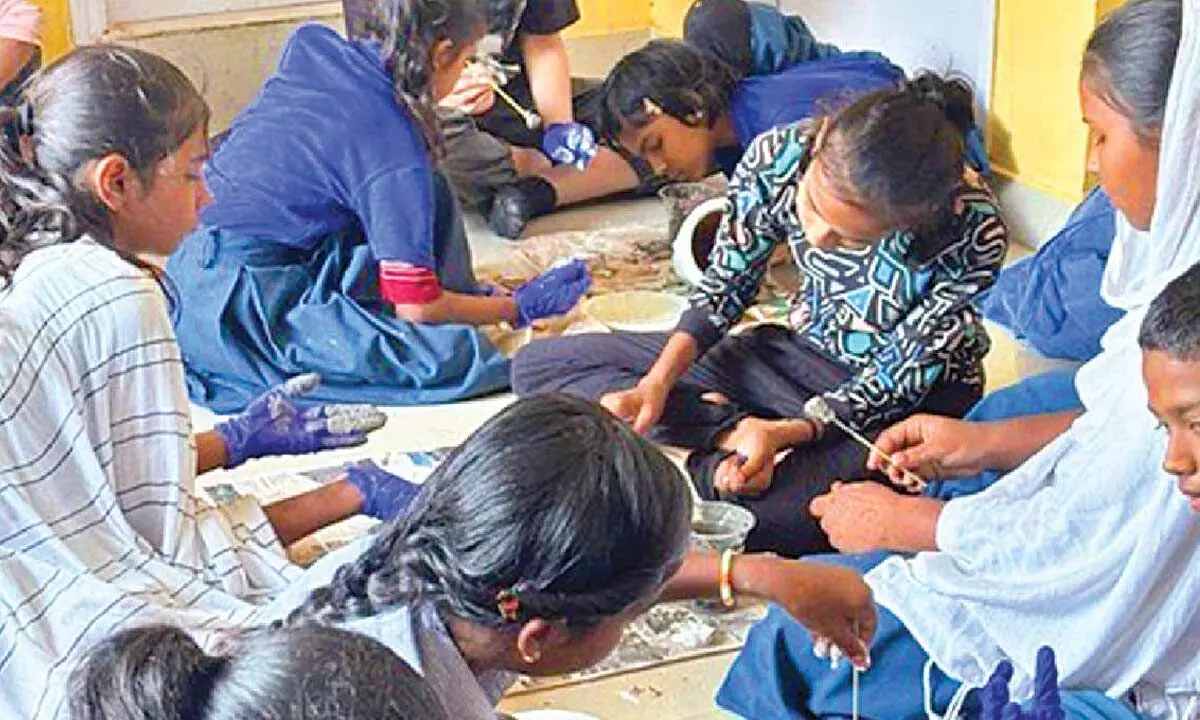
Samagra began with a simple observation: cities generate enormous waste, yet public spaces often lack meaningful visual connection with communities. Waste felt symbolic—it is abundant and ignored. By transforming discarded materials into public art around gender equity and sustainability, waste becomes a learning tool. The process also creates livelihood opportunities for women artisans, making environmental action participatory and inclusive.
Sparsa (The touch) addresses consent for children, a sensitive subject. What motivated you to create it?
While volunteering with NGOs, I noticed how difficult it was to find age-appropriate, culturally rooted material on consent. Most resources were either too technical or intimidating. I wanted a gentle, visual story that reflected everyday Indian childhoods. Sparsa was designed to empower children to understand boundaries without fear or shame, and to help adults start conversations they often avoid.
How do you choose themes and locations for public art installations?
I start by asking who needs representation in that space and what issue matters to the local community. Public places like metro stations and walkways are democratic spaces. Collaborating with NGOs, women artisans, and youth groups ensures the artwork reflects shared stories rather than individual expression.
Collaboration seems central to your work. How does it extend impact beyond the artwork?
The process itself builds community. From collecting waste to assembling installations, people form networks that last beyond the project.
Women gain income and creative identity, youth develop leadership skills, and NGOs gain visibility for their causes. The artwork becomes a shared civic experience.
Was there a moment when you realised Sparsa was making a real difference?
Yes. A young girl once told me, “Now I know I can say no.” That moment stayed with me. When institutions like police stations and libraries began requesting the book, it became clear that the story had grown into a practical tool for child safety.
How do you balance academics with activism and creative work?
Balance comes from structure and purpose. I plan timelines carefully and rely on mentors. My school has been supportive, and I see academics and activism as complementary—each strengthens the other.
How do you see the role of youth-led creative activism in the future?
Young people bring urgency and imagination. Creative activism moves faster than formal discourse and encourages co-creation rather than confrontation. I believe future solutions will combine art, research, and policy.
What lies ahead for Samagra and your own journey?
The next phase is scaling the model to more cities and integrating waste-to-art into urban systems. Personally, I hope to study gender and South Asian studies to strengthen the academic grounding of my work, while continuing to design tools that make gender equity accessible to all.