




- ‘Rangulu Ranguley’ captures Rama and Sita’s love story
- Safeguarding stories for future generations
- Our country needs not only IT professionals but also civil, mechanical chemical engineerings: NIT Rourkela Director
- Backdoor attacks on SMB systems rise 52% in H1 2026: Kaspersky
- Sobha Realty on expansion drive
- Hyundai to jack up capacity to 1.14 mn units, boost localisation
- Office leasing hits record 61 msf in first nine months of 2026
- 15-20% EBITDA growth for ONGC in FY27: S&P
If we do not use evidence, we may end up making the wrong policy choices: Karnataka Health Secretary
In Short
Experts convene at IIM Bangalore for the EPHP 2026 conference to discuss the future of health systems and the critical role of evidence-based policymaking.

Share :
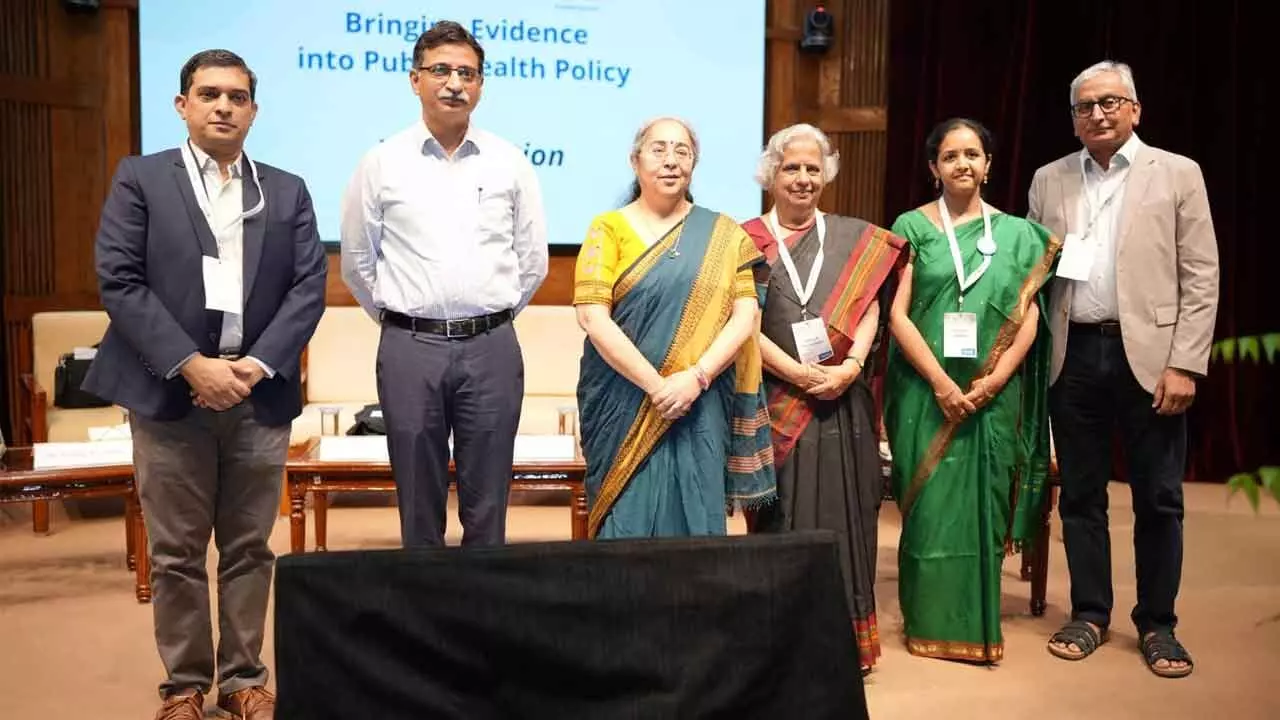
Bengaluru: Public health policies can become significantly more effective when grounded in robust evidence, while the absence or misinterpretation of data can lead to misguided decisions, said Sri Ritvik Ranjanam Pandey, Principal Secretary, Health & Family Welfare, Government of Karnataka, at the inauguration of the 5th edition of the Bringing Evidence to Public Health Policy (EPHP) Conference organised by Institute of Public Health Bengaluru (IPH Bengaluru), in collaboration with The George Institute for Global Health (GIGH) India, and the Institute of Tropical Medicine (ITM) Antwerp, with the Indian Council of Medical Research (ICMR) held at the Indian Institute of Management Bangalore (IIMB).
Addressing participants, Pandey highlighted the critical role of evidence in shaping effective public policy. “As much as evidence goes into policymaking, it helps us because it makes policies more effective and also sharpens those already in place,” he said. Drawing from his experience in the health department, he shared examples from tuberculosis control and maternal mortality surveillance to illustrate how assumptions unsupported by data can lead policymakers away from the real causes of public health challenges.
Referring to a review of tuberculosis mortality in Karnataka, he described how commonly cited explanations such as migration and alcohol use were not supported by available programme data. “If we do not use evidence in how we take decisions, we may end up making the wrong policy choices,” he noted. He further highlighted how analysis of maternal mortality data revealed limitations in current reporting systems, emphasizing the need for better-quality data and deeper investigation of underlying causes rather than relying solely on immediate clinical outcomes. Concluding his address, Pandey urged participants to use the conference as an opportunity to generate actionable evidence and practical solutions, noting that stronger research-policy partnerships can help governments make more informed decisions and improve public health outcomes.
While addressing the gathering, Prof. Arnab Mukherji, Professor at the Centre for Public Policy, IIM Bangalore, reflected on the institution’s longstanding engagement with public policy and health-related research. He highlighted the emergence of new initiatives focused on health systems and public policy and underscored the importance of engaging a broad range of stakeholders, including the private sector, to improve health outcomes.
Representing the Indian Council of Medical Research (ICMR), Dr. Ashoo Grover, Scientist-G and Head, Division of Delivery and Implementation Research, highlighted the importance of implementation research in bridging the persistent gap between evidence generation and policy adoption. She outlined ICMR’s efforts to institutionalize implementation research and strengthen research ecosystems to ensure that scientific evidence effectively informs health programmes and policies.
Prof. Vivekanand Jha, Executive Director of The George Institute for Global Health India, described EPHP as a growing movement dedicated to the often challenging task of translating evidence into policy and practice. He emphasized that evidence alone does not automatically influence policy and called for stronger collaboration among researchers, clinicians, policymakers and programme implementers. He also stressed the importance of building future-focused health systems that can anticipate emerging challenges rather than merely react to them.
Prof. Sundari Ravindran, Governing Board Member of the Institute of Public Health (IPH), Bengaluru, highlighted that public health research should ultimately contribute to meaningful change through policy reform, programme implementation and the development of innovative alternatives that address inequities within health systems.
Dr. Pragati Hebbar, Dean of the T. T. Narasimhan School of Advanced Studies at IPH Bengaluru and representative of Health Systems Global, emphasized the importance of fostering connections, encouraging difficult but necessary conversations, and creating learning spaces that contribute to health system transformation. She encouraged participants to use the conference as an opportunity to build collaborations and generate actionable solutions for complex public health challenges.
The three-day conference focuses on the theme of future-focused health systems and features plenary sessions, panel discussions, workshops, technical presentations and skill-building sessions. Discussions will explore implementation research, evidence-informed policymaking, health systems strengthening, digital health innovations, health equity and strategies for translating research into practice.
Nearly 300 participants, including researchers, policymakers, clinicians, programme implementers, public health practitioners, students and representatives from academic institutions, government agencies, civil society organizations and development partners, are participating in this conference.
Is Actor Dhanush Eyeing a Political Debut? Will His Next Act Be Cinema, Welfare or Politics?
Cyclone Arnab To intensify To Very Severe Storm, Red Alert For Andhra Pradesh And Odisha
Delhi CM Gupta launches trial run of Namo Yamuna Cruise Safari; service to begin before Chhath Puja
Fire Breaks Out at Delhi’s North Block After Short Circuit, Six Fire Engines Rushed to Spot
Owaisi’s ‘Abdul’ Pitch Irks Akhilesh Yadav. Puts SP on the Defensive
Rahul Gandhi’s convoy vehicles collide on Purvanchal Expressway in UP; several injured


