Karnataka Temple Adopts Mechanical Elephant for Rituals, Promotes Ethical Treatment of Wildlife

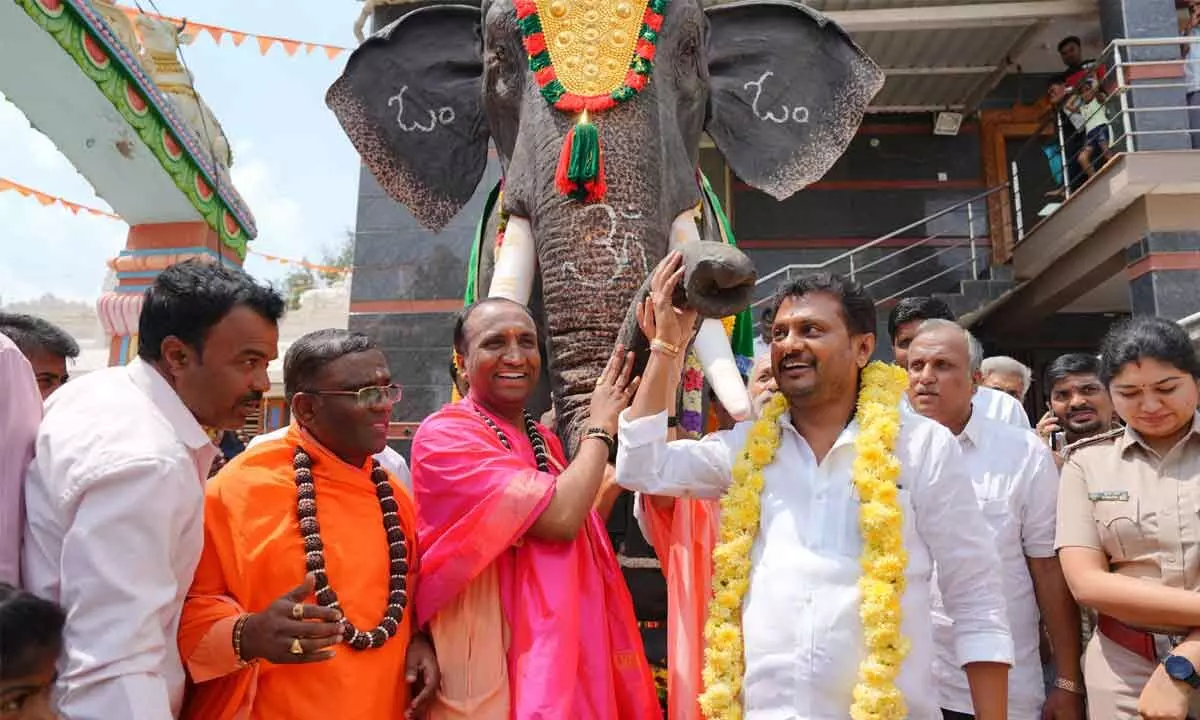
Shri Umamaheshwara Veerabhadreshwara Temple at Shilamatha, Tavarekere in Davanagere has adopted a life-sized mechanical elephant, Umamaheshwara, to replace the use of live elephants in its rituals and ceremonies.
Davanagere : Shri Umamaheshwara Veerabhadreshwara Temple at Shilamatha, Tavarekere in Davanagere has adopted a life-sized mechanical elephant, Umamaheshwara, to replace the use of live elephants in its rituals and ceremonies. The initiative, supported by actor Suniel Shetty, along with non-governmental organisations People for the Ethical Treatment of Animals (PETA) India and Compassion Unlimited Plus Action (CUPA), marks a progressive shift in temple traditions. The mechanical elephant was sponsored by the Thackersey Group.
The ceremonial unveiling of Umamaheshwara took place in the presence of dignitaries, including Davanagere MLA Basavaraju V Shivaganga, Range Forest Officer Dr. Dhananjaya Sarji, former MLA Shwetha Viswanath, former MLA K. Madal Virupakshappa, and the temple's spiritual leader, Shri Renuka Shivacharya Swamiji. Spiritual heads Shri Rachoteshwara Shivacharaya Swamiji and Dr. Abhinava Sidaalinga Shivacharya Swamiji also attended the event. The inauguration was followed by a traditional Mangala Vadhyam performance.
Speaking on the occasion, Suniel Shetty lauded the initiative, stating, “Wild elephants play a crucial role in maintaining ecological balance. This effort ensures that temple rituals can continue without causing harm to these magnificent creatures.”
MLA Basavaraju V Shivaganga highlighted the importance of the move, noting that the mechanical elephant closely resembles a real one and could inspire other temples to adopt similar measures. Former MLA K. Madal Virupakshappa echoed this sentiment, calling for wider adoption of mechanical elephants across the country to protect wildlife.
Shri Renuka Shivacharya Swamiji, the temple head, expressed delight at the addition of Umamaheshwara, stating, “This mechanical elephant allows us to uphold our traditions in a humane and ethical manner. We encourage other temples to follow this path.”
The move aligns with PETA India’s campaign, which has been advocating for the replacement of live elephants in temple processions. So far, at least 13 mechanical elephants have been adopted by temples across South India, eight of which were facilitated by PETA India. The three-metre-tall, 800-kilogram mechanical elephants are designed to replicate real elephants in movement and appearance, capable of shaking their heads, moving their ears and trunks, and even spraying water.
The use of captive elephants in temples has long been criticised due to reports of mistreatment. Elephants in captivity often suffer from inadequate living conditions, chaining, and lack of medical care, leading to stress and aggression. According to the Heritage Animal Task Force, captive elephants have caused over 500 human deaths in Kerala alone over the past 15 years.
The Shri Umamaheshwara Veerabhadreshwara Temple, a revered 1,200-year-old pilgrimage site, is well known for its annual Gramada Jatra Mahotsava, Shravana Masa Pooja, and Karthika Masa Deepotsava, which attract thousands of devotees. With the introduction of Umamaheshwara, the temple is now setting a precedent for ethical and sustainable temple practices.