A painting should be entered, not decoded says painter Mannat Gandatre

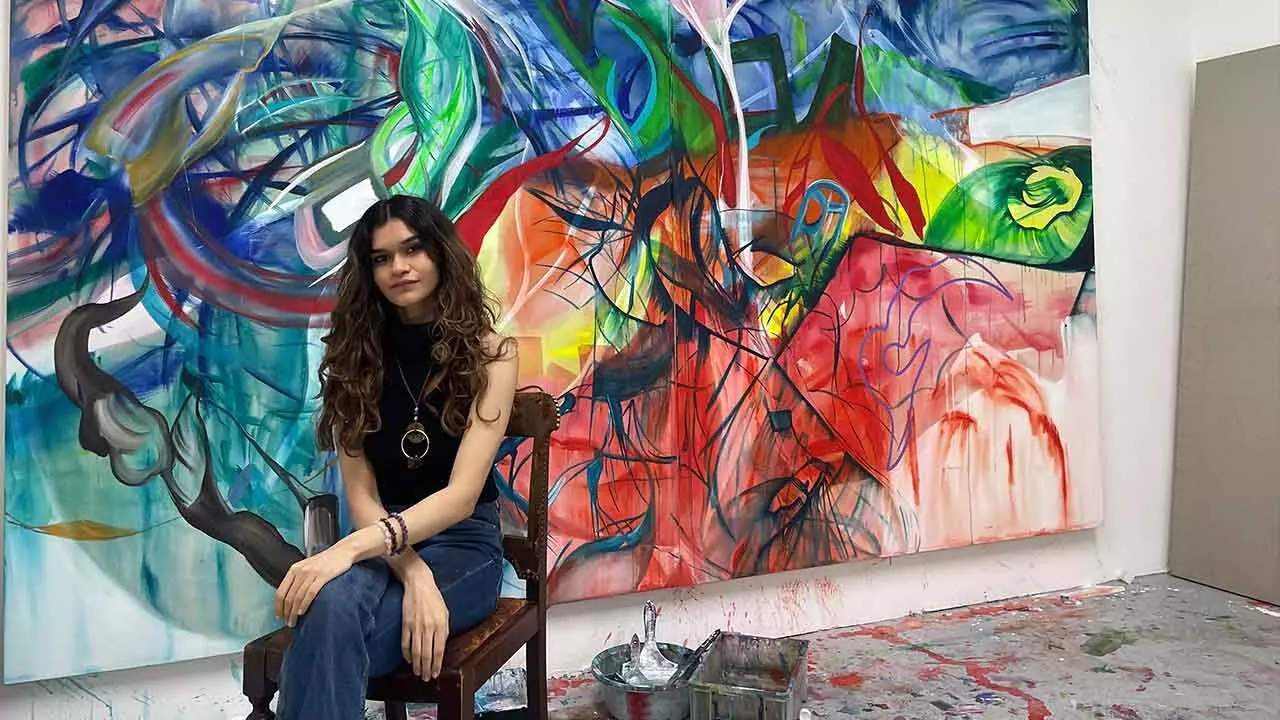
Painter Mannat Gandotre approaches abstraction as a living, breathing system — one shaped as much by improvisation and atonality as by memory, structure, and spiritual inquiry. A graduate of the Royal College of Art, Gandotre moves between New Delhi and London, drawing from the emotive architecture of Ragamala painting and the spatial tensions of contemporary abstraction. Her canvases do not present images to be deciphered; they propose atmospheres to inhabit.
In this conversation, she reflects on painting as an urgent act, the discipline of improvisation, and the charged dialogue between Indian visual traditions and a global contemporary art context.
You describe painting as an innate calling — even an urgent act. What compels you toward the canvas?
I’m a painter based in London, originally from New Delhi, India. Painting feels like a deep, innate calling — at times almost urgent. It’s how I work through existential and spiritual realities in physical form. Through the act of making, I try to summon portals — spaces one can reside within.
My process unfolds incidentally, through encounter, friction, and response. I’m drawn to atonality, improvisation, colour, frequencies, and ambient sound as visual systems. I’m interested in how form can become alive, almost sentient. I often think about how a painting might operate as a system rather than an image — something to enter rather than decode.
Your work often references jazz improvisation and atonality. How does musical dissonance translate visually?
Improvisation, for me, isn’t exclusive to music. It applies equally to painting. It’s instinctive decision-making guided by internal rules that develop through repetition and attention.
Atonality, in this sense, is about resisting hierarchy. No single form dominates. No colour resolves the composition without a fight.
I think of a painting as a kind of symphony, where forms and colours function like band members. Their gravitational pull in relation to one another generates tension. That tension produces chaos — but not disorder. It’s held together by an internal logic.
You’ve described painting as “creating problems and resolving them.” How does that tension unfold in a single work?
A painting may begin with intuitive gestures, but those gestures quickly generate problems. Introducing a colour I instinctively resist doesn’t mean removing it — it becomes a new force within the composition. A mark shifts pressure elsewhere. A colour alters its neighbouring forms. The entire system adjusts.
Resolution isn’t about equilibrium. It’s the moment when everything holds together under pressure. The tension remains — but it becomes coherent.
Ragamala painting historically visualises the emotional essence of music. How do you reinterpret this tradition within abstraction?
Ragamala stays with me not as imagery, but as structure — as a sonic system. Its sensitivity to mood, time, and intensity suggests that emotion can be organised rather than illustrated.
That sensibility informs how I approach abstraction. I’m interested in how a painting can hold atmosphere through rhythm and spatial tension without depicting anything literal. In that sense, painting becomes a way of tuning perception.
Your compositions balance intuitive mark-making with rigorous structure. How do you negotiate spontaneity and control?
The work begins with free association. I allow myself to move intuitively, trusting that openness will lead to serendipity. In those early stages, the hand moves like that of a dancer — responsive, instinctive.
As the painting develops, the process becomes far more precise. The hand shifts from that of a dancer to that of a surgeon. There’s less action and more looking, more thinking. That transition between spontaneity and control is what keeps the work alive while still holding it together.
Having studied at the Royal College of Art, how has working between Indian traditions and a global contemporary context shaped your vocabulary?
Working between Indian visual traditions and an international contemporary art context has made me attentive to what I think of as signals rather than influences.
Alongside references such as Ragamala or the murals of Ajanta Caves and Khajuraho Group of Monuments, I’m equally attentive to the theatrics of a boiling kettle, torn posters, or shadows on a staircase. These signals shape how I think about rhythm and instability.
A painting becomes a site of thinking, acting, and recognising.
Your work was recently part of Tendril of the Same Continent at the India Art Fair. How does it enter into dialogue with other contemporary abstractionists?
The work is driven by its own internal necessities, yet it inevitably enters a wider field of abstraction. In exhibitions like Tendril of the Same Continent, it can feel as though similar streams of thought are moving through the canvases — each operating through different systems of colour, line, and form, yet holding shared questions.
That’s what creates a conversation. Not mere proximity, but the intensity and urgency of seeking.