Advanced Automatic Protein Bar Making Line in India

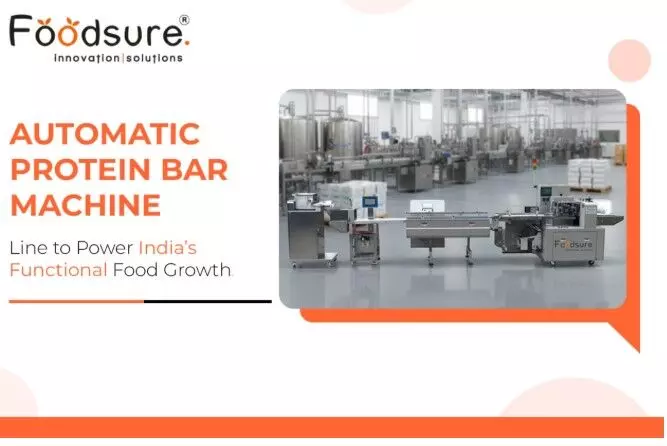
Set up a fully automated protein bar unit with an Automatic Protein Bar Making Line, engineered for clean and efficient production. Learn features and ROI today.
Foodsure Machines Launches Automatic Protein Bar Making Line to Power India’s Functional Food Growth
Walk into any Indian modern trade aisle, and you’ll notice something peculiar. Forget what you know about incremental growth, because the Indian functional food market is undergoing a seismic transformation, achieving a growth rate of 15+ CAGR. It’s a structural shift as a young, urban & nutritionally aware population has rewritten what “snacking” means. And, with that shift comes a manufacturing challenge that few plants in India can currently handle.
That vacuum is exactly what Foodsure Machines’ Advanced Automatic Protein Bar-making line comes to the rescue. Today, protein bar production is no longer a craft-floor experiment but a precision-driven industrial process, which is governed by ingredient flavour, mass-flow consistency & engineering discipline.
The Market: Why India Suddenly Needs Serious Automation?
India’s protein bar segment has grown more in the last 36 months than in the previous decade combined. What started as a niche urban demand has quietly expanded into Tier-2 & Tier-3 pockets. The industry has hit a maturity curve where:
● Manual or semi-manual production cannot meet uniformity demands
● Brands need speed-to-shelf to survive
● Modern trade demands predictable SKU consistency
● Investors value automated plants as strategic assets
● Export players need global compliance footprints.
Category | 2021 | 2024 | 2027 Projection |
Market Size (INR Cr) | 410 | 1,120 | 2,750 |
Automation Adoption | 18% | 41% | 67% |
New Brand Launches/Year | 22 | 64 | 90+ |
Export-Oriented Facilities | 6 | 21 | 48+ |
Market Snapshot Table (India: Protein Bar Manufacturing Demand).
This is not an incremental upstick, but a category formalisation. Manufacturing systems now need to evolve from “good enough” to “industrial-grade certainty.”
Where Manual & Semi-Manual Lines Collapse
Protein bar manufacturing is deceptive. It might look simple, but it’s a mix of ingredients, extrude, cut, cool, wrap. And yet, the process is extremely sensitive to variations. Protein powders behave differently under temperature stress. Liquid binders react unpredictably when shear forces vary. Nuts, seeds, and inclusions all shift the flow dynamics of the mass.
A semi-manual setup typically fails because:
● Thermal Exposure Is Uncontrolled: Heat pockets and uneven mixing deteriorate the protein matrix.
● Consistency Drops After Every Batch: Operators alter pressure, hand-mix durations, and binder ratios unconsciously.
● Scaling from 200 kg/day to 1,500 kg/day Becomes Impossible: Labour fatigue + material inconsistency = broken product lines.
● Cutting Accuracy Is Erratic: Bar weights fluctuate, leading to regulatory non-compliance.
● Hygiene Falls Short of Modern Trade Requirements: Manual interfaces increase microbial risk.
● Enter automation, not as a luxury, but as the structural foundation of tomorrow’s nutrition factories.
Metric
Insight / Data
Source / Notes
Global protein bar market size (2024)
USD 15.97 billion
Fortune Business Insights
Global projected market size (2032)
USD 24.25 billion
Growth across 2025–2032
Global CAGR (Protein Bar Segment, 2025–2032)
5.45% CAGR
Fortune Business Insights
Global protein snacks market (broader category)
USD 24.0B (2024) → USD 74.1B (2034), ~12.1% CAGR
Protein bars sit within this category (InsightAce Analytic)
India protein bar market size (2024)
USD 863.9 million
Grand View Research
India projected market size (2030)
USD 1,266.9 million
Indian market study
India CAGR (2025–2030)
6.6% CAGR
Higher than global baseline (Grand View Research)
India energy/protein-rich bars growth (subcategory)
14.0%+ CAGR (2025–2030), protein bars ~44% share
Strong demand for processing (Mordor Intelligence)
The Engineering Intelligence Behind Foodsure’s Automatic Protein Bar Line
This is where the conversation shifts from “machinery” to “industrial architecture”. Foodsure’s line isn’t a mechanical arrangement, but an integrated ecosystem that is engineered around flow behaviour, uniform thermal pathways, mass precision, sanitation control and continuity of output.
And, the system is built on five pillars:
● Controlled Mass-Flow Dynamics: A well-designed bar mass behaves like a semi-solid fluid. Too rigid, and the line chokes. Too loose and the bar shapes collapse.
Foodsure’s system controls:
❖ Rheology
❖ Material mobility
❖ Binder activation windows
❖ And, protein denaturation thresholds
This ensures the stability across batches without mass-ageing side effects.
● Low-Shear Mixing Engine with Thermal Governance: Protein matrices are fragile. High shear creates structural breakdown; uncontrolled heat deteriorates texture.
This line uses:
❖ Low-shear horizontal blending
❖ Temperature-governed jacket control
❖ Ingredient layering logic
❖ And, uniform binder distribution channels
The result is a consistent, strong, cohesive bar mass that holds its shape and eats well.
● High-Precision Extrusion and Bar Forming: Extrusion is the heart of bar uniformity.
Foodsure’s extrusion head manages:
❖ Width uniformity
❖ Pressure balance
❖ Density stability
❖ And, real-time flow correction
Even a slight variation of 1–1.5 mm can alter bar weight by 4–7%. This system ensures efficiency where others depend on the operator's “feel.”
● Intelligent Cutting Mechanism with Servo Accuracy
The servo-controlled cutting ensures:
❖ Millimetre-level length precision
❖ Controlled blade descent
❖ Real-time correction during speed fluctuations
❖ And, zero smearing or bar deformation
This is how brands achieve export-ready consistency.
● Rapid Cooling + Hygienic Conveyance: Cooling is not always about dropping temperature. It’s about stabilising the protein network. And, Foodsure’s cooling system:
❖ Regulates airflow speed
❖ Maintains humidity balance
❖ Ensures uniform set stability
❖ Protects bars from deformation during travel
This stabilisation window is critical for wrapping lines.
Graph: Growth of Automated Protein Bar Facilities in India Year | Number of Fully Automated Units
2019 | ███ 3
2020 | ████ 4
2021 | ██████ 6
2022 | █████████ 9
2023 | █████████████ 14
2024 | █████████████████ 19
2025* | ██████████████████████ 25+
(Projection based on industry trends and current commissioning rates)
The Business Logic: What Automation Actually Delivers
Automation isn’t about removing people; it’s about reducing variability.
Parameter
Semi-Manual Setup
Foodsure Automatic Line
Impact / Notes
Higher Throughput
180–350 kg/day
1,000–3,000 kg/day
4–8× increase in daily output
Material Savings
Irregular binder distribution → higher loss
Uniform binder distribution
3.8%–7.5% raw material savings, especially in nut/seed/protein-dense recipes
Labour Stability
High dependency on skilled operators; retention issues
Labour is redeployed, not reduced
Stabilises workforce demand; lowers reliance on specialised labour
Operational Continuity
Frequent variability in product quality
Consistent texture, shape, weight
Ensures batch-to-batch uniformity; reduces “consistency cost”
Export Compliance Support
Needs manual checks & documentation
Automated data traceability & control
Supports FSMA, BRC, FSSAI, HACCP, GCC
Many Indian plants never reach export readiness simply because manual work introduces preventable inconsistencies. Foodsure didn’t create machines, they engineered a production ecosystem tailored to India’s ingredient profiles, humidity conditions and ambient temperature variance.
The design philosophy stands on:
● Robust stainless architecture
● Modular maintenance access
● Sanitation-first construction
● Recipe flexibility (granola, nuts, high-protein, seed bars)
● Operator-friendly interfaces
● Energy-efficient drives
● Minimal downtime pathways
A plant that runs well is not the one that runs fast, it’s the one that rarely stops.
Installation + Commissioning: A Process, Not a Delivery
Most brands underestimate the commissioning phase. Foodsure treats it as a structured, critical engineering stage:
Factor
Description
Plant Layout & Spatial Planning
Airflow, material flow, and movement logic across the production floor.
Recipe–Process Alignment
Fine-tuning extrusion pressure and machine parameters based on ingredient ratios.
Operator Skill Transfer
Not just training — skill migration from manual handling to controlled automation.
Stability Trials
Batch-wise mapping of process parameters to achieve consistent output.
Scale Stress Testing
Long-duration, high-speed runs to identify and eliminate bottlenecks before full-scale production.
(Key Factors in Setting Up an Automatic Protein Bar Line)
ROI Framework: Why Investors Prefer Automated Plants
Automated protein bar lines have a unique ROI signature. Their return is not linear; it jumps sharply after a threshold with accelerator points of:
● Lower per-unit cost
● Faster production cycles
● Minimum batch rejection
● Standardisation → better retailer relationships
● Export capability → higher-margin markets
● Predictable supply → better investor confidence
On average, most facilities recover investment in 14–26 months, depending on brand scale.
Case Insight: How Automation Changes Brand Trajectory?
A mid-sized brand scaling from 300 kg/day to 1,800 kg/day will experience a shift that isn’t merely quantitative.
They gain:
● Shelf presence reliability
● Ability to commit to modern trade volume
● Retailer confidence uplift
● Reduced operational firefighting
● Improved brand perception
● Higher valuation
A machine doesn’t change the brand, consistency does. Automation brings that consistency.
The Future: What This Technology Enables?
Over the next 5–7 years, India’s protein sector will see:
● High-fibre functional bars
● Performance segments (collagen, creatine blends)
● Clean-label, binder-free formulations
● Nut butter-based bars
● Ayurveda-infused nutrition formats
Foodsure’s line already supports this trajectory because its architecture isn’t built for one recipe, it’s built for “Material Behaviour Logic.” That’s what gives it longevity.
Conclusion
The protein bar category has exited the “startup phase” & entered the “industrial phase”- one where scale, uniformity, hygiene and engineering precision define which brands thrive. Foodsure Machines has taken a clear position in this fast-moving shift: Build manufacturing ecosystems that India can rely on for the next decade. Not just to meet demand, but to define the standard.
If India’s nutrition market is the engine, automated manufacturing is the gearbox, and Foodsure’s Automatic Protein Bar Making Line is built to shift the industry into its next gear.