MyVoice: Views of our readers 16th Dec 2025


Views of our readers
Today is Victory Day
The Indo-Pakistani war of 1971 that saw the creation of the People’s Republic of Bangladesh. marks a major victory for India and a humiliating defeat for Pakistan. The internal crisis between East and West Pakistan led to the third war between India and Pakistan and secession of East Pakistan. Delhi intervened in the conflict to help the more suppressed Bangladeshi people by crossing the border into East Pakistan in December 1971.
The Bangladesh liberation War ended with the surrender of 93,000 East Pakistani forces to Indian forces on December 16, 1971 with Pakistan Eastern Commander Ln Gen A A K Niazi signing the instrument of surrender to Indian Forces. This day is known as ‘Victory Day’ or ‘Vijay Diwas’. Bangladesh has a special place in India’s ‘neighbourhood first’ policy and the relation is ever more crucial in the current geopolitical scenario as well.
Dr B Madhusudhan Reddy, Karimnagar.
Honour ‘real Sydney hero’ Ahmed
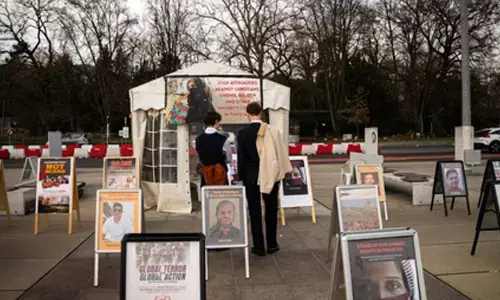
In the shocking terror attack at Sydney beach, the one man who emerged as the real saviour Ahmed al Ahmed, who risked his life, ran to the shooter and snatched his gun forcing the attacker to retreat. Alas, Ahmed got shot and suffered injuries on his arm and hand.
But his brave act helped save several lives. We request Australia, and all nations, to honour him with their respective bravery and gallantry awards. In fact, a more rewarding recognition would be in bestowing him the 2026 Nobel Peace Prize. This will inspire many citizens to do their bit to nullify terrorism in all its forms.
Sreelekha P S, Secunderabad-61
Prioritise united fight against air pollution
The editorial ‘Good to see Govt, Oppn agree to discuss air pollution in Parliament’ summed up the essential essence behind the issue to be discussed in the Parliament – the severely polluted and contaminated air that we all are breathing.
Meanwhile, the proposed course of action of the debate must not end up in needless accusations but must result in drawing a long-term map for Delhi NCR and other cities that are reeling under the looming threat of air pollution and toxic air that is unfit to breathe.
K R Venkata Narasimhan, Madurai
There are more pressing issues than Vande Mataram
Apropos ‘One day of unity; many days of hypocrisy’ (THI Dec 13). The writer has given a break to habitual Congress-bashing, by praising the leader of the opposition for indulging in a tame Parliamentary debate on the worsening pollution in Delhi. Rahul Gandhi’s mellowed debate drew equally tame response from the government which agreed to work together on the issue, displaying rare, desirable unity.
When the 150th anniversary of the national song, Vande Mataram was debated, it was back to wasteful rabble rousing with the government, led by Prime Minister Narendra Modi accusing Jawaharlal Nehru of altering the original Vande Mataram written by Bankim Chandra Chaterjee to appease Muslims, and also of being responsible for Partition. What did the government achieve by harping on Vande Mataram when there were other important issues like the IndiGo fiasco and SIR awaiting immediate attention?
Dr George Jacob, Kochi
Skills are reshaping traditional education
The article about the need for upskilling (THI Dec 14) sheds light on the evolving job market, where the debate between degrees and skills is becoming increasingly relevant. As the job landscape continues to shift, it is essential for educational institutions and students to recognise the importance of integrating both degrees and skills to stay ahead in the game. Degrees provide a comprehensive knowledge base, credential, and credibility, while skills offer practical experience and immediate workplace readiness.
Meanwhile, rather than pitting one against the other, we should focus on blending them for a well-rounded workforce. By carrying out a balanced approach, we can ensure that students are equipped with the theoretical foundation and the practical skills required to succeed in their chosen careers. Educational institutions must step up and redesign their curriculum to include real-world case studies, problem-solving tasks, and internships.
Moreover, institutions should forge partnerships with businesses to co-design courses and provide students with hands-on training. I agree that the Indian education system must evolve from being degree-focused to skill-empowered, where academic qualifications meet real-world skills. This way, we can shape a generation that is adaptable, resilient, and prepared to meet the demands of a rapidly changing global economy.
Kolluru Raju, Kakinada