H-1B Visa: The hardest hit will be...

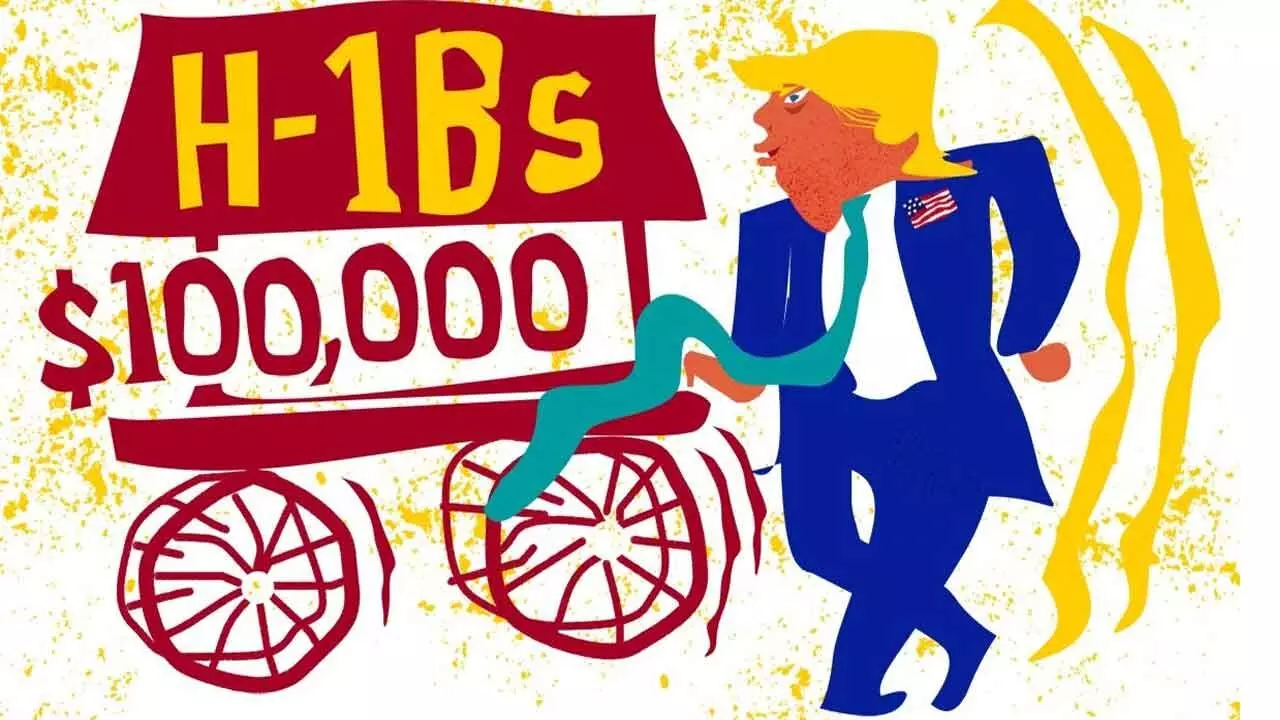
The US has replaced random H-1B selection with a wage-weighted lottery and a new $100,000 fee for applications, raising uncertainty for students and junior hires
New Delhi: The year 2025 is set to mark a turning point in the United States' immigration regime, with the random H-1B visa lottery system, used for over three decades, giving way to a new weighted selection framework.
Adding to the shift, a US federal judge has upheld President Donald Trump's proposal to impose a $100,000 fee on new H-1B visa applications.
Together, these changes have injected fresh uncertainty into the global talent pipeline, particularly for international students and entry-level professionals, as employers recalibrate hiring strategies around wage thresholds and local talent availability.
Industry body Nasscom in a statement said the recent changes with regards to the wage-weighted selection mechanism for H-1B visas represents a significant departure from the long-standing neutral lottery system, and raises important legal, economic and operational concerns.
'A sudden shift to a wage-weighted model would introduce uncertainty, increase compliance complexity, and disrupt long-established workforce planning, particularly for smaller and mid-sized firms that align recruitment with academic calendars, client delivery schedules, and product release cycles,' said Nasscom.
The new system, according to experts, is likely to tilt early-career hiring in favour of domestic candidates.
While this could benefit large technology companies with deeper pockets, smaller firms and startups that rely on global talent may face greater pressure.
"Companies will have to offer the highest range of wage to maximise the chances of the person being hired," Cyrus D Mehta, founder of a New York-based immigration law firm, said.
"The number of visas being issued under the H-1B category remains the same -- 65,000, and 20,000 for those with advanced degrees. However, the priority now will be given to those who pay the highest salary."
The new weighted system, Mehta said, will impact students and entry-level professionals. The latest move will benefit big tech companies which will be able to offer higher wages.
However, the US government's decision to eliminate random selection and instead prioritise higher-paid, higher-skilled foreign workers is unlikely to significantly alter the hiring strategies of Indian IT services companies, according to industry executives and immigration experts.
Late Tuesday night, the US department of homeland security amended regulations to replace the random lottery with a weighted process based on skill and wage levels.
In a press note, the DHS said the change was intended to 'better protect the wages, working conditions, and job opportunities for American workers.'
'The existing random selection process of H-1B registrations was exploited and abused by US employers who were primarily seeking to import foreign workers at lower wages than they would pay American workers,' said US Citizenship and Immigration Services Spokesperson Matthew Tragesser. Currently, the US issues 65,000 H-1B visas annually, with an additional 20,000 reserved for advanced degree holders from US universities.
Indian firms have historically secured a large share of these visas, though many have reduced their dependence over time by increasing onshore hiring.
The lottery hasn't been eliminated, it is no longer "random", noted Poorvi Chothani, managing partner at LawQuest.
Selection will now be weighted based on the US department of labor's Occupational Employment and Wage Statistics (OEWS) levels. Under the revised system, candidates offered Level 4 wages, the highest tier, will be entered into the selection pool four times, Level 3 candidates three times, Level 2 twice, and Level 1 only once.
Employers should therefore prioritise candidates whose skills and qualifications justify a Level 4 wage, said Chothani.
For large Indian IT firms, the impact is expected to be manageable.
"H-1B dependence has already declined materially," said Gaurav Vasu, founder and CEO of UnearthInsight. "Applications by top Indian IT companies fell from about 24,300 in 2022 to around 13,500 in 2024, a drop of over 40 per cent."
Vasu added that while mid-tier and smaller firms may face margin pressure, US technology giants such as Amazon, Microsoft, Google, and Meta are unlikely to alter hiring plans, as they already pay at higher wage levels.
In his efforts to further prevent the alleged misuse of the H-1B visa process, Trump, earlier in September, mandated that a $100,000 fee accompany new H-1B visa applications.
US District Judge Beryl Howell said in a ruling on Tuesday that the move to radically increase the cost of the popular visa was lawful.
Sources in the ministry of electronics and information technology said Indian IT companies had assured the government that the impact would be minimal.
"Our preliminary assessment suggests companies remain on track with hiring plans in both India and the US," a senior official said.
Indian IT services firms have been reducing reliance on H-1B visas since Trump's first term as US president.
In a recent interview with Business Standard, TCS CEO and MD K Krithivasan said the company could "survive" without such visas.
"In FY26, we sent just 500 people from India to the US on H-1B visas... There is no dependence," he said.
Similarly, Infosys CEO Salil Parekh said during the company's second-quarter results briefing that only a minority of employees require visa sponsorship.
'We have built a large number of centres and hubs, which are focused on digital, on innovation, on technology and AI in the US. We have relationships with universities. We have a training facility there... We will work with our clients without any disruption to their services,' said Parekh.