Maharashtra Political Workers Assault Migrant Auto Driver Over Language Dispute

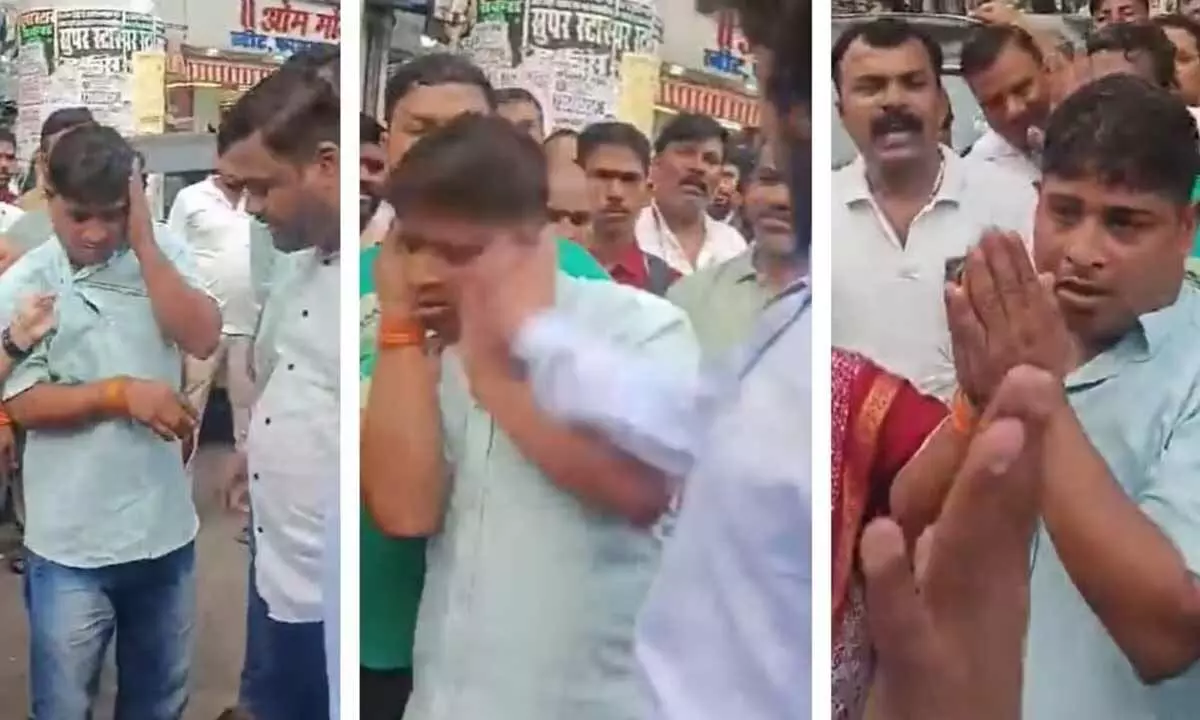
Shiv Sena and MNS workers physically attacked a migrant auto-rickshaw driver in Palghar after viral video showed him refusing to speak Marathi and insisting on Hindi and Bhojpuri communication.
A migrant auto-rickshaw driver faced public assault in Maharashtra's Palghar district by activists from Uddhav Thackeray's Shiv Sena faction and Raj Thackeray's Maharashtra Navnirman Sena following a viral confrontation over language preferences. The incident occurred days after a video surfaced showing the driver's refusal to communicate in Marathi.
The controversy began when the auto-rickshaw driver was recorded near Virar station confronting a local youth about language use. In the viral footage, the driver could be heard aggressively stating his preference for Hindi and Bhojpuri communication while declaring his unfamiliarity with Marathi. The driver was captured on camera telling the youth, "I will speak in Hindi, I will speak in Bhojpuri. I don't know Marathi," while appearing to force the local resident to communicate in languages other than Marathi.
The video circulation prompted strong reactions from regional political organizations, leading to coordinated efforts by Shiv Sena and MNS workers to locate the driver. The political activists subsequently confronted and physically assaulted the driver in broad daylight near the same Virar station where the original incident occurred.
On Saturday, a group comprising both male and female activists from Shiv Sena (UBT) and MNS surrounded the migrant driver on a busy public road. The assault was conducted openly, with the driver being slapped and beaten by multiple individuals. The political workers forced the driver to issue a public apology to the man and his sister, with whom he had allegedly behaved inappropriately during the earlier encounter.
The forced apology extended beyond the immediate victims to include the broader population of Maharashtra, with the driver being compelled to express regret for allegedly disrespecting the Marathi language and cultural icons associated with the state. The public nature of both the assault and the apology demonstrated the activists' intention to make the incident a visible example.
Shiv Sena (UBT) Virar city chief Uday Jadhav, who was present during the assault, publicly defended the violent action taken against the driver. Jadhav justified the assault as an appropriate response to perceived insults against Marathi language and culture, stating that anyone who disrespects Maharashtra, the Marathi language, or Marathi people would receive similar treatment in what he described as "true Shiv Sena style."
Local Shiv Sena functionaries echoed this sentiment, characterizing the assault as a "befitting lesson" delivered to the driver for his earlier behavior. The political workers portrayed their actions as defending regional linguistic pride and cultural identity against perceived disrespect from migrant populations.
Despite the widespread circulation of assault videos on social media platforms, law enforcement authorities reported that no formal complaints had been filed regarding the incident. Police officials stated that while they had viewed the viral footage and were conducting fact-verification processes, no individuals had come forward to register official complaints about the assault.
The language-related tensions have expanded beyond the immediate incident, affecting neighboring districts across the region. On July 1, MNS workers allegedly physically confronted a food stall owner in Bhayander, Thane district, for not conducting business in Marathi. This incident prompted local traders to organize protest demonstrations against such confrontational tactics.
The traders' protest actions subsequently led to counter-demonstrations organized by MNS and other regional political groups on July 8, with participants claiming to defend Marathi "asmita" or cultural pride. These counter-protests resulted in law enforcement detaining several workers from MNS, Shiv Sena (UBT), and NCP (SP) organizations.
The escalating incidents reflect broader tensions between regional linguistic identity movements and migrant populations in Maharashtra. The pattern of confrontations demonstrates how language preferences have become flashpoints for political mobilization and cultural assertion in the state's urban areas.