Majuli women show the way…Turning invasive water hyacinth into useful handicraft items

Guwahati: Water hyacinth, a fast-growing weed, is notorious for forming dense mats that block sunlight, kill native plants, deplete oxygen, and disrupt aquatic life. The free-floating perennial is known also for creating mosquito breeding grounds, obstructing waterways for boats and irrigation, damaging fisheries, and increasing flood risks, leading to severe ecological, economic, and health hazards. However, beating odds, resourceful women in Majuli, Assam have put water hyacinth to multiple uses, weaving an exemplary story of empowerment in rural Assam.
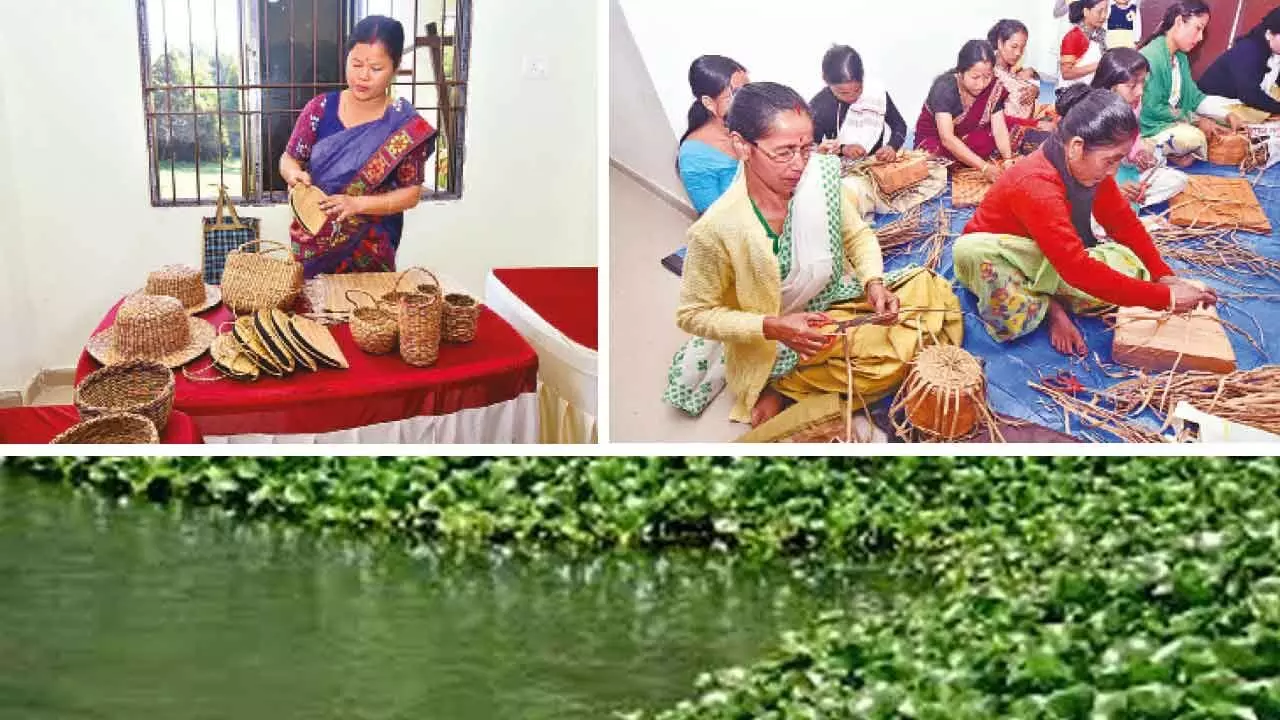
These Majuli women have transformed water hyacinth, locally known as ‘pani meteka’ (gurrapu dekka in Telugu), into a means of livelihood, sustainability, and pride by creating handicraft items, including utility products like purses, handbags, table mats, yoga mats and baskets, among others.
Water hyacinth reproduces quickly and often clogs slow-flowing streams and is widely considered only a waste that is best cleared from water bodies to prevent their further deterioration.
Majuli is the largest river island in Assam; it is bordered by the Brahmaputra River to the south and east, the Subansiri River to the west, and an anabranch of the Brahmaputra to the north. It abounds in water hyacinth, making the district a key cluster for this initiative, demonstrating resilience and innovation.
The North-Eastern states are already well-known for distinctive products made from bamboo and cane; now, water hyacinth has been added to the region’s standout handicraft products.
The Assam State Rural Livelihood Mission (ASRLM) thought of starting an intervention to utilise this natural resource by making handicraft items out of it. The project was eventually named by the livelihood team as ‘Weed to Wealth’. The women here saw potential in it as an eco-friendly activity.
Artisans skillfully transform water hyacinth stems into a diverse array of handmade products.
Amiya Mili, a woman, stated that by converting a locally sourced renewable resource into appealing and long-lasting products, new opportunities for income generation in rural areas were also created. “Under the ASRLM of the Government of India's NRLM, over 90 women work and craft useful products in the two units in Majuli,” she added.
Empowering women by training them in water hyacinth craft skills not only enhances their livelihood options but also contributes to conservation efforts by transforming an invasive plant into marketable products. This sustainable approach fosters economic independence while creatively utilising resources to address environmental challenges.
From some 50 kg of raw hyacinth plants, 15-20 kg of usable products can be made. Amiya explained that the process of transforming water hyacinth into useful products involves harvesting, cleaning and drying, splitting and stripping, dyeing and weaving them into the desired products. The resulting product resembles bamboo but is more affordable. “A product priced at Rs 500 in Assam can fetch Rs 2,500 in other states. People in other regions are much more cognisant of the worth of natural and handcrafted items,” she remarked.
Jnandeep Saikia, project manager ASRLM, said that it aims to transform this environmental issue into opportunities for economic and ecological benefits through innovative applications such as crafting and organic fertilizer development. The initiative aims to help these women earn a stable income. Water hyacinth grows abundantly in ponds and lakes of the local villages. Their activity will also help rejuvenate the water bodies.
Each woman has an average annual income of Rs 80,000 through this initiative. Banks are extending credit support, and marketing assistance is being facilitated by government agencies. The products are now available online and are receiving encouraging responses from across India.
The project manager said that under this initiative, women’s Self-Help Groups (SHGs) receive structured training, access to common facility centers, and support in product development. The crafted items—such as bags, baskets, mats, and home décor products—are promoted through modern marketing channels, including platforms like Asomicart, helping artisans reach wider markets.
“The Water Hyacinth Project stands as a powerful example of rural innovation, combining traditional craftsmanship with contemporary design, and market linkages. By transforming an invasive weed into a valuable resource, the initiative not only mitigates environmental damage but also enhances the livelihood options and economic independence of women across the region,” said Jnandeep Saikia.