KLIP collective decision of Cabinet, not mine alone: KCR

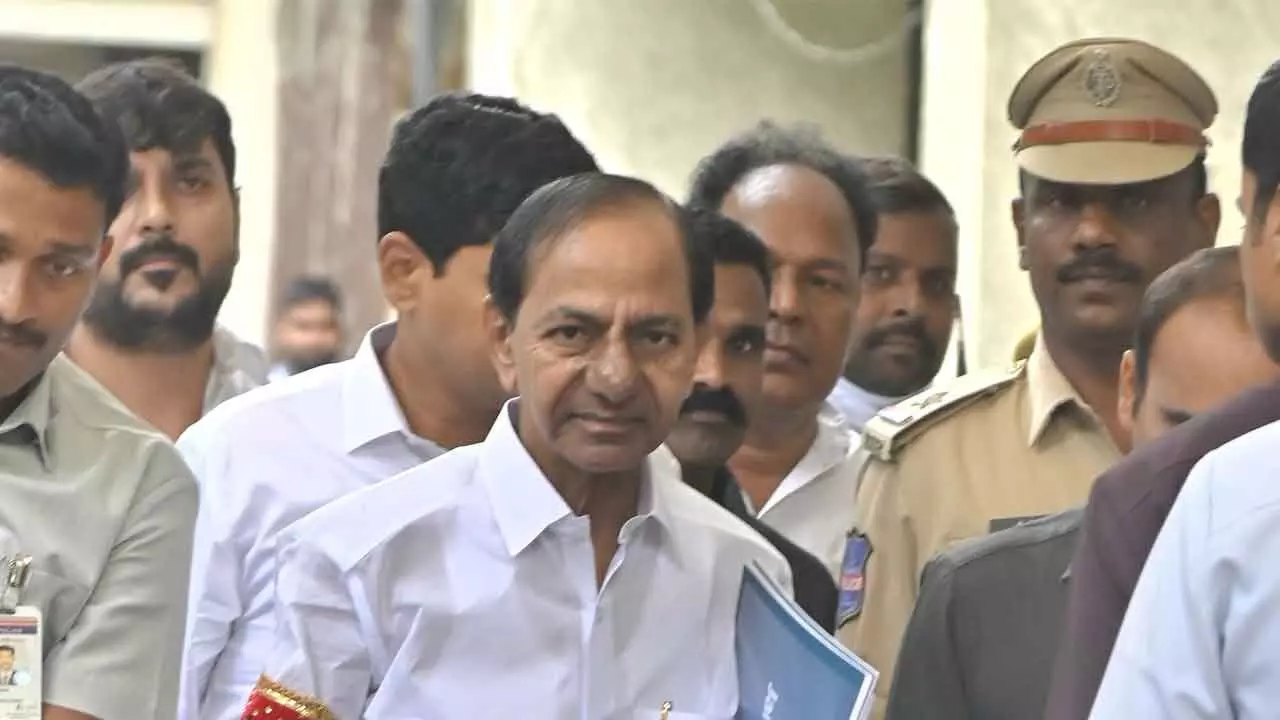
BRS chief deposes before Ghose panel in one-to-one inquiry
Hyderabad: Former chief minister K Chandrashekar Rao, putting the record straight on charges made by his detractors that the Kaleshwaram Lift Irrigation Project (KLIP) was his one-man show from concept to execution, told the Justice PC Ghose Commission, which is probing alleged irregularities in the project, that KLIP was constructed as per the collective decision of the state Cabinet and that he did not take any individual decisions in the construction of the project.
The BRS supremo deposed before the Commission, which earlier accepted his request to conduct a one-to-one inquiry without open court questioning in view of his frail health.
The former CM also disclosed the reasons for the completion of the project in just three years.
“Every decision with regard to the finalization of the project designs, location of the barrages and reservoirs, execution of the works and maintenance of the project and barrages were done only after the approval of the technical committees and engineers,” KCR told the Commission.
The Commission posed 18 questions to KCR, focusing mainly on his alleged role in the finalization of the project and barrages, damage suffered by three barrages – Medigadda, Annnaram and Sundilla, scrapping of the Tummidihetti barrage, release of water to barrage, mobilization of funds by constituting Kaleshwaram Corporation, utilization of funds etc.
Justice PC Ghose specifically sought to know the reasons for the completion of a project as big as Kaleshwaram project in a short time. It is learnt that KCR explained the urgency of the completion of the project to provide a succor to distressed farmers in the dry areas.
Further, KCR told the Commission, WAPCOS’ recommendations on the location change and water availability were taken into consideration during the construction of the project.
Explaining the main objective of the Kaleshwaram project, the former CM said that the government formed a corporation and borrowed money to complete the project without any delay.
When the Commission inquired about the release of water to the barrages, KCR explained he had no role in that and mentioned that the project engineers were responsible for the maintenance of water levels in the barrages.
The Maharastra government’s objection to the Tummidihetti was the main reason to construct a barrage at Medigadda, the former CM said.
The technical team recommended the construction of the three barrages and the Central Water Commission (CWC) made some suggestions which were also accepted by his government.
Official sources said that KCR submitted all documentary evidence in support of his submissions such as government orders, CWC letters and Technical Committee study on the project to the Commission during the 50-minute-long quizzing.