State’s schoolkids’ eye care earns national recognition

Vijayawada: The Andhra Pradesh medical and health department received national-level recognition for its effective implementation of free eye screening and spectacles distribution for schoolchildren over the past two years.
According to the latest report of the Union ministry of health and family welfare under the National Programme for Control of Blindness, the state’s proactive efforts in achieving targets set for the 2024–25 and 2025–26 academic years have emerged as a model for other States. The Centre has appreciated Andhra Pradesh’s best practices and announced that guidelines will soon be issued to replicate these measures nationwide.
In a move reflecting this recognition, the Centre has enhanced the annual target for spectacles distribution to Andhra Pradesh for the 2026–27 academic year from 90,000 to 2.5 lakh students. Medical and health minister Y Satya Kumar Yadav congratulated department officials on the achievement and urged them to sustain the same spirit and commitment in the coming years, the department said in a statement on Friday.
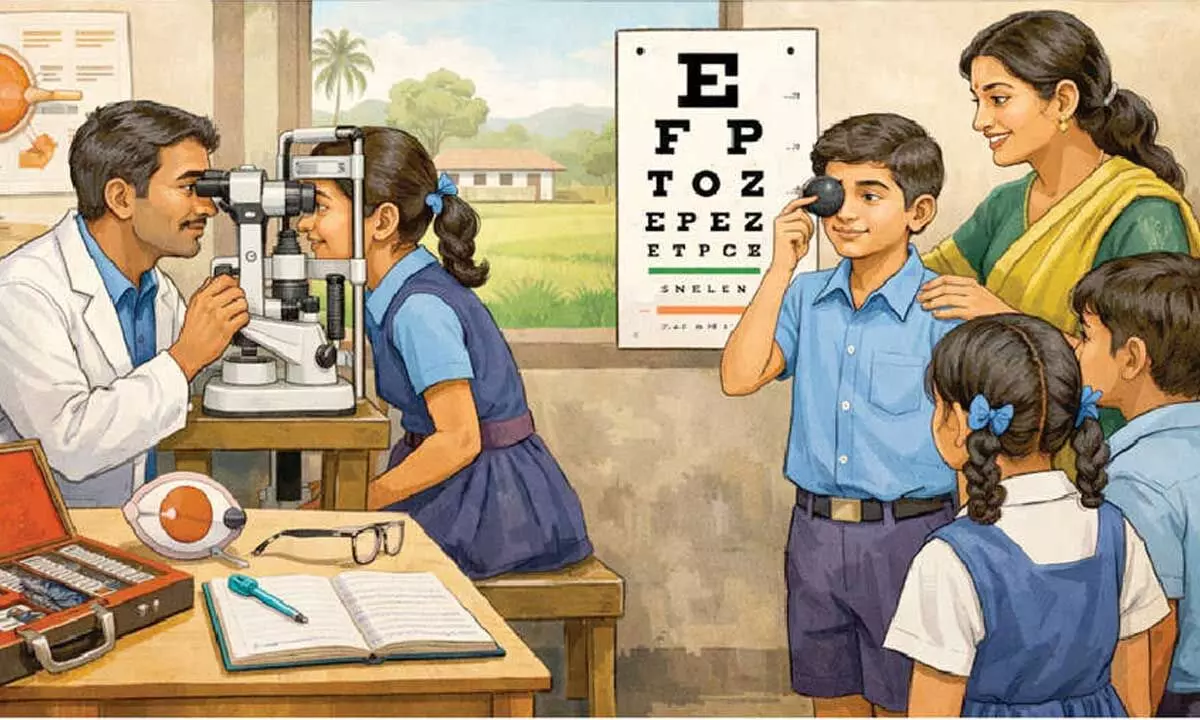
As part of the National Programme for Control of Blindness, free eye examinations are conducted for students studying in government schools, with spectacles provided to those found in need. The programme is jointly funded by the Centre and the state in a 60:40 ratio, with a total expenditure of Rs 3 crore. The cost per spectacle is capped at Rs 280.
Eye tests are conducted for government school students aged between six and 18 years by paramedical ophthalmic officers and assistants every year from July to November.
Initially, the Centre had set a target of providing spectacles to 90,000 students with vision below 6/12. Schools are selected for screening based on regional requirements and the socio-economic background of students.
Once eye examinations conclude in November, the district Blindness Control Society, under the supervision of the district collector, selects spectacle suppliers through an open tender process. Distribution is completed by February each year. The quality of spectacles supplied by the selected agencies is tested using lensometers, and any substandard products are rejected and replaced.
State programme officer and joint director Dr Sunil Kumar Naik said continuous reviews of screening progress, staff deployment and speedy completion of tender procedures have helped achieve the desired outcomes. He added that the satisfactory progress in screenings and spectacles distribution prompted the Centre to scale up the target to 2.50 lakh students for 2026–27, involving an estimated expenditure of about Rs 7.7 crore.
For 2024–25, against a target of 90,000 students, spectacles were distributed to as many as 1,89,102 students. For 2025–26, arrangements have already been completed to distribute spectacles to 94,689 students, with the number expected to rise further. Notably, voluntary organisations have also come forward to extend services beyond the stipulated targets.