How childhood experience impacts retirement wealth

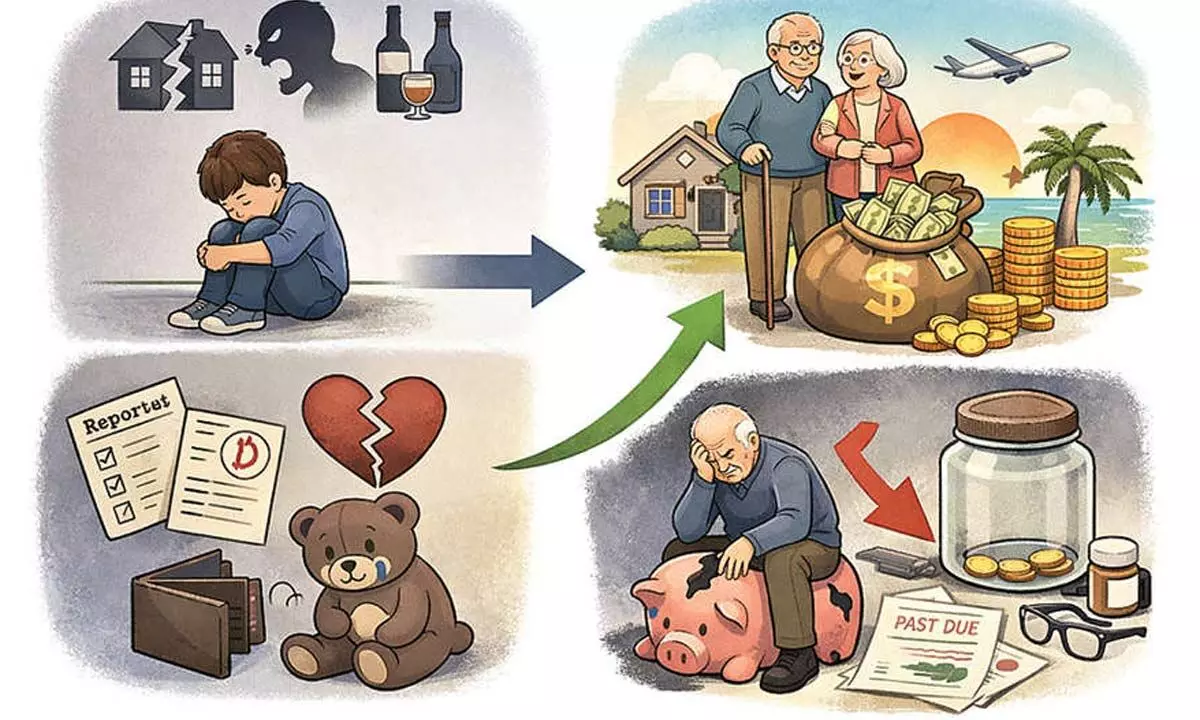
Weknow that investment decisions and thus the outcomes are largely destined by the investor behavior. This is a cumulative history of biases, beliefs and experiences. New research threw further light on how Adverse Childhood Experiences (ACE) such as abuse, neglect and household dysfunction significantly impact their retirement corpus. Broadly, the work collates how these traumas create long term financial deficits that persist even when accounting for factors like education and family.
These ACEs have been associated with less education and employment, lower earnings and higher rates of divorce. Such outcomes are damaging on their own and can also impede the ability to build wealth. But very limited research has focused on the ACEs and wealth as individuals approach retirement. Centre for Retirement Research of Boston College highlight that while these experiences cannot be changed, the findings emphasize the critical role of Social Security as a financial backstop and the need for personized financial planning that addresses emotional, trauma-based financial behaviors.
In the ’90s, a seminal study based at Kaiser Permanente’s San Diego Health Appraisal Clinic first laid out the idea of ACEs, identifying 10 experiences that fit into three broad categories: abuse, neglect and household dysfunction. Since this initial flurry of research, more recent studies have found that these physical and mental health impacts spill over to individuals’ finances. Before people even start their careers, ACEs reduce the probability of getting a college degree, one of the best predictors of career earnings. Once working, those with ACEs have high rates of absenteeism and other issues at work.Not surprisingly, they also have much higher rates of nonemployment.
This survey began as a sample of 12,686 individuals ages 14-22 (born from 1957-1964), who were ages 52-60 at the end of our analysis period.The retrospective nature of the data deserves some attention, since individuals may either forget adverse events as they age, exaggerate them to justify poor economic or other outcomes, or inaccurately report such events for a variety of reasons (e.g., shame, trauma, family pride, community norms).
This analysis measures wealth as assets minus liabilities for the individual’s household Assets include savings and checking accounts as well as directly held stocks, bonds, and CDs, and the value of retirement accounts such as 401(k)s and IRAs. Assets also include the self-reported value of homes, other real estate, vehicles, and businesses. Debts include money owed on homes, other real estate, vehicles, and businesses, as well as any revolving debt.
The uncontrolled results present a stark reality – individuals that have experienced ACEs end up with net worth near retirement that is $48,000 to $85,000 lower than those without ACEs. Compared to the median net worth of $110,000 for those without any ACEs, the impact magnitude represents a relative reduction of 44 to 77 per cent. Looking at the results with controls, the effect sizes range from $28,000 for those with parental separation to $50,000 for those with a mental illness in their household growing up.
These reductions are also considerable creating persistent consequences – ranging from 25 to 45 per cent relative to those without ACEs. And, importantly, these large negative effects are occurring for people who otherwise come from similar households with respect to race, parental education, and parental income.
People who experience significant childhood adversity accumulate 25 to 45per cent less wealth by their fifties and sixties. That’s a loss of $250,000 to $450,000 for every million dollars a person might have amassed.Through no fault of their own, the lasting impact on them, the late-career adults analysed in this brief were exposed to ACEs as children. Those ACEs are correlated with negative impacts on their financial lives. These insights could play crucial for advisors and investors alike in understanding at their failure to save and invest optimally.
(The author is a partner with “Wealocity Analytics”, a SEBI registered Research Analyst firm and could be reached at [email protected])