Kanwar Yatra: When governance becomes management of religious events

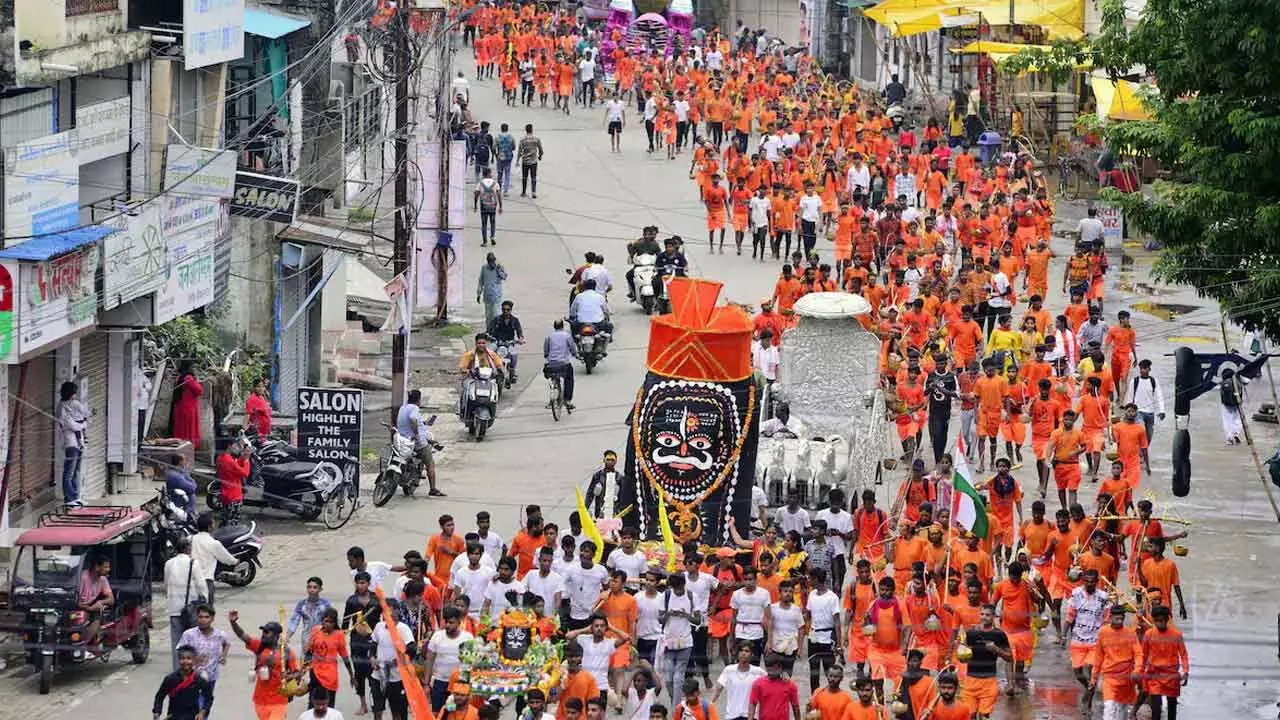
It looks like the Yogi Adityanath regime in Uttar Pradesh and large sections of the Sangh Parivar equate governance with the management of religious events. First it was Mahakumbh and now it is Kanwar Yatra. Incidentally, it is not just the government machinery, but life itself finds itself enmeshed in the intricacies of pilgrimages. The Kanwar Yatra, a deeply revered Hindu pilgrimage undertaken in the month of Shravan, draws lakhs of devotees, known as Kanwariyas, walk long distances to fetch water from the Ganga and offer it to Lord Shiva in temples.
Over time, this event has evolved from a humble spiritual exercise into a massive and heavily orchestrated religious procession, drawing extensive state support. In UP, as in other BJP-ruled states like Uttarakhand, Haryana, and Delhi, the Kanwar Yatra transforms the civic and administrative landscape for several weeks each year. It is no different this year. As the yatra gains momentum, several districts in UP have taken the extreme step of shutting down schools temporarily. The ostensible reason is to safeguard students amid overwhelming road congestion, traffic diversions, and the general chaos that accompanies the event.
District administrations have also rerouted traffic, deployed thousands of police personnel, and put civic services on high alert. Roads are reserved for Kanwariyas, while ordinary citizens face long detours and disruptions to daily life. Worse still, educational institutions being closed for religious reasons sets a problematic precedent. It sends a clear message: spiritual events, when they reach a certain magnitude, can override secular responsibilities like education. Students, particularly from rural and lower-income families who rely heavily on government schools, are the silent victims. Their academic calendar, already fragile due to Covid-related disruptions in recent years, is being tampered with for reasons that are no way related to education.
This normalisation of such disruptions reflects a misplaced priority. Thankfully, the Supreme Court has taken cognisance of petitions challenging another controversial move by the state government: a directive mandating eateries and dhabas along the Kanwar route to display QR codes with ownership information. Ostensibly framed as a security measure, critics argue that this directive opens the door to surveillance and possible targeting of minority-run establishments.
There is a growing perception that such policies are less about public safety and more about religious profiling, under the guise of administrative diligence. The apex court has rightly sought an explanation from the Uttar Pradesh government on the legality and intent behind this decision. What is alarming is how all stakeholders—administrators, judges, law enforcement—are sucked into the vortex of this religious exercise, willingly or otherwise. From district magistrates to police commissioners, from municipal workers to teachers, almost every arm of governance is redirected to facilitate a pilgrimage.
This is not just an expression of religious accommodation but an institutional surrender to spectacle. Governance is becoming indistinguishable from the management of festivals. This must stop. There is nothing wrong with supporting religious events in a secular and diverse democracy like India. It is entirely reasonable for the state to ensure safety, hygiene, and traffic regulation during such events. However, when religious festivities start dictating the tempo and tenor of governance, it becomes problematic.
When students are denied education so that roads can be cleared for devotees, when businesses are monitored in the name of religious security, when hospitals, fire services, and administrative offices and that is when one should take such initiative with a pinch of salt.