Orange Economy: Major tributary to Viksit Bharat

The recent Budget-2025 lays a strong foundation for Bharat’s Orange aka Creative Economy, positioning it as a key driver toward the Viksit Bharat 2047 vision.
The recent Budget-2025 lays a strong foundation for Bharat’s Orange aka Creative Economy, positioning it as a key driver toward the Viksit Bharat 2047 vision. With a focus on youth empowerment, tradition knowledge preservation, and a globally competitive creative sector, these provisions aim to make Bharat a leader in the global creative economy.
Strengthening Bhartiya Gyan Parampara
A major initiative in the Budget-2025 is the “Gyan Bharatam Mission”, which will document and conserve over 1 crore manuscripts through partnerships with academic institutions, museums, and private collectors. The establishment of a “National Digital Repository of Indian Knowledge Systems” will facilitate large-scale knowledge sharing.
Budgetary allocations for Indian languages have increased to ₹347.03 crore for 2025-26, marking an 11.91% rise from the previous year. This investment strengthens Bharat’s multilingual creative sector and enhances cultural preservation.
Bharat’s Orange Economy: An Engine for Growth
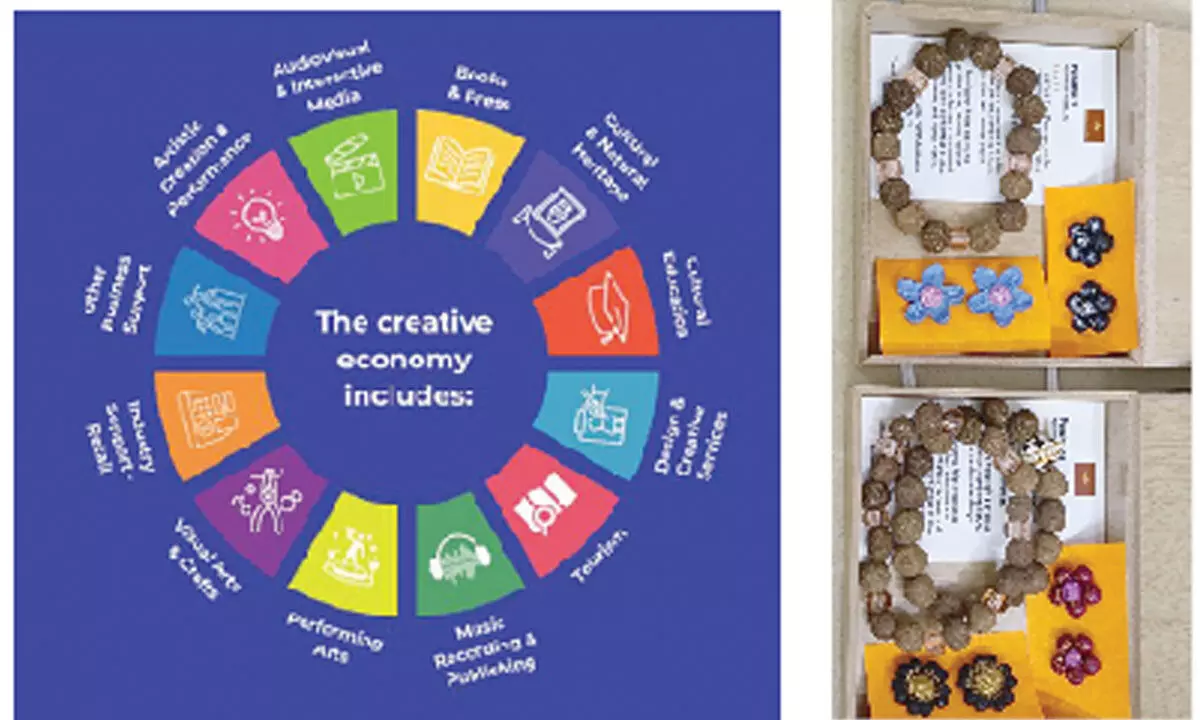
Valued at ₹50,000 crore (US$6.14 billion) in 2019-20, Bharat’s Orange Economy spans 12 domains, including performing arts, crafts, film, AI/VR, and gaming. While COVID-19 reduced its GDP contribution from 2.5% to 1.5%, digital transformation and policy support are set to accelerate its growth. Bharat is already among the top 10 global exporters of creative goods, contributing US$13.8 billion (2.6% of global exports).
Globally, the creative economy generates over $2.3 trillion in revenue, contributing 3% to world GDP. Bharat’s vast cultural heritage and digital-native workforce present an opportunity to emerge as a leader in this space, with 10 crore youth entering the workforce annually.
Orange Economy: A Global Perspective
The Orange Economy includes arts, crafts, film, music, design, architecture, cultural tourism, and digital content creation. According to UNCTAD, creative industries employ over 50 million people worldwide, offering salaries 88% higher than non-creative jobs. This sector fosters innovation, strengthens cultural identity, and promotes social inclusion.
For Bharat, this economy enables the integration of traditional knowledge systems with modern economic frameworks, transforming handicrafts, textiles, and festivals from informal markets into structured, revenue-generating industries.
Unexploited Cultural Assets
Bharat cultural assets encompass:
● 4,000+ traditional crafts
● 2,500+ performing art forms
● 100+ UNESCO-recognised intangible cultural heritage elements
● Diverse languages, festivals, rituals, and natural assets
Despite this wealth, much of Bharat’s creative sector remains informal due to lack of financial support, institutional backing, and technological integration.
Historically, villages have blended agriculture and creative production, ensuring sustainability. Recognising them as creative production hubs can maximise their potential through:
● Formal recognition – Granting industry status to traditional crafts
● Digital expansion – Leveraging technology for global marketing
● Creative hubs – Establishing artisan clusters for collaboration
Cultural Festivals as Economic Catalysts
Cultural festivals drive economic growth via tourism, hospitality, and handicrafts:
● Maha Kumbh Mela 2019 – Attracted 120 million visitors, generating revenue of ₹1,200 crore for Uttar Pradesh
● Hornbill Festival, Nagaland – Contributes ₹100 crore annually
● Surajkund Mela – Supports thousands of artisans
Expanding and digitising these festivals can further strengthen Bharat’s global creative footprint.
Traditional Knowledge and Rural Employment
Bharat’s traditional knowledge systems—including Ayurveda, handloom weaving, folk medicine, and organic farming—hold vast economic potential. The handloom sector alone employs over 4.3 million people and significantly contributes to exports.
Strategies to enhance rural creative employment:
● Skill training – Combining traditional knowledge with modern techniques
● Financial support – Providing microfinance and low-interest loans
● GI tagging – Protecting indigenous products
● E-commerce integration – Connecting artisans with global markets
Demographic Advantage and Job Creation
With 10 crore digital natives entering the workforce annually, Bharat can leverage its Orange Economy by:
● Integrating cultural entrepreneurship with technology
● Boosting employment in gaming, animation, and virtual tourism
● Encouraging local businesses in folk art, local products, and heritage tourism
● Forging international cultural collaborations
Integration of Disruptive Technologies
Technologies like AI, blockchain, AR/VR, and 3D printing can transform Bharat’s Orange Economy while maintaining its cultural ethos:
● Digital platforms – Empowering artisans via e-commerce
● Blockchain – Securing intellectual property
● AR/VR – Enhancing storytelling and heritage tourism
● Skill development – Equipping artisans with tech expertise
Dharma (Duties &Virtues) Driven Creative Economy: A Scientific Exploration
Modern neuroscience confirms that art stimulates cognitive functions linked to empathy and emotional regulation—principles rooted in ancient Bharat. Ancient texts like Natya Shastra provide insights into immersive experiences. AI-driven techniques can reconstruct Shilpa Shastra, preserving temple architecture through VR/AR tourism.
Big data analytics can extract narratives from the ancient repositories, developing content for films and interactive media. Vedantic innovation frameworks can enhance design thinking and problem-solving in creative industries.
Janjati Art as a Pillar of Orange Economy
Ethnographic research can boost the market for Warli, Gond, and Madhubani art, integrating them into AR/VR apps for global reach. Eco-sustainable craftsmanship—using natural dyes and biodegradable materials—can position Bharat as a leader in sustainable fashion.
Biocultural heritage and tribal healing practices offer new opportunities in wellness tourism and herbal cosmetics, while AI-driven ethnobotanical mapping promotes eco-conscious harvesting.
Bharatiya Kala Vigyan: Science of Indian Art
● AI-powered computational analysis – Digital cataloging of Indian art
● Augmented Reality in Gurukul education – Virtual arts learning experiences
● Sanskrit in computational linguistics – AI-generated literary content
● Astro-informatics in creative planning – Aligning cultural events with data analytics
● Biodesign & ethnobotany – Innovations in sustainable fashion
Future Directions for Integrating Science and Tradition
● Blockchain for provenance – Certifying tribal art authenticity
● AI-driven cultural analytics – Predicting global trends
● Virtual reality festivals – Offering immersive experiences
● Predictive analytics – Understanding consumer preferences in arts and crafts
● Ethnographic AI – Digitally archiving indigenous cultural practices
Challenges and the Way Forward
Despite its immense potential, Bharat’s Orange Economy faces challenges such as funding gaps, informal sector constraints, and limited technological access. Solutions include:
● Policy support – Strengthening legal frameworks and financial incentives
● Institutional collaboration – Engaging private and public partnerships
● Skilling initiatives – Enhancing digital and entrepreneurial skills for artisans
By blending ancient wisdom with modern technology, Bharat’s Orange Economy can drive economic growth, preserve cultural heritage, and establish itself as a global leader in the creative economy, aligning with the vision of Viksit Bharat 2047.
(The writer is an Author & Creative Economy Expert)