Swami Rama Tirtha on Kalma

In the wake of recent tragic events in Pahalgam, the term kalma has sparked widespread curiosity and concern. This reflection revisits Swami Rama Tirtha’s profound interfaith dialogue from 1905, offering a spiritual lens beyond sectarian dogma
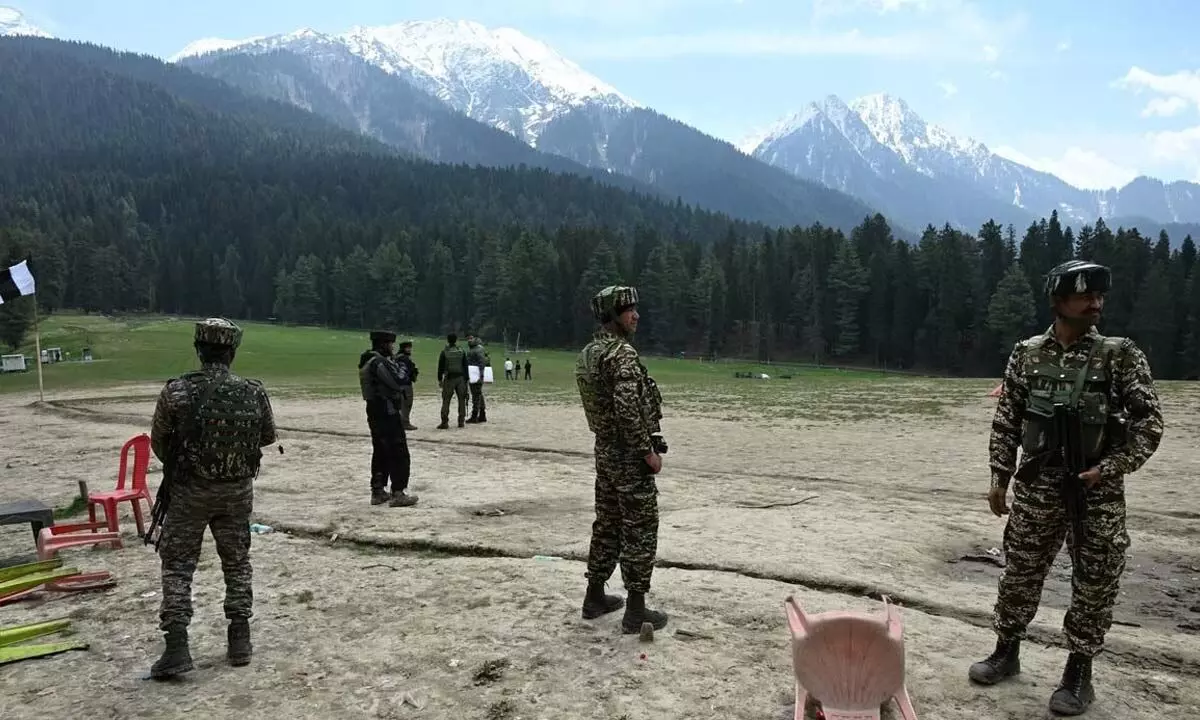
The whole nation got educated about kalma when the terrorists killed tourists in Pahalgam recently. The tourists did not know kalma, but to be doubly sure, the terrorists had their own biometric test to confirm that they were kafirs who had to be shot.
This raised my curiosity on kalma, purely academically, and not with the idea of avoiding a bullet. Looking for an explanation on kalma, I came across the teachings of Swami Rama Tirtha, born in Lahore, a scholar in English, Urdu, Persian, and Arabic, who lived a century ago, occasionally engaging in interfaith discussions. One such discussion, held in 1905, can be seen in ‘In the Woods of God-Realization’ (vol.6). The Swami talks about kalma with a group of Muslim intellectuals who had come to see him during his visit to Lucknow. This is a long discussion worth studying.
In all humility, recognizing the divinity in all, the Swami explains to the visitors that the real meaning of La ilah illillah is that ‘there is nothing but Allah or God’, whereas the moulvis say that it means ‘there is only one God, Allah’. If they say so, says Swami, ‘there is nothing new in Islam, because every religion says that there is only one God’ (ibid. p 155). He goes on to compare the original meaning of kalma with Vedanta which says, ‘there is only one God or Brahman, and that there is no duality at all’. He says, “He (God) is not only nearer than your own aorta (as told in Islam) but He is nearer than the aorta of every being. ..He is omnipresent and omniscient….present in every particle in the universe’ (ibid. p156).
A similar explanation is also told about the word kafir, which according to ordinary moulvis is ‘a non-Muslim’. Swami says ‘dear friends, the word meaning of kufra is to hide. What? To hide the Truth or Reality is kufra and he who hides Truth is kafir’. He further says how Truth is only one eternal and imperishable. Saying that a non-Muslim is a kafir means hiding the Truth, because the same God created them. He says, ‘O friends, according to the Koran all are equal in the eyes of God who is the Rabbul-Almin, the lord of all the worlds. We all emanate from Him. We are all His sons. Will God be pleased with you to see his sons being massacred in his very name? (ibid p.154). Swami goes on to say that killing non-Muslims in the name of God is real kufra, and such person is a kafir’
An honest and also bold discussion running into about 75 pages in the book. We do not know whether any other Hindu monk, apart from Swami Dayananda Saraswati of Arya Samaj, had such discussion with people of other faiths. But Swami Dayananda was in a mode of deconstruction, reducing all religions into rubble. His critique of Hinduism is what is quoted by those who denigrate Hinduism. But most of us are not bothered about Truth but are guided by our own selfish motives of advancing our religion or belief.
A look into Indian history and Sanskrit literature shows that discussions among people of different schools of Hindu philosophy and also interfaith discussions (Buddhists, Jains and Hindus) were held in the courts of kings. The kings too, like the present-day leaders, were interested in the harmony among all groups, though they too had some religious identity. They helped all communities by creating a story of divine intervention. For instance, Pratapa Rudra, a Shaivite king visited the present day Nandyal area (of AP) and found the area dominated by Vaishnavism. The story was that during his morning prayers on the river bank the king was repeatedly trying to make a Shiva lingam with sand, but it was always taking the shape of Lord Narasimha. Hence, he got an excuse to build a magnificent temple for Narasimha in Ahobilam.
We all do have friends in all religions and probably the only way is to know each other’s doctrine, their positive and negative aspects. Good scholarship has to be fostered by the government too and honest discussions have to be encouraged. It may show that all groups are kafirs to some degree or other. Let countries fight for political or economic reasons but let them not tarnish their God by combining selfishness and imperialism with religion. If they keep selfishness away and look for Truth, there can be hope for peace.
(The writer is a former
DGP, Andhra Pradesh)