What’s in a Name? Everything
The phenomenon of nomenclature undergoing transformation is not merely on account of the passage of time. Many roads within cities, as well as those leading from one city to another, also derive their names from famous historical personalities. And, as in the case of their city counterparts, undergo a process of transformation in keeping with the changing political complexion of the region
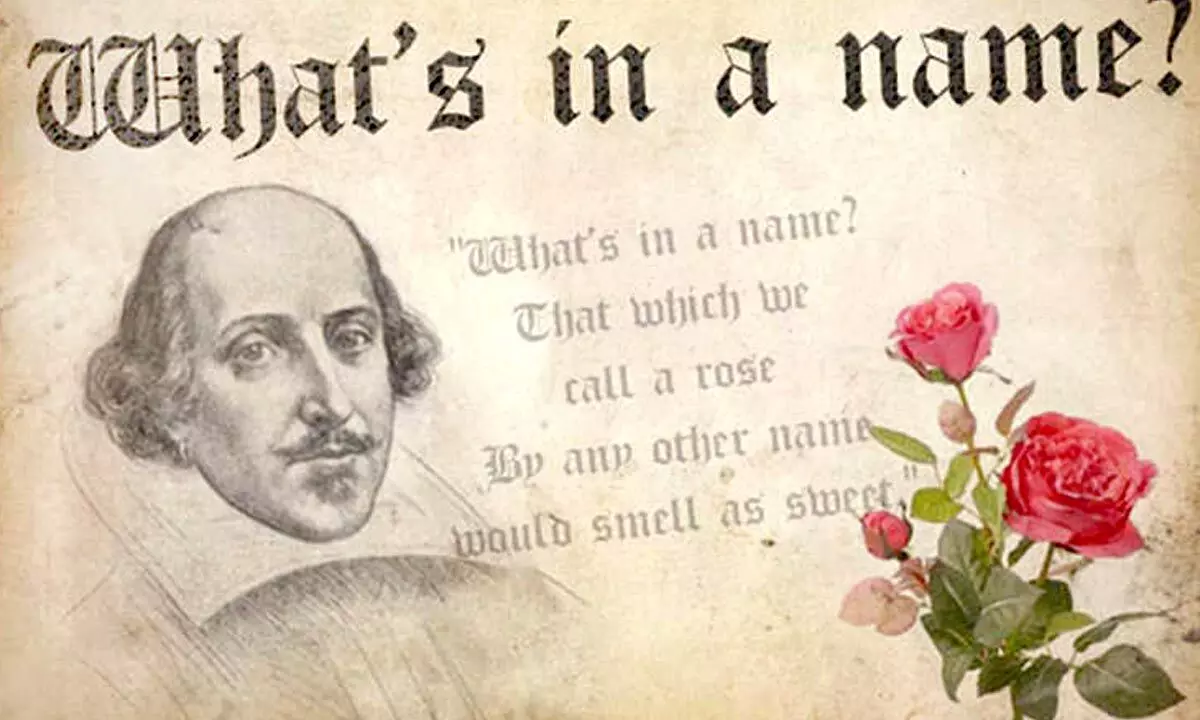
In the immortal Shakespeare’s play, Romeo and Juliet, Juliet says, “What’s in a name? That which we call rose by any other name would smell just as sweet.”
The name of a person, an object or a place is the first gift of identity, and a story of a unique cultural background. It is more than just a word. It is an integral part of identity. Making a sincere attempt, correctly to pronounce your name, is a sign of respect, and acknowledgement of individuality and heritage. Many cities, towns, and areas within them, carry extremely interesting names. The first reference to the name, Delhi, for instance, can be traced to the 1st century BCE, when Raja Dhillu built a city near the site of the future Qutub Minar, and named it after himself. Over time, however, people from different parts of India have begun to pronounce the name differently. While most of the country call it Dilli, with a soft D, as ‘th’ in ‘then’ or ‘this’, people from the Southern states, pronounce it Dell-he.
There are many other instances, of the elapse of time causing changes in the pronunciation of names, whether of cities, towns or persons. For example, Kolkata, which, for a long time, was Calcutta, has regained its original pronunciation. The original name, as a matter of fact, was either ‘Kalikshetra’, meaning the place of Adyashakti Kāli, in Sanskrit, or ‘Kalikkhetrô’, (the Bengali pronunciation of Kalikshetra), meaning ‘area of Goddess Kali’. Likewise, Mumbai was called Bombay for quite some time, before coming back to Mumbai again. The name of Mumbai city is derived from the Hindu Goddess Mumba Devi, worshipped by the earliest inhabitants, the Kolis.
Somewhat different is the reason why Chennapatanam, so named in honour of Channappa Nayak, the Nayaka ruler under the suzerainty of the Vijayanagar Empire in the 16th century, came to be called by British settlers as Madras, in honour of Mandraspatnam, a nearby village, close to the Fort. Similarly, Rajamahendravaram in Andhra Pradesh, has come to be known as Rajahmundry, and Orugallu, in Telangana, as Warangal. The way the name of the ancient city Constantinople underwent transformation over time, from the original Byzantium, first into Constantinople, and then to Istanbul, now capital of Turkey, is another example. The city, incidentally, straddles two continents, Asia and Europe, the only one to do so in the whole world. An interesting feature about Israel is that it is located at the crossroads of three continents Europe, Africa and Asia. There are, however, towns which belong to more than one country, such as, for example, Baarle, which is both a part of northern Belgium, as well as Southern Netherlands. Somewhat similarly, the city of Chandigarh, in India, is the capital of two states, namely, Punjab, and Haryana.
Talking of cities, one recalls the city of Pompeii, known as the ‘Lost City’, which was destroyed in 79 BCE, following the eruption of Mount Vesuvius an active volcano. There are also cities with special features, called Twin Cities. One example is that of Hyderabad and Secunderabad, which, at one point, are connected by the famous Tank Bund, across the Hussain Sagar Lake, and also Saint Paul and Minneapolis, which lie on either side of river Mississippi, in the USA.
The phenomenon of nomenclature undergoing transformation is not merely on account of the passage of time. Many roads within cities, as well as those leading from one city to another, also derive their names from famous historical personalities. And, as in the case of their city counterparts, undergo a process of transformation in keeping with the changing political complexion of the region. For instance, we have the two iconic stretches, in the country‘s capital, namely Rajpath and Janpath, originally known during the British era as King’s Way and Queen’s Way, being recently been rechristened. While Rajpath is now called ‘Kartavya Path’ (Duty Road), Janpath retains its name, meaning People’s Road. The provocation for the change, if one is to go by the official version, is that the old name represented the country’s colonial legacy and the new description represents the symbolic value of the two stretches. On similar lines, we have the two well-known arterial roads in Secunderabad, namely King’s Way and James Street, now going by the names of Rashtrapati Road and Mahatma Gandhi Road, as symbols of a similar spirit.
Cities, towns, and parts of them, are also often known by names ending with different expressions or after well-known persons as a mark of remembrance and respect. Such as, for instance, Pur, Nagar, Colony, Place, Bagh, or, in the Southern states, Palli, Basti or Peta. Also, Ghat, if on the banks of a river, or Gunj, if it is a market.
Cities are, on occasion, also named after great people, as a mark of respect and remembrance. Some examples are Washington, named after President George Washington, by an act of the United States Congress, and Cairo, meaning the Vanquisher, or Conqueror, the name having been given by Caliph al-Mu’izz, following the establishment of the city as the capital of the Fatimid dynasty.
In a similar fashion, Rajendra Nagar is the name of several localities in India, particularly the area, in Hyderabad, where many important scientific and academic institutions are located. They have been named after Rajendra Prasad, the first President of India. Gandhinagar, the capital of Gujarat, and Nehru Place in Delhi are other such instances where the names of great former political leaders and freedom fighters have been used. Such names also have a special meaning in many cases. For example, Beijing stands for the northern capital, in order to distinguish the city from the Southern capital Nanjing. The name. Arunachal Pradesh, the state situated in the north eastern corner of India, stands for the ‘Place where the Sun rises’ and its capital Ita Nagar is named after the Ita Fort, built with bricks in the 14th century ADE. There are many more such examples, one being that of Nagpur, named after the river Nag, the Marathi word for snake, and Allahabad, named by Emperor Akbar to mean the ‘City of Allah’ or ‘God’s place’, reflecting the significance of the city as a cultural and religious hub. The names of cities also figure frequently in the celluloid world, either in a dialogue form or in the lyrics of a song. There was that beautiful song, for example, sung by the immortal Ashok Kumar, movie actor par excellence of yesteryear, in the Hindi film, ‘Aasheerwad’, of 1968 vintage. The lyrics were composed on the subject of a moving train, or a ‘Rail Gaadi’, and describe a train chugging through many railway stations, such as Dharampur, Barampur, Mangalore, Bangalore, Mandwa, Khandwa, Raipur, Jaipur, etc. Likewise, in the Telugu movie, Vivahabhojanambu, the popular actor/comedian, Veerbhadra Rao recites, non-stop, to fellow comedian Brahmanandam, the names of cities and localities while describing how someone went around, looking for somebody else, in the most hilarious way.
In the context of naming children, either after Gods and Goddesses, or ancestors to be remembered with respect, I must relate an amusing incident. It is quite common, in fact, more or less the done thing, for children to be named after their grandparents. Since other compulsions also need to be attended to, parents often give their children a string of names, only one of which finally emerges as the one to be used in day-to-day life. When my son, who is now called Arvind by everyone, and Bubbles by family and friends), was being named in the customary and traditional ‘Barasala’ or the naming ceremony, my wife, Usha, and I did the same thing. Believe it or not, the name that emerged was Satya Narasimha Kumara Govinda Bhimasankara Aravind! Bhimasankaram was my father‘s name, and the rest, as you can see, are those of different Gods. As the names were being written in a plate of rice, as prescribed by the procedure, the priest who performing the ceremony, earnestly pleaded with us, to see whether he could be spared the duty of conducting the ‘Odugu’, or the ‘Upanayanam’, or the thread ceremony, of Arvind, in which his name would have to be repeated, several times by the presiding priest!
(The writer was formerly Chief Secretary, Government of Andhra Pradesh)