A burning log and national Emergency: Lessons in tough love


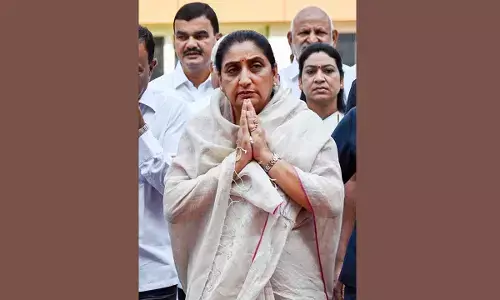
While I sat down to write about India’s Emergency and whether it was truly a black spot, a thought struck me with unexpected clarity. My admiration for Indira Gandhi, a towering figure in India’s history, might not stem solely from her own legacy. It could well be a vicarious reflection of my deep reverence for Peddappa — the woman who raised me, shaped me, and instilled in me the values I hold dear. The more I pondered this, the more I saw threads of similarity between these two formidable women, each a force of nature in her own right. To explore this connection, let me first introduce Peddappa and explain who she was and why she looms so large in my life.
Who was Peddappa?
Peddappa wasn’t just a name; it was a title, a mantle of respect earned through courage, compassion, and an unyielding spirit. Born Sitaramamma, she was my mother’s paternal aunt, a child widow who became the bedrock of our family. Her story begins in tragedy.
When the Razakars attacked her village, brutally killing her elder brother (my maternal grandfather) and others, she stepped into the chaos. With remarkable bravery, she saved the surviving members of his family — my maternal grandmother, mother, uncle, and aunt—taking them under her wing. She became not just their protector but a father figure, raising them, ensuring their marriages, and holding the family together.
We lived as one unit, including my widowed maternal grandmother, with my father, who treated Peddappa as a mother. I was one of four siblings, and she raised us all as well. Of course, I was her favourite for very many reasons.
Peddappa’s duality — her ferocity and tenderness — left an indelible mark on me. My maternal grandmother once recounted an incident that captured this perfectly. A guest, my maternal grandmother’s brother from a neighbouring village, made a lewd remark toward Peddappa as she cooked chicken curry for him, trying to exploit her status as a young widow. Her response was swift and volcanic. She yanked a burning log from the stove and thrashed him relentlessly until he fell at her feet, begging forgiveness. Yet what followed was extraordinary: after avenging her honour, she calmly prepared a medicinal concoction for his wounds and fed him the very curry she had been cooking. This blend of Maa Kali’s wrath and Maa Gauri’s nurturing stunned everyone. Moved by her strength and grace, he labelled her “Peddappa” — ‘pedda’ meaning elder or respected, and ‘appa’ meaning elder sister in Telugu. The name stuck, and soon everyone, young and old, called her Peddappa, her birth name fading into obscurity.
A leader by instinct, not ambition:
Peddappa wasn’t just a family legend; she was a pillar of our village. Her commanding personality and natural leadership shone through, earning her the unanimous choice as ward member for nearly 25 years. Yet she refused the sarpanch’s post—an office many coveted—because power for its own sake never interested her. She led not for titles but for duty, a trait I would later recognize in Indira Gandhi’s own complex relationship with authority.
Growing up under her care was an education in itself. During my college days in Warangal, I would return home to a ritual that was both a challenge and a lesson. Peddappa would insist I catch a rooster from our acre-wide courtyard — alive and uninjured, no stones or sticks allowed. It was a sprint, a test of agility and grit. Once caught, she’d guide me through slaughtering, dressing, and cutting it, then she would cook it into a curry. Why me specifically, when farmhands could doit? Because she believed men needed courage, a hunter’s spirit, a readiness to face lifehead-on. She was indulgent with boys, yes, but a strict disciplinarian too. Crossing her Laxman Rekha was unthinkable. Misbehave with a woman or girl, and you would face her wrath. “Men should behave like men,” she’d say, her disdain for cowardice palpable.
Beyond the village:
Years later, when I served as the Superintendent of Police in Nabarangpur, Odisha, Peddappa lived with me and my wife. Far from the Telugu-speaking world, her presence still transcended language. Once, at a family dinner hosted by my friend Ajay Raizada, the divisional forest officer (DFO), she charmed everyone despite knowing only Telugu, a language unfamiliar to the others. After a delicious meal, she approached the hostess, said “Shabash!” and gave her a hearty pat on the back—a universal gesture of approval. The hostess was so smitten that she fondly inquired about Peddappa in conversations for years afterward.
But Nabarangpur, a small town with little to offer, left her restless, with only my wife and me to converse with in Telugu. One day, she asked me to arrange VHS cassettes of the Ramayana serial. I hesitated, noting it was in Hindi, a language she didn’t understand. Her reply was casual yet profound: “Why do you need to know Hindi to watch Ramayana?”
That simple question floored me. It spoke of the timeless, unifying power of our epics — how they bind us across languages and regions, not through political constructs but through a deeper, dharmic civilization. How great were our sages who united us, transcending linguistic and regional barriers through our Devis, devatas, teerthas, and timeless epics. This is our true Hindu civilizational nation. Our unity wasn’t political; it was civilizational and dharmic, spanning kingdoms, deeper and more enduring than ephemeral political bonds.
Peddappa and Indira Gandhi-Kindred Spirits:
So where does Indira Gandhi fit into this? As I reflect on her, I see echoes of Peddappa in Indira Gandhi — two women of iron will, shaped by adversity, who wielded authority with fierceness and care. Peddappa ruled our family and village with protective zeal, unafraid to wield a burning log when honour demanded it, yet quick to heal and nurture. Indira Gandhi, too, governed India with steely resolve, navigating crises while striving to hold a fractious nation together.
Like Peddappa, Indira Gandhi was a disciplinarian who brooked no nonsense, yet she carried a maternal streak. Peddappa instilled in me courage and a fighting spirit; Indira, through her actions, instilled in a nation the will to endure. Both were products of their times — Peddappa shaped by village life and tradition, Indira by the crucible of independence and nation-building. And both, in my eyes, left legacies of strength and resilience.
A debt to two titans:
As I wrote earlier of my father’s immense influence, I now see Peddappa’s role was equally transformative. Together, they moulded me into who I am. And as I revisit the Emergency through this lens, I wonder: was it truly a black spot, or a chapter of tough love from a leader who, like Peddappa, sought to protect and discipline her charge?
My admiration for Indira Gandhi, I now realise, is tinged with the memory of Peddappa — two women who, in their own spheres, taught what it means to stand tall, to fight, and to care.
(The author is a retired IPS officer and former Director of CBI)