Hyderabad’s dying lakes: A wake-up call for urban reform

Once revered as the “City of Lakes,” Hyderabad is now grappling with a governance crisis, where its lakes—long-standing public goods—are being sacrificed for private gains
Once revered as the “City of Lakes,” Hyderabad is now grappling with a governance crisis, where its lakes—long-standing public goods—are being sacrificed for private gains. Recent data from the National Remote Sensing Centre (NRSC) reveal a stark reality: between 1979 and 2023, Hyderabad’s lake area has declined by 61%, shrinking from 40.35 square kilometres to just 16 square kilometres. This alarming depletion of a vital public resource demands urgent policy intervention. Can Hyderabad afford to let private encroachments dictate urban expansion, or is it time to reassert lakes as public goods essential to the city’s sustainability?
The Disappearing Lakes: An Ecological Crisis
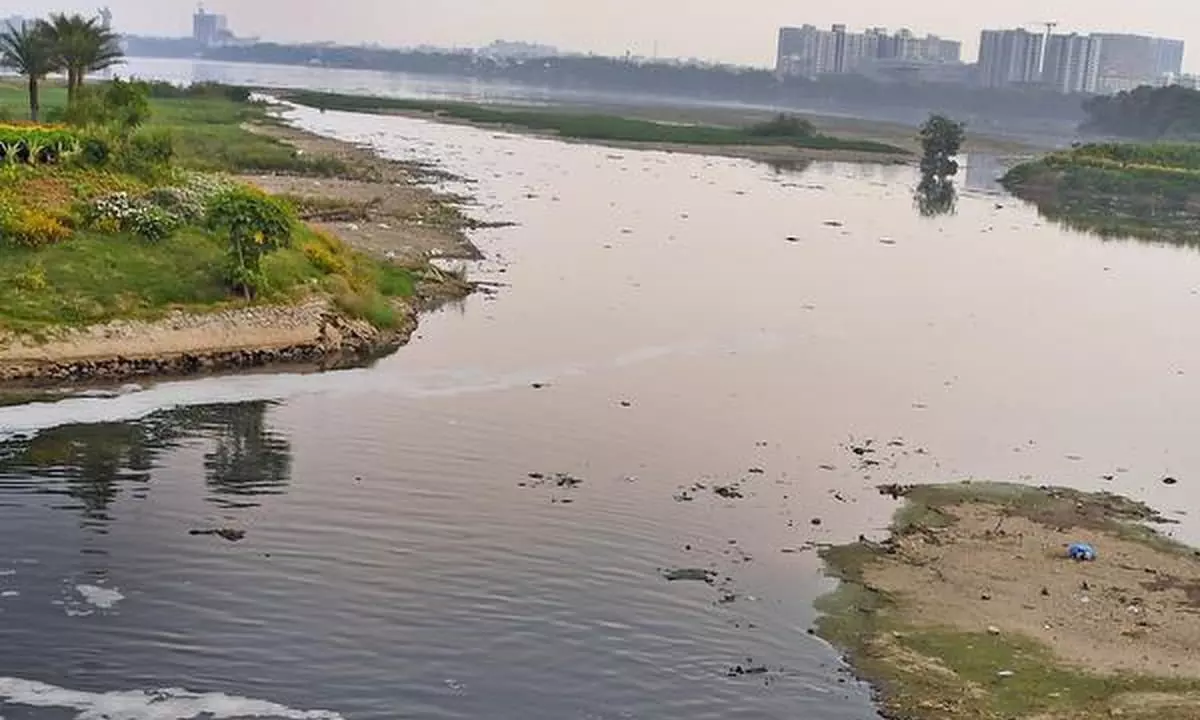
Historically, Hyderabad’s lakes have served crucial public functions—regulating floods, recharging groundwater, moderating the microclimate, and enriching cultural and ecological landscapes. However, the real estate boom of the 1990s and 2000s marked a shift towards privatisation. More than 3,000 water bodies have been encroached upon, transforming shared environmental assets into commodities for commercial and residential development. Policies that facilitated land conversion accelerated this process, treating lakes as disposable rather than indispensable. Today, only 185 lakes remain within the Greater Hyderabad Municipal Corporation (GHMC) limits, many of which are silted, polluted, or filled with sewage—severely diminishing their public utility.
The Real Cost: What is Being Lost?
The degradation of Hyderabad’s lakes is not only an environmental issue but also a significant economic concern. The loss of these natural assets deprives residents of essential ecosystem services and forces them to rely on costly alternatives, such as bottled water and air conditioning—expenses that are both financially burdensome and environmentally unsustainable.
These water bodies once provided crucial services, including air filtration, noise reduction, microclimate regulation, and sewage treatment. According to global ecosystem service valuation estimates, wetlands and lakes provide services worth $12,500 per hectare per year. Based on this, the estimated annual loss due to lake degradation in Hyderabad—where lake area has reduced to 2,435 hectares—is approximately $30.44 million (₹2,494 crores). This represents around 65% of the Greater Hyderabad Municipal Corporation’s (GHMC) budget for 2024-25. The figures underscore the economic ramifications of ecosystem degradation, highlighting that conservation is not only an environmental imperative but also a matter of fiscal responsibility.
Moreover, the disappearance of lakes exacerbates urban heat islands, worsens air pollution, and increases flood risks. The financial burden of managing these consequences—rising healthcare costs, increased energy consumption, and emergency flood relief—ultimately falls on the public, while private beneficiaries of lake encroachments reap unchecked profits.
Climate Change: A
Compounding Crisis
Rapid urbanisation, coupled with climate change, presents a severe challenge for Hyderabad. Climate variability is expected to increase the frequency and intensity of rainfall, making lakes crucial for flood management. Yet, many of these lakes have lost their capacity to regulate water due to encroachment and silting.
Recent reports indicate that 33 lakes were discharging excess water downstream due to heavy rains, while seven reached full tank levels, mirroring the devastation of the 2019-20 floods, where breached tanks caused fatalities. Hyderabad’s dwindling lake network represents a significant vulnerability in the face of future climate scenarios. Encroached and polluted lakes cannot effectively manage water, exacerbating the risk of flooding.
Reclaiming Lakes as Public Goods
Addressing this crisis requires a fundamental shift in urban governance—one that treats lakes as public goods rather than obstacles to private development. So, what can be done to halt this alarming trend?
Strict enforcement of existing regulations to prevent further encroachments on Hyderabad’s lakes. Large-scale restoration initiatives, including dredging, desilting, and removal of encroachments, to revive the lakes. Rehabilitation with native vegetation and community-led conservation efforts to ensure long-term sustainability. An integrated urban water management framework, treating lakes, wetlands, and stormwater drains as interconnected systems, should be central to Hyderabad’s urban planning policy. This will enhance flood management, groundwater recharge, and overall water quality while aligning developmental goals with environmental sustainability.
As Hyderabad continues to grow, the city stands at a critical crossroads: will it allow further privatisation of public resources at an enormous social cost, or will it commit to an urban planning model that safeguards lakes as essential public goods? The costs of neglect are clear, and the burden of inaction will only compound over time. The question remains: will Hyderabad reclaim its lakes for the public, or will they be permanently lost to private interests?
Peddi is with GIPE Pune, and Mitra and Mohapatra arewith NCAER New Delhi. The views expressed are personal.